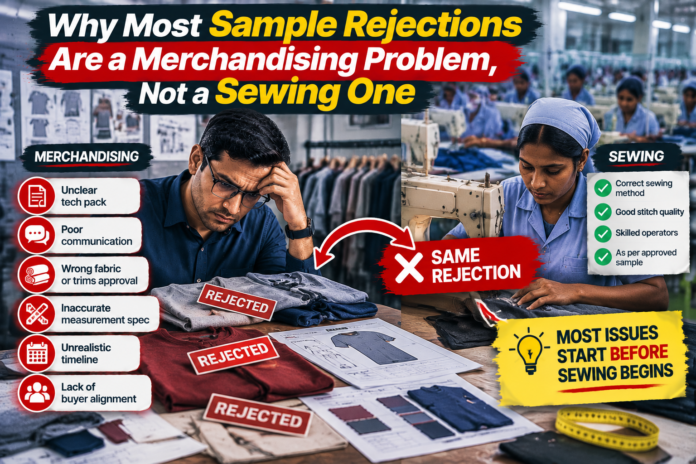

The sample came back rejected for the third time, and Tanvir was standing in the sample room holding it, trying to figure out how to explain this to his manager without it sounding like an excuse.
“It’s the sewing team,” he’d said the first two times. “They’re not following the pattern properly.” And to be fair, that’s usually the first thing anyone assumes when a sample fails. The needle is what touches the fabric, so the needle gets blamed. It’s the most visible part of the process, the last hands the garment passes through before it goes to the buyer, so it’s the easiest place for the blame to land.
But this was the third rejection on the same style, and Tanvir’s supervisor, a quiet woman named Rehana apa who had been reviewing samples for almost fifteen years, took the rejected piece from his hands, turned it over twice, and asked him a question that changed how he thought about his job.
“Tanvir, before you sent this to sewing — what exactly did you tell them to make?”
He opened his mouth to answer, and realized he didn’t have a clean answer. He’d sent the tech pack. He’d sent the buyer’s comments from the last round. He hadn’t actually sat down with the sewing team and walked through what had changed, what mattered most this time, or which of the buyer’s notes were serious and which were minor preferences. He’d assumed the tech pack would speak for itself.
It hadn’t.
The Tech Pack Isn’t the Same as Communication
Here’s the uncomfortable truth Rehana apa was gently pointing him toward: a tech pack is a document. It’s necessary, but it’s not the same thing as making sure the person cutting and sewing the sample actually understands what matters most about this particular garment, this time, for this buyer.
Buyers leave comments in different tones and different levels of seriousness, and a merchandiser’s job is to translate that into something the sample room can actually act on. “Please check the collar stand height” might be a minor observation, worth a small correction next round. “The collar stand height is unacceptable and must be fixed before we can consider this style further” is a completely different level of urgency, one that should probably get flagged out loud, not just buried as line four in a six-point comment list pasted directly from the buyer’s email.
Tanvir had been forwarding buyer comments almost exactly as he received them, trusting that clear English would translate into clear instructions. But the sewing team wasn’t reading the buyer’s tone the way Tanvir was. They were reading a list of technical points, all formatted the same way, all looking equally important, or equally unimportant, depending on how busy the day was.
When Rehana apa sat down with the sewing supervisor and actually explained, out loud, which of the buyer’s four comments was the one that had already caused two rejections, the supervisor’s face changed immediately. “Nobody told me this one mattered most,” he said. “I thought the fit comment was the main one.”
That single conversation, five minutes long, did more than any revised tech pack could have.
The Measurement That Was Never Actually Confirmed
The second sample rejection had a different root cause, and it was one Tanvir found even harder to accept, because it pointed directly back to something he’d done himself, weeks earlier.
During the initial development stage, the buyer’s spec sheet had listed a chest measurement that looked slightly unusual compared to their previous styles — about half an inch tighter than what this buyer normally asked for on a similar silhouette. Tanvir had noticed it. He remembered noticing it. And then he’d moved on, assuming it was intentional, because questioning a buyer’s spec sheet felt, at the time, like second-guessing someone who presumably knew their own brand’s fit better than he did.
It wasn’t intentional. It was a typo, carried over from a template the buyer’s design team had copy-pasted from a different style. Nobody on the buyer’s side caught it either, until the sample came back and their own fit technician flagged that it “felt tight,” without initially realizing why.
This is one of the most common, least discussed sources of sample rejection in the entire industry: a measurement or spec detail that looks slightly off, gets noticed by someone on the factory side, and then gets quietly let go instead of confirmed, because asking feels like it might slow things down or look like the factory doesn’t know what it’s doing.
The truth is almost always the opposite. A merchandiser who sends a quick, polite confirmation email — “just want to double-check this chest measurement before we cut, it looks slightly different from your usual spec, please confirm” — looks careful, not incompetent. It takes two minutes to send. It can save an entire sample cycle, sometimes two weeks or more, depending on how backed up the sample room already is.
Tanvir had noticed the problem and said nothing. That silence, not any sewing machine, was what actually produced the second rejection.
The Approval That Was Never Really an Approval
The third rejection, the one Tanvir was holding when Rehana apa asked her question, traced back to something even further upstream — a fabric approval from months earlier that had never been as solid as everyone treated it.
The buyer had approved a fabric swatch during the initial development stage. But “approved” in that email had actually come with a small qualifier: approved, pending confirmation of colorfastness after washing. Tanvir had seen that qualifier. He’d filed the approval as final anyway, partly because the wording was buried in the middle of a longer email, and partly because, honestly, colorfastness testing almost always passes on this particular fabric base, so it felt like a formality.
This time, it didn’t pass cleanly. The wash test came back with a very slight shade change, subtle enough that it might not have mattered to a less particular buyer, but enough to fail this specific brand’s internal standard. By the time that result came back, the sample had already been fully sewn and sent, built on a fabric approval that was never actually complete.
None of this was the sewing team’s fault. They sewed exactly what they were given, on a fabric that had already been cut and prepared for them. The failure happened weeks earlier, in a merchandiser’s decision to treat a conditional approval as a final one, because chasing down the missing confirmation felt like unnecessary extra work at the time.
Why It’s Always Easier to Blame the Floor
Standing in that sample room, Tanvir started to see a pattern across all three rejections that had nothing to do with sewing skill at all. In every single case, the actual failure had happened earlier, in the merchandising stage, in a decision or a silence that had nothing to do with a needle or a machine.
A comment that wasn’t translated clearly enough. A measurement that looked wrong and wasn’t questioned. An approval that wasn’t actually complete, treated as if it were.
It’s easy to see why sewing gets blamed first, even when it isn’t really responsible. The rejection shows up physically at the end of the process — a real garment, in your hands, visibly wrong. The sewing floor is the last stop before that failure becomes visible, so it’s the most natural place for the blame to land, purely because of timing, not because of where the actual mistake occurred.
But a sample is really just the final, physical proof of every decision that came before it — every buyer comment that was or wasn’t clearly explained, every spec detail that was or wasn’t double-checked, every approval that was or wasn’t actually finished. The sewing team can only build, as precisely as their skill allows, whatever version of the garment the information in front of them describes. If that information is incomplete, unclear, or quietly assumed rather than confirmed, no amount of sewing skill can produce the right result, because the right result was never fully defined in the first place.
What Rehana Apa Actually Changed
After that third rejection, Rehana apa didn’t lecture Tanvir about being more careful, the way a frustrated manager might. She walked him through building a small habit instead, one that had nothing to do with talent and everything to do with process.
Before any sample goes to the floor, she started asking her team to answer three simple questions out loud, not just assume the tech pack already covered them.
Is there anything in the buyer’s comments that needs to be explained in person, not just forwarded as text, because its urgency or importance might not be obvious from the wording alone?
Is there any spec, measurement, or detail that looked even slightly unusual during review, and if so, has it actually been confirmed with the buyer, or just assumed to be correct?
Is every approval this sample depends on — fabric, trims, wash, color — actually final, or does any of it carry a condition that hasn’t been fully closed out yet?
It’s not a complicated checklist. It doesn’t require new software or extra staff. It requires a merchandiser treating those three questions as seriously as they treat the tech pack itself, instead of assuming the paperwork has already done that job.
The Real Cost of Getting This Wrong
Every sample rejection costs real time — days, sometimes weeks, depending on how backed up the sample room is, and how far into the season the buyer’s calendar already sits. Buyers notice repeated rejections too, even when they’re too polite to say so directly. A factory that needs three or four rounds to get a sample right starts to look, quietly, less capable than one that gets it close on the first try, even if the actual sewing skill in both factories is identical.
Tanvir’s factory wasn’t losing that reputation because their sewing team couldn’t execute a pattern properly. They were losing it because the information reaching the sewing floor kept arriving incomplete, unclear, or quietly unconfirmed, and nobody upstream was catching that gap before it turned into a rejected sample.
That’s the part worth sitting with, for any merchandiser reading their own rejection reports and reaching, automatically, for the same explanation Tanvir used twice before Rehana apa stopped him. The sewing floor sews what it’s told. When the samples keep coming back wrong, the more useful question almost always isn’t “what did the sewing team get wrong.” It’s “what did we actually tell them, and how sure are we that it was right.”