Exclusive content
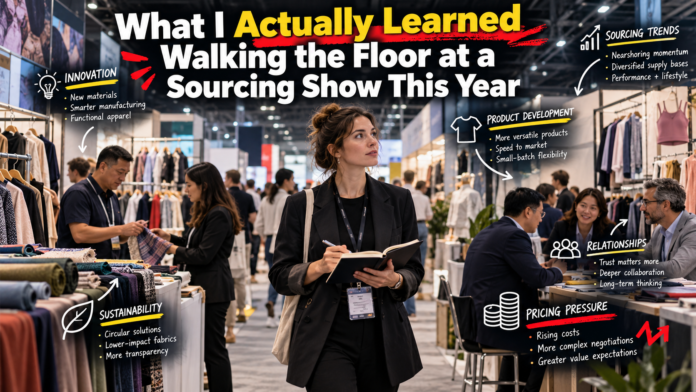
I go to sourcing shows every year, and if I’m honest, most years I walk the floor with a fairly fixed routine in my head. Check the usual fabric mills. Say hello to a couple of trim suppliers we already work with. Collect a stack of business cards I mostly never look at again. Grab a coffee, talk to a few old contacts, leave with maybe one or two genuinely new leads. Useful, but not exactly eye-opening.
This year was different, and it took me almost the whole first day to actually notice why. It wasn’t any single booth or any single conversation. It was a pattern, slowly building across dozens of small moments, that told me something about where this industry is actually heading — something I don’t think I would have picked up on just reading reports at my desk.
The Countries I Didn’t Expect to See
The first thing that caught my attention, walking in, was the pavilion map itself. Alongside the usual, familiar names — China, India, the regular crowd — there were pavilions and booths from countries I genuinely hadn’t expected to see with this much presence. Uzbekistan had a real, organized pavilion. Taiwan had a dedicated trend display, not just a scattering of individual exhibitors. Smaller, newer sourcing regions were showing up with real intent, real investment in their booths, not the token, half-hearted presence some newer countries used to have at these shows a few years back.
I stood there for a minute just looking at the floor plan, and it hit me — this wasn’t random. Buyers have spent the last few years actively looking to diversify away from putting all their sourcing eggs in one or two baskets. I already knew that intellectually, the way you know a fact without really feeling it. Seeing it physically mapped out across a show floor, booth after booth from countries that barely used to register at these events, made it land differently. This diversification isn’t a talking point in a trade magazine anymore. It’s actually happening, actively, right now, and it’s happening as a direct response to buyers wanting more sourcing options, not fewer.
For Bangladesh, that’s worth sitting with honestly, not defensively. We’ve built decades of trust and infrastructure that these newer regions don’t have yet. But “we’re still the default choice” is a very different, much safer position than “we’re one of several serious choices buyers are actively comparing us against.” Walking that floor, it felt a lot more like the second one.
The Booth That Made Me Genuinely Uncomfortable
There was a booth, fairly modest in size, run by a group demonstrating digital sampling and 3D garment visualization tools. I’d read about this technology before, in passing, the way you read about a lot of things without really absorbing them. Watching it live, in front of me, was different.
A buyer standing next to me was reviewing a full 3D rendering of a jacket — fabric drape, color, trims, everything — rotating it on a screen, requesting a color change, and watching it update in something close to real time. No physical sample. No courier shipment. No two-week wait for a fit sample to travel from a factory floor to a buyer’s desk on another continent.
I felt a small, uncomfortable knot in my stomach watching that, if I’m being completely honest. Part of my own value, for years, has been managing exactly that physical sample process — chasing the pattern master, pushing the sample room, tracking the courier, explaining delays. If a meaningful chunk of that entire cycle can genuinely move into a screen before physical fabric ever gets touched, that changes something real about what a merchandiser’s actual day-to-day work looks like, and I don’t think I’d fully let that sink in before standing at that booth.
I don’t think it replaces physical samples entirely — fabric hand-feel, real drape, actual construction quality, none of that fully translates to a screen yet, not convincingly. But it clearly shortens a part of the process that used to eat real weeks off every timeline. Watching it, I kept thinking about Mahin’s whole struggle with sample timelines, proto to fit to PP, and how differently that conversation might go if a chunk of the earlier rounds could genuinely happen digitally first.
The Sustainability Corner Wasn’t a Corner Anymore
A few years back, at shows like this, sustainability had its own small, slightly separate section — a corner you could walk past if you were in a hurry, a handful of booths talking about recycled fiber and organic cotton, treated a bit like a niche interest rather than a central theme.
This year, it wasn’t a corner. It was threaded through almost every conversation I had, regardless of what the booth was actually selling. A fabric mill talking about their base cotton blend would, without me even asking, bring up their water usage certification. A trim supplier showing me zipper options mentioned, unprompted, which of their lines used recycled metal content. It wasn’t performative, exactly — it felt more like this had simply become part of the baseline pitch now, the way price and lead time always have been, rather than a special add-on for buyers who specifically asked.
That tracks with something I’d already sensed from buyer emails over the past couple of years — more questions about traceability, more requests for documentation we didn’t used to get asked for as often. Standing on that floor, I realized it’s not really a request coming from a handful of unusually demanding buyers anymore. It’s become close to a baseline expectation across the board, woven into how suppliers themselves choose to present their products, whether or not a specific buyer even asks.
The Conversation With a Smaller Supplier That Stuck With Me
I spent maybe twenty minutes at a booth run by a relatively small, newer supplier, nowhere near the scale of the big established mills I usually gravitate toward out of habit. What struck me wasn’t their fabric, which was fine, perfectly reasonable quality. It was how they talked about their own business.
They weren’t pitching volume. They were pitching flexibility — smaller minimum order quantities, faster turnaround on smaller runs, genuine comfort handling frequent style changes rather than treating them as a disruption. It reminded me immediately of something I’d been thinking about since writing about the fast fashion slowdown a while back — how buyers are increasingly placing smaller, more frequent orders instead of big seasonal bulk commitments, and how some factories are quietly repositioning themselves specifically to serve that shift well, rather than just tolerating it as an inconvenience.
This small supplier had clearly built their entire pitch around exactly that reality. Not the biggest, not the cheapest, but genuinely built for the shape of demand that’s actually showing up now, rather than the shape of demand that used to dominate five or ten years ago. I don’t think that supplier was doing anything revolutionary. I think they’d just paid closer attention to where the market was actually heading than a lot of bigger, more established players who are still, understandably, more comfortable in the old bulk-order rhythm.
What I Didn’t See, Which Was Almost as Telling
Walking back through my notes that evening, I realized something interesting by what was mostly absent, not what was present. I didn’t hear nearly as much pure price-competition talk as I remembered from previous years — the kind of booth conversation that starts and ends entirely with “we can beat anyone’s rate.” It was there, somewhere, but it wasn’t the dominant note anymore.
What replaced it, across a surprising number of conversations, was talk about reliability, documentation, flexibility, and speed — the same shift toward “how do we actually compete beyond just being cheap” that’s been quietly building across this whole industry, the kind of shift I’d been circling in my own writing for months without quite seeing it reflected back at me this clearly, in real conversations, on a real show floor.
It made me think about that email Rafiq bhai keeps getting, the “can you match Vietnam’s price” one. Standing on that floor, watching supplier after supplier lead with something other than raw price, I got a clearer sense of why that old pitch is fading everywhere, not just in Bangladesh. Everyone at this show, buyers and suppliers alike, seemed to already understand that price alone isn’t winning the room the way it used to. It’s just still, apparently, the hardest habit for a lot of us to actually let go of in practice.
What I’m Actually Taking Back to My Desk
I didn’t come home from this show with some dramatic new strategy, and I don’t think that’s really the point of walking a floor like this anyway. What I came back with was a clearer, more honest sense of where the ground is actually shifting under this industry, felt directly rather than just read about secondhand.
I’m going to spend more time actually learning what the digital sampling tools can realistically do for us, instead of dismissing them as a distant, someday technology. I’m going to ask more pointed questions from our own fabric and trim suppliers about sustainability documentation, proactively, before a buyer forces the issue and catches us unprepared. And I’m going to think harder about whether our own factory is genuinely built to handle smaller, more frequent orders efficiently, or whether we’re still quietly optimized for a bulk-order rhythm that isn’t showing up as reliably as it used to.
None of this is dramatic, and none of it will show up as a single big change anyone notices immediately. But that’s honestly what most of these shifts feel like from the inside, I think — not one loud moment where everything changes at once, but a slow accumulation of small signals, booth after booth, conversation after conversation, until you finally step back and realize the floor itself has quietly rearranged into something different than what you walked in expecting to see.
I’ll go back next year, and I suspect the floor will have shifted again in ways I can’t fully predict from here. But I think I’ll walk it differently now — less on autopilot, more genuinely paying attention to what the shape of the whole floor is actually trying to tell me, not just the individual booths I already knew I wanted to visit.