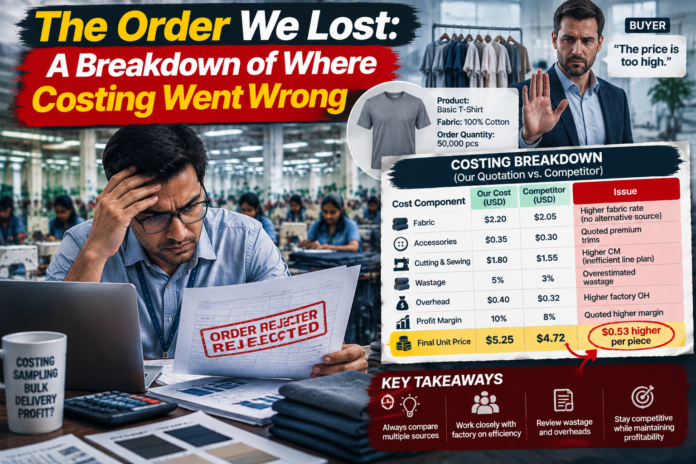

Nobody told Rumana the order was gone. She found out by accident, scrolling through a shared order-status sheet on a Thursday afternoon, when she noticed the line for a buyer she’d been quoting for six weeks had quietly changed from “In Negotiation” to “Placed — Vietnam.”
She read it twice, thinking it was a mistake. Then she opened her email and went back through every message in that thread, trying to understand what had actually happened, and where, exactly, six weeks of work had come apart.
This is the story of that order, told honestly, the way Rumana eventually told it to her own team a few weeks later — not to assign blame, but because she realized, looking back, that the loss hadn’t happened in one dramatic moment. It had happened in five small places, stacked one on top of another, none of them individually fatal, all of them together enough to lose a good order to a competitor.
Week One: The First Number Was Already Wrong
The order was for a mid-range woven shirt, a style the buyer had run successfully with two other suppliers before, now looking to add a third factory to their supply base. Rumana had costed it the way she always did — pulling a similar past style’s fabric consumption figure as a starting reference, because the construction looked close enough on paper.
It wasn’t close enough. The new style had a slightly fuller cut through the body and an extra yoke seam that changed the pattern layout more than Rumana had accounted for when she borrowed the old consumption number. She hadn’t actually had the pattern master run a fresh marker for this specific style before quoting. It felt, at the time, like a reasonable shortcut — the buyer wanted a quick indicative price to compare suppliers, not a final costing, and getting an exact marker done for every early-stage inquiry felt like more effort than the moment called for.
That shortcut put her fabric consumption about 6 percent lower than what the style would actually need once properly marked. Her very first quote to the buyer, the number that set the tone for the entire negotiation, was already built on a foundation that couldn’t hold.
Week Two: The Buyer Liked the Wrong Number
The buyer’s response came back fast and enthusiastic. Rumana’s price was the most competitive of the three factories being considered, by a real margin, not a narrow one. The buyer’s merchandiser wrote back asking to move quickly to sample development, mentioning, almost in passing, that this price point made Rumana’s factory the clear front-runner.
This should have been the moment Rumana paused and double-checked her own number, precisely because it had performed unusually well. A quote that beats two experienced competitors by a wide margin is either a genuine competitive advantage, or a sign that something in the underlying math is off. Instead, she felt the natural pull of positive momentum — a buyer excited, a deal moving forward, a factory looking good in front of a promising new client — and she let that feeling carry her past the instinct to re-verify, rather than through it.
She now recognizes that specific feeling as one of the more dangerous moments in costing: the temptation to protect a number that’s making everyone happy, instead of stress-testing it precisely because it’s performing better than expected.
Week Three: The Real Marker Finally Happened, Quietly
By the time the pattern master actually built a proper marker for the confirmed sample construction, three weeks had passed, and the buyer had already mentally slotted Rumana’s factory into their sourcing plan. The real consumption figure came back at 2.05 meters per unit, not the 1.93 Rumana had originally quoted.
She sat with that number for a full day before deciding what to do with it, and this is the part of the story she’s most honest about when she tells it now: she didn’t correct it immediately. She told herself she’d raise it once the sample was approved and the order felt more locked in, reasoning that a mid-negotiation price correction, this early, might spook a buyer who’d been given every reason to feel confident in her number.
That decision — quiet, understandable, and ultimately costly — meant the buyer spent the next two weeks building internal approvals, and possibly turning down other suppliers, based on a price Rumana already privately knew wasn’t accurate.
Week Four: The Correction Landed Badly
When Rumana finally sent the corrected costing, right after sample approval, the new fabric consumption pushed her unit price up by almost 9 percent from her original quote. She explained the reason clearly and honestly — the confirmed construction required more fabric than the early estimate had assumed, a completely normal and common occurrence in this industry.
The buyer’s reply was polite, but the tone had shifted, noticeably. Not accusatory, just cooler, more careful. “We built our internal costing around your original number,” the merchandiser wrote back. “A jump this late makes it harder for us to justify moving forward with your factory over the others.”
This is the part of the story that stings the most in hindsight, because the underlying fabric requirement genuinely hadn’t changed at any point — the actual consumption had always been 2.05 meters, from the very first day, whether anyone had measured it accurately or not. What had actually happened was that Rumana’s early number had never reflected reality, and by the time reality caught up with the buyer, it looked less like an honest correction and more like an unreliable factory quietly raising its price after winning the buyer’s trust.
She hadn’t done that deliberately. But from where the buyer was sitting, the timing made it look exactly that way, and timing, in a buyer relationship, often matters as much as intent.
Week Five: The Quiet Comparison She Never Saw Happening
What Rumana didn’t know, during that same week, was that the buyer had quietly gone back to one of their existing Vietnam suppliers, the one they’d originally been trying to diversify away from, and asked for a revised quote on the same style, partly as a hedge against the uncertainty Rumana’s price jump had introduced.
That Vietnam factory, with years of history and trust already built with this buyer, came back with a price that was actually slightly higher than Rumana’s corrected number, but attached to a level of confidence the buyer no longer fully had with her. It’s a detail Rumana only learned much later, through an industry contact, almost as an aside in an unrelated conversation. The buyer hadn’t chosen Vietnam because it was cheaper. They’d chosen it because it was certain, and by that point in the negotiation, certainty was worth more to them than the extra percentage Rumana’s factory might have saved them.
Week Six: The Line on the Sheet That Changed
By the time Rumana saw “Placed — Vietnam” on that shared tracker, the outcome had already been decided for close to a week. There was no dramatic final email, no clear moment where the buyer announced they were walking away. The relationship had simply cooled, quietly, order by order, until the placement decision was made somewhere she wasn’t part of, and the only evidence that reached her was one changed word in a status column.
Breaking Down Where It Actually Went Wrong
Looking back at the whole six weeks, Rumana could see clearly that no single mistake had lost the order on its own. It had been five smaller failures, each one reasonable in isolation, stacking on top of each other until the total weight became too much to recover from.
The first failure was quoting from a borrowed reference instead of a real marker, a shortcut that felt harmless at the early inquiry stage but planted a wrong number at the very foundation of the entire negotiation.
The second was not questioning a quote that was winning unusually easily, treating early success as validation instead of as a signal worth double-checking, precisely because unusually good numbers deserve more scrutiny, not less.
The third was sitting on a known correction for two weeks, letting comfort and momentum delay an update that needed to happen the moment the real number was known, not whenever it felt least disruptive to deliver.
The fourth was the price jump itself, which wasn’t really the problem — price corrections happen constantly in this industry, and any reasonable buyer expects some adjustment between an early estimate and a confirmed sample costing. The real problem was the size and the timing, a 9 percent jump landing late, after trust and internal approvals had already been built around the earlier number, instead of a smaller, earlier correction that would have felt like normal refinement rather than a late surprise.
The fifth, the one Rumana had almost no control over, was simply that trust, once shaken, doesn’t get evaluated purely on price anymore. The buyer didn’t choose the cheaper option in the end. They chose the option that felt safer, and no amount of last-minute price flexibility from Rumana could fully repair that shift once it had happened.
What She Actually Changed Afterward
Rumana didn’t stop giving early, indicative quotes to buyers during initial inquiries — that’s simply how the industry moves, and demanding a full, final marker before every early conversation would slow her down more than it would help her. But she changed two specific things about how she handles that early stage now.
She started clearly labeling early quotes as preliminary, in writing, explicitly noting that final pricing would depend on the confirmed marker once sample construction was locked — a small phrase that costs nothing to include and quietly protects both sides from exactly the kind of late, unexplained jump that had damaged the buyer’s trust in her.
And she stopped sitting on known corrections, even uncomfortable ones. The moment the real marker came back different from her original estimate, she now sends the update immediately, not after the sample is approved, not once things feel more locked in. An early correction reads as diligence. The exact same correction, delivered late, reads as something closer to bait and switch, even when nobody involved actually intended it that way.
The Real Lesson in Losing That Order
What stayed with Rumana longest wasn’t the lost revenue, though that mattered too. It was realizing how much of costing accuracy is really about timing and honesty, not just getting the final number right. She had, eventually, arrived at the correct fabric consumption. The problem was never really the math. It was when she let that correct number reach the buyer, and how much quiet discomfort she’d let build up in the gap between knowing something was wrong and actually saying so.
A costing sheet isn’t just a calculation a merchandiser runs once and defends forever. It’s an ongoing conversation with a buyer, one that holds together on trust as much as on numbers. Rumana’s numbers, eventually, were accurate. But by the time they were, the trust that should have carried them across the finish line had already quietly moved to a factory on the other side of the world that had never given the buyer a reason to doubt a single figure they’d been shown.
She still thinks about that order sometimes, not with bitterness, but as the clearest lesson six weeks of work ever taught her: in merchandising, being right eventually isn’t the same as being right on time, and the gap between those two things is exactly where good orders quietly go to die.