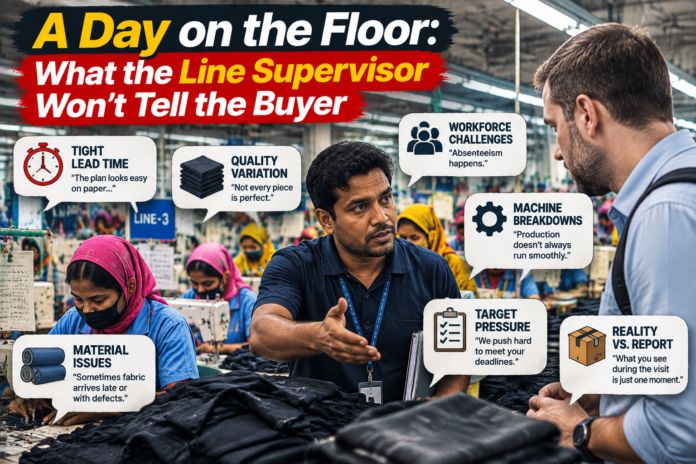

The buyer’s visit was scheduled for 11 am, and by 9, Shahin had already walked the line four times.
He’d been a line supervisor for eleven years, long enough to know exactly what a buyer visit looks like from the floor side, and exactly how different it is from what actually happens on an ordinary Tuesday. Machines running smoothly. Operators focused, unhurried. The line balanced, output steady, nothing visibly wrong anywhere. By the time the buyer walked through with the merchandiser and the compliance officer, everything would look, and mostly be, exactly as it should.
What Shahin wouldn’t say out loud, standing there smiling and answering polite questions through the merchandiser’s translation, was everything that had actually gone into making that Tuesday look like every other Tuesday. Not because he was hiding something dishonest. Because most of it wasn’t the kind of thing that fits into a factory tour, and most of it wasn’t the merchandiser’s story to tell either, even if she’d known to ask.
The Machine That Wasn’t Actually Fine
Two days before the visit, machine fourteen had started skipping stitches intermittently, just often enough to slow the operator down without being consistent enough to diagnose easily. Shahin had pulled the mechanic in that same afternoon, and between them they’d traced it to a timing issue that needed a part they didn’t have in stock.
He hadn’t escalated it to the merchandiser. Not because it wasn’t worth mentioning, but because by the time it would have reached her desk as a formal issue, he’d already solved it a different way — borrowing a spare machine from a line that had finished its own order early, running it in that spot for two days while the part got sourced locally. The line kept its output target. The merchandiser’s weekly report showed sewing on schedule, which was true, technically, and also hid an entire small crisis that had been fully absorbed on the floor before it ever became anyone else’s problem.
This happens more often than most merchandisers realize. A good line supervisor isn’t just running machines. He’s constantly catching small breakdowns — mechanical, human, material — and quietly solving them before they show up as a line item anyone upstream has to explain. The tracker says “on target” because someone made sure it stayed true, not because nothing ever went wrong.
The Operator Who Was Struggling, Not Lazy
There was a newer operator on the line, a young woman who’d been placed on a moderately complex operation three weeks earlier, and her output had been consistently below target since day one. On paper, that’s the kind of number that eventually gets flagged as a productivity problem, something a merchandiser reviewing SMV and line efficiency reports might eventually ask about.
What the numbers didn’t show was that Shahin had already spent extra time with her personally, twice, adjusting her machine setup, walking through the motion with her slowly, because he’d recognized early that her struggle wasn’t attitude or effort. It was a training gap nobody had properly closed before putting her on that operation. He’d quietly kept her output target slightly protected for another week, absorbing the shortfall into the line’s overall numbers by shifting a small amount of extra work to two more experienced operators nearby, rather than letting her individual number show up starkly against everyone else’s.
He’d never explain this to a buyer during a floor visit, and he wouldn’t necessarily volunteer it to the merchandiser either, unless directly asked, because from where he stood, it wasn’t a failure worth reporting upward. It was just what running a line responsibly actually looks like — small, constant adjustments, invisible from outside, that keep the whole system functioning without every minor struggle becoming a formal incident.
The Real Reason the Line Was Balanced
Buyers touring a floor often comment, approvingly, on how “balanced” a line looks — no operator visibly overwhelmed, no obvious bottleneck at any single station, a smooth, even flow from start to finish. It reads, reasonably, as evidence of good planning.
What it doesn’t show is how much of that balance gets rebuilt, quietly, almost every single day. Shahin adjusted his line layout constantly — shifting an operator from one station to another mid-shift when he noticed a bottleneck forming, pulling a helper over to assist on a station running slow, sometimes rearranging three or four positions in a single afternoon based on what he was actually watching happen in real time, not what the original line plan from planning department had assumed on paper.
None of these adjustments get written down anywhere a buyer or a merchandiser would normally see. They’re not failures of the original plan, exactly — they’re just the ordinary, constant correction that turns an theoretical line balance into an actual one. A line that looks effortlessly smooth during an 11 am visit is usually smooth precisely because someone has been actively, invisibly managing it all morning, not because it simply runs that way on its own.
What He Actually Tells the Merchandiser — and What He Doesn’t
Shahin’s relationship with his merchandiser, a woman named Farhana who’d worked with his line for almost two years, was a genuinely good one. He trusted her, and she trusted him. But even in a strong working relationship, there was an unspoken filter on what made it into their daily conversations.
He told her when something threatened the delivery date. He told her when a quality issue was serious enough that it might come back as a buyer complaint later, or when a material shortage was going to cause a real, unavoidable slowdown she needed to plan around. Those were his real responsibilities to flag, and he took them seriously, because those were the things that actually affected her ability to manage the buyer relationship and the shipment timeline honestly.
What he didn’t routinely tell her was the daily texture underneath all of that — which operator needed extra coaching this week, which machine had a minor issue he’d already solved himself, which small rebalancing he’d done that morning to keep output on track. Not because it was secret, but because it wasn’t, in his judgment, actually useful information for her to carry. She had her own long list of things to manage — costing, buyer emails, sample approvals, shipment documents — and loading her down with every small operational adjustment he made in a day wouldn’t have helped either of them. It would have just been noise sitting on top of the two or three things that genuinely mattered.
Why This Gap Exists, and Why It’s Not Really Dishonesty
There’s a version of this story that could sound uncomfortable, even a little troubling — a floor that looks one way to buyers and merchandisers, and functions quite differently underneath, day to day. But sitting with Shahin long enough to actually understand his reasoning, that’s not really what’s happening.
Every functioning workplace runs on some version of this gap. A restaurant kitchen looks calm and controlled to a customer at the table, while the actual kitchen behind that door is a constant, fast-moving sequence of small problems getting solved in real time, none of which the customer needs to see or would even find meaningful if they did. A line supervisor’s floor works the same way. The buyer’s job is to evaluate whether the garment coming off that line meets their standard, on time, at the agreed price and quality. Shahin’s daily troubleshooting — the machine, the new operator, the constant micro-rebalancing — isn’t information the buyer actually needs in order to make that evaluation. It’s simply the mechanism by which the visible result stays consistent.
Where it would become a real problem is if something in that daily list actually crossed into the category that matters — a genuine, unresolved quality risk, a delivery threat, a compliance issue — and got quietly absorbed anyway, hidden rather than solved, out of a desire to look good during a visit rather than actually be good. That line matters, and a supervisor who blurs it, hiding real problems instead of solving small ones, isn’t practicing discretion. He’s creating exactly the kind of risk merchandisers should be worried about.
Shahin drew that line clearly for himself, even if he’d never articulated it quite that way. Solve it and it stays solved: no need to report it upward, because there’s genuinely nothing left for anyone else to act on. Solve it, but the underlying risk isn’t actually gone: report it, every time, because pretending otherwise just moves the problem downstream to someone with less ability to fix it than he currently has.
What This Means for the Merchandiser Standing Next to Him
For Farhana, and for merchandisers like her, the real lesson buried in a day like this isn’t that floor supervisors are hiding things that should worry her. It’s that the tracker she reads every morning — sewing on target, line balanced, output steady — represents an outcome, not a description of how smoothly the day actually went to produce that outcome. A calm report doesn’t mean a calm day happened underneath it. It usually means someone experienced was actively managing a normal, constant stream of small problems well enough that none of them needed to travel any further than the floor itself.
The merchandisers who build the strongest relationships with their line supervisors aren’t the ones demanding a report of every micro-adjustment made in a shift, which would be exhausting and mostly unhelpful for everyone involved. They’re the ones who’ve built enough trust, over enough time, that the supervisor genuinely understands which two or three things actually need to reach her desk, and reliably brings those forward without being chased for them.
Standing on the floor that Tuesday at 11 am, watching the buyer nod approvingly at how smoothly everything seemed to be running, Shahin wasn’t performing a lie. He was simply standing at the visible end of a hundred small decisions nobody outside that floor would ever need to know about, each one made so that the one thing that actually mattered — a good garment, made well, on time — would be the only thing anyone upstream ever had reason to see.