
Exclusive content
Shuvo had been doing this job for four years, and he still remembered the exact feeling of opening that P&L report for the first time. He’d costed the order himself. Buttons, zippers, labels, poly bags, hangtags — every trim line item was there, neatly filled into the costing sheet, matched against supplier quotes he’d collected himself. The order shipped on time. The buyer was happy. And then finance sent over the actual numbers, and his margin had quietly shrunk by almost two full percentage points from what he’d promised.
Fabric wasn’t the problem. He’d checked that first, the way everyone does, because fabric is the big, obvious number everyone watches closely. The real damage was hiding somewhere smaller, somewhere nobody had really been paying attention to — in the trims.
“Trims are cheap,” his manager used to say, half-joking, whenever Shuvo asked for extra time to double-check a trim quote. “Don’t waste your whole day on a button.” And for years, Shuvo believed that. Buttons and zippers and labels were the small stuff, the line items you filled in quickly so you could get to the real costing — fabric and CMT. It took him losing two full points of margin on a single order to realize how wrong that assumption was.
The Quote That Was Already Old
The first mistake Shuvo found, once he actually sat down and traced every trim line item back to its source, was embarrassingly simple. He’d used a zipper price from a supplier quote that was nearly eight months old. It wasn’t laziness exactly — it was habit. He had a spreadsheet of “standard” trim prices that the whole merchandising team pulled from, updated whenever someone remembered to update it, which wasn’t often.
In those eight months, the metal price behind that particular zipper had moved. Not dramatically, just enough — a few cents per piece. On its own, a few cents sounds like nothing. Multiplied across an order of sixty thousand pieces, it was real money, and it was money nobody had actually decided to give away. It had just quietly leaked out through an outdated number sitting in a shared file.
This is the trap with trims that doesn’t exist the same way with fabric. Fabric prices get checked constantly, because everyone knows fabric moves the needle. Trim prices get treated as fixed facts, copied from order to order, style to style, season to season, long after the actual market price has drifted away from what’s written down.
The Wastage Nobody Wrote Down
The second mistake took longer to find, because it wasn’t a wrong number. It was a missing one.
Shuvo’s costing sheet listed exactly one button per placket, exactly as many as the garment actually needed, multiplied by the order quantity. Clean. Logical. Also, completely wrong in practice, because it assumed every single button survived the sewing line perfectly.
They don’t. Buttons crack under the attaching machine. Rivets get misaligned and have to be redone with a fresh one. Snap buttons pop off during quality checks and need replacing. None of this is unusual — it’s just normal production reality — but none of it was in his costing sheet either, because he’d costed for a perfect world instead of the real one.
When he finally asked the production floor for actual consumption data from a past order, the real trim wastage came out to almost 4 percent above the exact “on-paper” requirement. Four percent doesn’t sound dramatic when you say it out loud. But it’s four percent of every single trim line item on the sheet, all at once, all quietly missing from the original costing.
Most experienced merchandisers build in a small wastage allowance out of habit, without necessarily thinking hard about why. Shuvo had been doing it for fabric religiously, because everyone drills fabric wastage into you early. He’d never really applied the same habit to trims, treating them as if they were somehow exempt from the same physical reality that fabric lives in every single day on the cutting and sewing floor.
The Landed Cost Nobody Costed
The third mistake was the one that stung the most, because it wasn’t really a mistake in his numbers — it was a gap in his thinking.
The order used an imported trim, a specific metal fitting the buyer’s tech pack insisted on, not available locally at the quality level required. Shuvo had the supplier’s ex-factory price, clean and clear, and that’s the number that went into his costing sheet.
What he hadn’t fully built in was everything that happens to a trim between “leaves the supplier’s factory” and “arrives at your cutting floor, ready to use.” Freight. Customs duty. Local handling and clearing charges. A currency that had moved slightly against him between the quote date and the actual payment date. Individually, each of these felt like someone else’s department’s problem — finance handles duty, the import team handles clearing, why should a merchandiser be tracking exchange rates.
But all of it lands, eventually, on the real landed cost of that trim, and the real landed cost is the only number that actually matters to the order’s margin. The ex-factory price he’d used wasn’t wrong, exactly. It just wasn’t the whole truth, and the gap between “what the supplier charges” and “what it actually costs to have that trim in your hand, ready to sew” had quietly eaten more margin than either the outdated zipper price or the button wastage combined.
The MOQ Trap
There was a fourth one, smaller than the others but still worth naming, because Shuvo watched a colleague fall into it the following season. She’d costed a hangtag at the unit price the supplier quoted for a large volume, because that’s the price listed at the top of the supplier’s quotation sheet. But the actual order she was costing was for a smaller quantity, below the minimum order threshold that unlocked that price.
Below that quantity, the same supplier charged a noticeably higher unit rate, because smaller runs cost more per piece to produce. It was written clearly enough in the supplier’s quote, just further down, in a tier table nobody had scrolled to. One overlooked line, one wrong assumption about volume, and the actual trim cost came in meaningfully above what had been promised to the buyer.
MOQ tiers are one of those things that seem obvious once you’ve been burned by one, and completely invisible until you have been.
Why Trims Get This Kind of Blind Spot
Sitting with all four of these mistakes laid out together, Shuvo started to understand why trims kept slipping through in a way fabric almost never did. Fabric is the star of the costing sheet. It’s the biggest number, the one everyone double-checks, the one that gets a dedicated line of scrutiny from senior merchandisers and sometimes even factory owners directly. Trims are treated like supporting cast — a dozen small line items, each one individually too small to seem worth obsessing over.
But margin doesn’t erode from one big mistake most of the time. It erodes from a handful of small, individually forgivable gaps that nobody bothered chasing down, because each one alone looked too minor to matter. An outdated zipper quote. An unaccounted wastage percentage. A landed cost that quietly excluded duty and freight. An MOQ tier missed by one row in a spreadsheet. None of them, on their own, would have shown up as a crisis. Stacked together, across a whole order, they were the entire two points of margin Shuvo lost on that first costing.
What Shuvo Changed
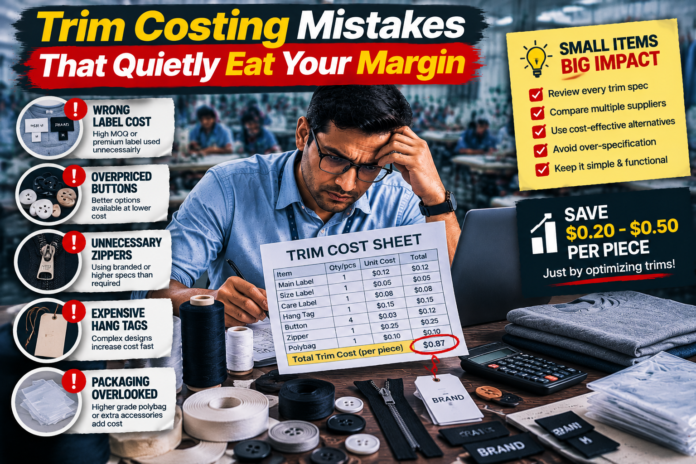
After that order, Shuvo built himself a habit that had nothing to do with fancy software or complicated formulas — just a short checklist he now runs through every single time before he finalizes a costing sheet involving trims:
Is this trim price current, or is it a number that’s been sitting in a shared file for months without anyone re-checking it?
Does this line account for realistic wastage — rejected buttons, misfired rivets, damaged labels — or does it assume a perfect production run that never actually happens?
If this trim is imported, does the number represent the true landed cost, including freight, duty, and clearing, or just the price the supplier quoted at their own factory gate?
Is the order quantity actually above the MOQ tier this price is based on, or is there a smaller, more expensive tier hiding further down the same quote sheet?
None of these questions take long to ask. That’s the part that frustrated Shuvo most, looking back — none of this required more time or more expertise than he already had. It just required treating trims with the same seriousness he’d always given fabric, instead of rushing through them because they felt small.
The Habit That Actually Protects the Margin
There’s a quiet lesson in all of this that goes beyond trims specifically. The costing mistakes that hurt a merchandiser’s margin are rarely the dramatic ones — the fabric price that doubles overnight, the CMT negotiation that falls apart completely. Those get noticed immediately, and they get fixed immediately, because they’re too big to ignore.
It’s the small, repeated, almost boring gaps that do the real damage, precisely because they’re easy to overlook, order after order, until someone finally sits down and traces every single number back to where it actually came from.
Shuvo still costs fabric first, the same as he always did — it’s still the biggest number, and it deserves the attention it gets. But now, before he sends any costing sheet to a buyer, he spends just as much care on the smaller lines too, the buttons and zippers and labels and hangtags that used to feel too minor to double-check.
Two lost points of margin taught him that “small line item” and “small consequence” aren’t actually the same thing. They just look that way, right up until finance sends over the real numbers.