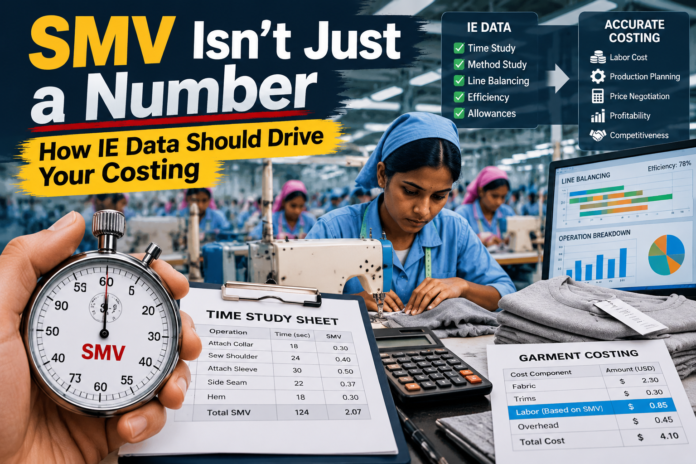

Tariq had a habit that his industrial engineering colleague, a sharp, no-nonsense woman named Dilruba, had been quietly annoyed by for almost two years before she finally said something about it.
“You keep asking me for one number,” she told him, one afternoon, after he’d stopped by her desk for the third time that week with the same request. “SMV for this style. That’s it. That’s all you ever want from me.”
He blinked, genuinely not understanding what she meant. “Isn’t that… what I need? The SMV, so I can calculate the CMT?”
“That’s what you think you need,” she said, pulling up a spreadsheet full of numbers he’d never actually seen before, despite sitting two floors above her department for years. “This is what I actually have. You’ve been costing with about five percent of it.”
That conversation changed how Tariq thought about his entire relationship with the IE department, and it’s worth walking through exactly what he learned, because the gap between what most merchandisers ask for and what industrial engineering actually tracks is bigger, and more expensive, than almost anyone realizes until someone shows them directly.
What SMV Actually Is, Underneath the One Number
SMV — Standard Minute Value — is the amount of time a skilled, properly trained operator should take to complete one operation, under normal working conditions, at a hundred percent efficiency. Add up the SMV for every single operation in a garment — attach collar, set sleeve, close side seam, and so on — and you get the total SMV for the whole style. That total number is what most merchandisers, Tariq included, take straight to their CMT calculation, multiply against a labor cost per minute, and call it done.
It’s not wrong, exactly. It’s just incomplete, in a way that quietly costs money on almost every order that isn’t a simple, familiar, repeat style.
“SMV tells you the ideal time,” Dilruba explained. “It doesn’t tell you the actual time a real line, with real operators, on their first week with a new construction, is going to take. Those are two completely different numbers, and you’ve only ever been asking me for the first one.”
The Gap Between Standard and Actual
Dilruba pulled up data from a style Tariq had costed six months earlier, one with a moderately complex construction the factory hadn’t run before — a new type of seam finish the buyer had specifically requested. The SMV for that operation, calculated under standard, ideal conditions, was 0.85 minutes.
The actual average time, tracked by IE during the first week of bulk production, was 1.35 minutes. Not because the operators were unskilled. Because nobody on that line had ever done this exact operation before, and it took real repetition, real practice, before their speed actually matched the standard the SMV assumed from day one.
By the second week, the actual time had dropped to 1.05 minutes. By the third week, it settled close to the original 0.85 SMV, right where the standard said it should be all along.
“So the SMV wasn’t wrong,” Dilruba said. “It’s the right number, eventually. You just costed the whole order as if ‘eventually’ started on day one, instead of two or three weeks in.”
Tariq sat with that for a moment, doing the mental math on how many of his own past orders had probably carried this exact same gap, quietly, without him ever knowing to look for it.
Why This Matters More Than Tariq Had Realized
The financial impact of that gap isn’t small, once you actually calculate it properly. If a line runs at 63 percent efficiency for the first week, gradually climbing to 78 percent in week two, and only reaches something close to full standard efficiency by week three, the effective labor cost per garment during that ramp-up period is meaningfully higher than what a flat, standard SMV-based CMT rate assumes for the entire order.
On a short order, this barely matters — you might never even reach full efficiency before the order’s finished, meaning the “ramp-up” period basically is the whole order, and a merchandiser who ignores this is costing the entire style wrong, not just the first week of it. On a longer order, the ramp-up cost gets diluted across enough units that it matters less overall, but it still represents real money in the early days that a flat SMV-based costing never accounted for.
“You’ve probably been eating this cost quietly for years,” Dilruba told him. “Not because your CMT rate was wrong. Because you were applying it as if every single day of production was day thirty, instead of day one.”
The Data Tariq Had Never Actually Asked For
Once Tariq understood the gap, he started asking Dilruba different questions, and she started showing him data she’d apparently been tracking for years, data that had simply never made its way into his costing process because nobody had ever asked for it in a form he could use.
Learning curve data by construction type. IE tracked, style by style, how long it typically took a line to move from initial output to full standard efficiency, broken down by the type of new element involved — a new stitch type, a new attachment method, a new fabric that behaved differently under the machines than what operators were used to. Some learning curves were short, two or three days. Others, especially with genuinely unfamiliar constructions, stretched past a full week.
Efficiency data by line, not just by factory. Not every line in the factory performed identically, even on the same style. Some lines had more experienced operators, better supervisor coaching, or simply more practice with certain construction types than others. A flat, factory-wide efficiency assumption hid real differences that mattered when deciding which line, specifically, would run a particular order.
Machine and method-specific time data, not just aggregate SMV. Two operations with the same total SMV could behave very differently in practice — one might be a simple, forgiving motion that operators picked up almost instantly, while another, with the same standard time, might be fiddly and error-prone, generating rework that ate into effective output in a way the SMV number alone never captured.
None of this was secret information Dilruba had been hiding. It was just data that lived entirely within IE’s own systems and reports, because nobody outside that department had ever asked for it in a way that connected it back to costing.
How Tariq Started Using It
The first real change was simple, almost embarrassingly so, once he actually implemented it: for any style involving a genuinely new construction element, Tariq started asking Dilruba directly, before finalizing his costing, roughly how long she expected the learning curve to run, based on similar past styles with a comparable new element.
He then built a small, explicit “ramp-up allowance” into his CMT calculation for those specific styles — not a vague buffer, but a number grounded in Dilruba’s actual historical data, reflecting the real, extra labor cost of those first days or weeks running below full efficiency. For familiar, repeat styles, where the whole line already knew the construction cold, he left the standard SMV-based rate untouched, because there, the standard assumption was already accurate from day one.
The second change was about which line got assigned to which order. Instead of treating line allocation as purely a planning department decision, disconnected from costing, Tariq started asking whether a style with an unfamiliar construction could realistically be assigned to a line with operators who’d handled something similar before, potentially shortening the learning curve and the associated cost gap, compared to placing it on a line meeting the construction for the very first time.
The Order That Proved the Difference
The real test came a few months later, on a style with a construction detail the factory had genuinely never run before — a specific embellishment attachment method the buyer’s tech pack required. Under Tariq’s old approach, he would have costed this purely off the standard SMV, the same way he’d costed the earlier style that had actually run 1.35 minutes against an 0.85 minute standard for its first week.
This time, he sat with Dilruba beforehand. Based on similar past introductions of unfamiliar attachment methods, she estimated a learning curve of roughly ten working days before the line would reach full standard efficiency on this specific operation. Tariq built that into his costing as an explicit line item, clearly labeled, rather than hoping the standard rate would somehow hold from day one.
When the order actually ran, the real ramp-up period came in close to Dilruba’s estimate, slightly shorter than projected, in fact, because the line she’d recommended had handled a loosely related embellishment technique on a previous order. The final margin on that style came in almost exactly where Tariq had promised it would, a result that, looking back at his past few years of costing similarly complex styles, felt genuinely unusual.
“That’s the whole point,” Dilruba told him, when he mentioned how close the numbers had landed. “This isn’t magic. It’s just not pretending day one and day thirty are the same day, the way every SMV-only costing sheet quietly does.”
Why This Gap Exists Across the Industry, Not Just for Tariq
Talking to other merchandisers later, Tariq realized this wasn’t a gap unique to his own habits. It’s built into how most merchandising training treats SMV — as a single, clean input into a CMT formula, rather than as one piece of a much richer dataset that industrial engineering departments are often already collecting, quietly, in systems most merchandisers never think to ask about.
Part of the disconnect is structural. IE and merchandising often sit in genuinely different departments, sometimes different buildings, reporting up through different management chains, with limited natural reason to sit down together regularly. IE cares about production efficiency, line balancing, operator training. Merchandising cares about costing, buyer negotiation, order tracking. Both departments are, in a real sense, working with pieces of the exact same underlying reality — how long it actually takes to make this garment — without necessarily realizing how much value sits in simply combining what each side already knows.
What Tariq Tells Junior Merchandisers Now
The advice Tariq gives newer merchandisers on his team isn’t complicated, and it doesn’t require any new software or formal process change to start. It requires one habit: before costing any style with a genuinely new construction element, walk down and actually talk to whoever handles IE, not just to request the SMV number, but to ask a second, more specific question — how long has it historically taken a line to reach full efficiency on something similar to this.
Sometimes the answer is “not long, this is close enough to things we’ve done before that it won’t really matter.” That’s useful information too, confirming the standard SMV-based rate is safe to use as-is. But sometimes, the answer reveals a real, quantifiable gap, exactly the kind that used to quietly eat into Tariq’s margin for years before he ever thought to ask the question at all.
The Real Lesson Underneath the Number
What stayed with Tariq longest from that first conversation with Dilruba wasn’t really about learning curves specifically, even though that became the most immediately useful thing he changed. It was realizing how much genuinely useful data exists just outside a merchandiser’s usual line of sight, sitting in another department’s systems, never making its way into a costing sheet simply because nobody had ever built the habit of asking for it.
SMV, on its own, is a perfectly good number. It tells you, accurately, what a fully trained line should take to complete an operation under standard conditions. The mistake Tariq had been making for years wasn’t trusting that number — it was assuming it was the only number that mattered, when the real story of what an order actually costs to produce lives in the fuller picture underneath it: how long it takes a specific line to actually reach that standard, on this specific construction, starting from day one.