
Exclusive content
Shohan saw the headline on his phone before he’d even had his morning tea. “Bangladesh Exports Grow 13% in August on RMG Rebound.” He felt a small, genuine lift reading it, the kind of quiet relief that comes from good news about an industry you’ve spent your whole career inside. He forwarded it to his team’s WhatsApp group with a simple message: “Good news for us this season.”
By lunchtime, one of his junior merchandisers had replied with a link to a different article, published the same week, with a headline that told almost the opposite story: RMG exports had actually declined for the full fiscal year, missing the government’s own target by a wide margin. Shohan read that one twice, genuinely confused. Both articles cited the same source, the Export Promotion Bureau. Both were, as far as he could tell, accurate. And yet they seemed to be telling him completely different things about the same industry, in the same country, in roughly the same stretch of time.
That confusion sent him to an old university friend, an economist now working at a research firm in Dhaka, over a long phone call that ended up changing how Shohan reads every export report that crosses his desk since.
The Number That Made Everyone Feel Good
“Thirteen percent sounds great,” his friend said, once Shohan had explained what he’d read. “And it’s not wrong. But you’re a merchandiser, not an economist, and you’re reading it the way an economist wants you to read it, not the way that actually helps you plan an order book.”
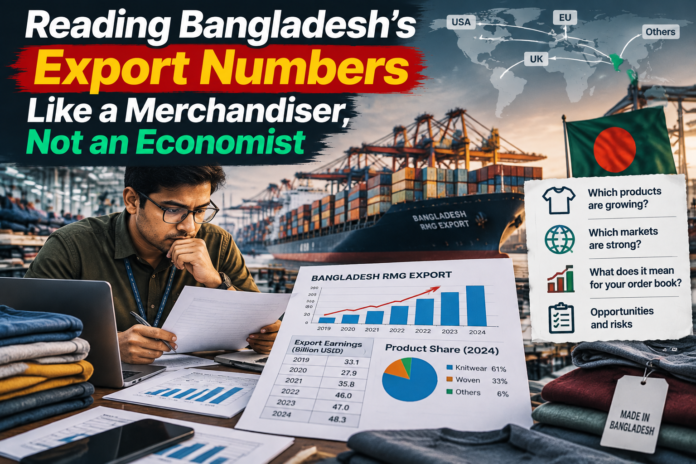
He walked Shohan through the actual figures behind that headline. Bangladesh’s merchandise exports had indeed jumped 13.14 percent year-on-year in August, reaching $4.43 billion, with RMG earnings rising nearly 14 percent to $3.89 billion for the month. Knitwear had grown almost 15 percent, woven garments close to 13 percent. On its face, genuinely strong numbers.
But his friend pointed to something Shohan had completely skipped past in his excitement — the same month’s exports had actually fallen 6.3 percent compared to the previous month, July. And the BGMEA president himself, quoted in one of the same articles, had cautioned that this was happening against what he called a relatively low base, meaning August of the previous year had been an unusually weak month, which made this August’s year-on-year comparison look more dramatic than it really was. Export performance, in his own words, hadn’t actually improved significantly.
“This is the first thing a merchandiser needs to learn to check,” his friend said. “Is this growth measured against a strong month, or a weak one. A thirteen percent jump against a terrible August last year isn’t the same story as a thirteen percent jump against a normal one. The percentage is honest. What it’s actually telling you depends entirely on what it’s being compared against.”
The Full Year Nobody Was Celebrating
Zooming out further, his friend showed him the bigger picture that had prompted that second, gloomier article Shohan’s junior had sent over. For the full fiscal year 2025-26, RMG exports had actually declined 1.64 percent compared to the year before, landing at $38.7 billion. Total merchandise exports for the year came in just under $48 billion, missing the government’s own $55 billion target by a meaningful distance, and slipping slightly, by about half a percent, from the previous year’s total.
“So which is it,” Shohan asked, genuinely trying to reconcile the two stories in his head. “Are we growing or shrinking?”
“Both, depending on which window you’re looking through,” his friend said. “That’s exactly the trap. A single month can look fantastic while the full year underneath it is still soft. A single month can also look terrible while the underlying year is actually fine. You have to hold both pictures at once, or you’ll keep getting whiplash every time a new monthly number comes out.”
He pulled up one more example that made the point almost uncomfortably clear — February of that same year, when knitwear exports had actually fallen over 15 percent year-on-year, and dropped more than 34 percent compared to the month right before it. A single bad month, in isolation, looked like a genuine crisis. Six months later, that same year’s overall knitwear performance had mostly evened back out. The February panic, in hindsight, had been real in the moment but misleading as a signal about the year as a whole.
Why the Knit-vs-Woven Split Actually Matters to Him
This part of the conversation was the one that landed most directly on Shohan’s own factory, because his unit specialized almost entirely in woven shirts, not knitwear. He’d been reading every headline RMG number as if it applied evenly across his whole business, without separating out which segment was actually driving the number.
Looking at the first half of that same calendar year, his friend showed him, the two segments had told genuinely different stories. Woven garments had posted a small positive growth of under one percent. Knitwear had actually declined by almost two percent over the same period. A headline that simply said “RMG exports roughly flat” was quietly averaging together two segments moving in slightly different directions.
“You don’t sell knitwear,” his friend said. “So a headline driven mostly by a knitwear swing, up or down, isn’t really telling you much about your own order book at all. You need to find the woven number specifically, every time, and mostly ignore the blended headline unless you’re trying to understand the industry as a whole, not your own slice of it.”
That single habit, Shohan realized, would have saved him a fair amount of misplaced worry over the past year. He’d absorbed more than one alarming headline number that, once you actually separated it by category, had barely touched the specific segment his factory actually operated in.
The Market Share Story Hiding Inside the Growth Numbers
The part of the conversation that actually gave Shohan something to act on, rather than just something to understand, came when his friend pulled up the market breakdown from the most recent two-month period.
The United States had grown fastest among Bangladesh’s major single-country destinations, with exports rising over 11 percent, pushing its share of the country’s total garment exports up to just over 21 percent, from about 20 percent the year before. Non-traditional markets — buyers outside the usual EU and US concentration — had grown almost as fast, expanding their own share of the total pie as well.
The European Union, meanwhile, still the largest single bloc buying from Bangladesh by a wide margin, had grown by only a couple of percentage points, modest enough that its actual share of the total had slipped slightly, from just under 48 percent down to under 47 percent. And exports to a handful of specific markets — Russia, China, India — had fallen sharply, by double-digit percentages in some cases, though from a smaller base that made the dollar impact less dramatic than the percentage alone suggested.
“This is the number that should actually change how you think about your own buyer mix,” his friend told him. “Not whether the total went up or down this month. Whether your factory’s own buyers are sitting in the part of the market that’s gaining share, or the part that’s slowly losing it.”
Shohan thought immediately about his own client list. Two of his three biggest buyers were EU-based, the exact segment quietly losing relative share even while growing in absolute terms. His newest relationship, the one he’d been treating almost as a side project, was with a smaller US-based brand. For the first time, he looked at that account not as a nice-to-have diversification, but as sitting exactly in the part of the market currently growing fastest and gaining share.
Learning to Ask a Different Set of Questions
By the end of that call, Shohan had a genuinely different mental checklist for how he reads an export report now, compared to how he’d read that first exciting headline over his morning tea.
Instead of just asking “did exports go up or down,” he’d learned to ask whether the comparison was against a strong month or an unusually weak one, since a percentage alone, without that context, can make an ordinary month look either dramatic or disastrous depending purely on what came before it.
Instead of trusting a single month’s number on its own, he’d learned to check it against the surrounding trend — the month before, the same month a year earlier, and where the fuller year had been tracking overall — because a single data point, isolated from its own context, is one of the easiest things in the world to misread in either direction.
Instead of absorbing a blended, industry-wide RMG figure as if it applied evenly to his own business, he’d learned to dig for the specific segment breakdown, knit versus woven, that actually matched what his own factory produced, since a headline number averaging two genuinely different stories together tells you less about your own reality than it appears to.
And instead of only asking whether the total number was good or bad, he’d started asking a more useful, forward-looking question: which specific markets and buyer segments were actually gaining share, and did his own client list sit inside that growing slice, or the slowly shrinking one.
What This Actually Changes About His Job
None of this turned Shohan into an economist, and he has no particular interest in becoming one. His job is still costing, negotiating, managing production timelines, the same work it’s always been. But he’s noticed, in the months since that phone call, that he reads every export report differently now, with a kind of skepticism toward the headline number and a genuine curiosity about what’s actually sitting underneath it.
That shift showed up concretely, too, not just in how he reads the news. When his factory’s leadership sat down to discuss which buyer relationships to prioritize chasing over the following year, Shohan found himself, for the first time, actually contributing real data to that conversation instead of just gut instinct — pointing out, specifically, which regions were gaining real share of Bangladesh’s export mix and which were slowly losing it, and suggesting the factory lean harder into developing its smaller US accounts rather than assuming its comfortable, established EU relationships would keep growing at the same pace they always had.
An export number, read the way Shohan used to read it, over morning tea, was just a mood — good news or bad news, a headline to forward to a group chat and move on from. Read the way his economist friend actually reads it, patiently, against its proper context, broken down by the segments and markets that actually matter to a specific factory’s specific business, that same number becomes something closer to a genuinely useful signal — not a headline to react to, but real information he can actually use to decide where his own factory’s next order book is most likely to come from.