
Exclusive content
The vendor’s demo had a slide with a single word on it: Everything.
Rashed sat at the back of the conference room, watching the third software presentation of the month. The factory owner was in the front row, nodding. The IT manager was taking notes. Behind the vendor, a dashboard glowed with coloured charts: orders, inventory, production, shipments, finance, all on one screen.
The owner had been clear about why they were here. Orders were getting harder to track, costing took too long, buyer comments went missing, and nobody could say at four in the afternoon how many pieces a line had really sewn. “I want one system that fixes all of this,” he had said that morning.
When the demo ended, the vendor invited questions. Rashed, a senior merchandiser, had three.
“Where do we log buyer fit comments, with dates, so our T&A updates itself?”
“Yes, we can do that,” the vendor said.
“Can I see today’s output for each line without calling the floor?”
“Yes, absolutely.”
“Can the costing pick up actual yarn prices from purchasing?”
“Yes.”
Three questions, three yeses. Rashed wrote the word down in his notebook and drew a small question mark next to it. Over the following months he would learn that each yes belonged to a different type of system, with a different price and timeline.
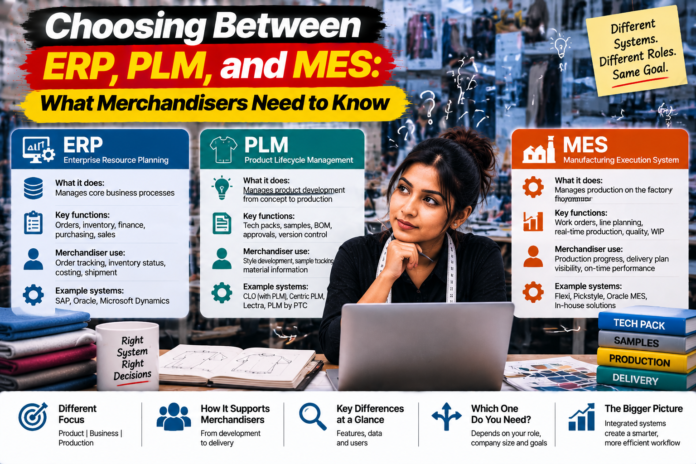
This article is about those three systems: ERP, PLM and MES. The acronyms get thrown around as if they’re interchangeable. They aren’t, and choosing between them, or the order to buy them in, is one of the most expensive decisions a factory makes.
Three systems, three different jobs
The simplest way to separate them is by the question each one answers.
ERP answers: “What do we have, what do we owe, and what do we need?” ERP stands for Enterprise Resource Planning. It’s the factory’s backbone: orders, purchasing, inventory, costing, finance, payroll and shipping documents. In apparel, a good ERP handles the style master, bills of materials, size and colour breakdowns, material requirements, purchase orders, stock in the store, and the numbers that end up in accounts.
PLM answers: “What exactly are we making, and has everyone agreed?” PLM stands for Product Lifecycle Management. It lives in the world of development: tech packs, specifications, bills of materials in draft, sample requests, fit comments, approvals and version history. Its job is to keep the factory and the buyer looking at the same, current version of a style.
MES answers: “What is happening on the floor right now?” MES stands for Manufacturing Execution System. It tracks cutting, bundles, sewing lines, work in progress, output against plan, efficiency, defects and downtime, as they happen, not at the end of the day.
Put in a sentence: ERP runs the business, PLM runs the product, and MES runs the production floor.
| Question | ERP | PLM | MES |
|---|---|---|---|
| Main focus | Money, materials, orders | Product development and approvals | Real-time production |
| Typical users | Accounts, store, purchasing, merchandising | Merchandising, sampling, design, buyer teams | Production, planning, quality, floor supervisors |
| Typical data | POs, stock, costs, invoices | Tech packs, comments, samples, versions | Output, WIP, defects, efficiency |
| Typical failure if missing | Costing errors, stock confusion | Lost comments, wrong versions | Late surprises from the floor |
Real products blur these lines, but the underlying jobs stay distinct, and so do the strengths.
Where merchandisers actually live
Here’s what the vendors rarely say plainly. Merchandisers touch all three systems, but not equally.
In ERP, a merchandiser creates the style, builds the BOM, prepares the costing, books fabric and trims, tracks purchase orders and watches shipments. This is where most of the daily work sits, and where mistakes become money.
In PLM, a merchandiser manages the conversation with the buyer: sending samples, logging comments, tracking approvals, keeping versions straight. For many factories this is the messiest part of the job, because the evidence lives in email, WhatsApp and photographs.
In MES, a merchandiser is mostly a reader. You don’t enter data, but you depend on it. Whether the T&A is believable depends on whether you can see real output against plan, and whether the answer to “will we ship on time?” comes from the floor or from hope.
If you’re asked to help choose a system, don’t ask what it can do. Ask which of your daily problems it would remove.
Back to Rashed: the wrong question
The factory chose an ERP. It was a sensible choice, in its way. The accounts team was struggling with stock records, the store couldn’t reconcile what had been issued, and costing numbers kept disagreeing with purchasing. Within a year the ERP was live, and those problems genuinely improved.
But Rashed’s own problems didn’t go away.
Buyer comments still arrived by email and WhatsApp, and the ERP had no good place to log them. The T&A stayed in Excel because the system’s version couldn’t handle approvals that shifted by the day. And the floor still wrote output on paper, entered into the system the next morning, which meant the dashboard the owner loved was always one day behind.
The factory hadn’t bought the wrong system. It had bought one of three, while expecting it to do the work of all three. The word Everything on the vendor’s slide had done what slogans do. It had made a collection of different problems feel like one.
Start from the pain, not the product
Before looking at any product, map your pain to the right system. A simple exercise: write down the ten things that most often go wrong in a typical month, then ask which job each one belongs to.
- We quoted a price and the actual cost was different. That’s costing and purchasing data: ERP.
- We ran out of trims because nobody saw the shortage. Stock and material planning: ERP.
- The buyer says they approved something we can’t find. Version and comment history: PLM.
- We sewed from an old tech pack. Version control: PLM.
- We don’t know until evening that a line fell behind. Real-time output: MES.
- Our efficiency numbers don’t match what the floor says. Shop-floor data: MES.
- Three people have three different T&As. This one needs all three systems to talk to each other.
You’ll probably find that your pain clusters in one area. That cluster is where to start. If most of it sits in money and materials, ERP first. If it sits in samples and comments, PLM first. If it sits on the floor, MES first. There’s no universal order, and anyone who gives you one without asking about your factory is selling something.
What to demand from each
Once you know which system matters most, here’s what a merchandiser should look for. This isn’t a feature checklist for a vendor. It’s a way of testing whether the system fits how apparel really works.
From an ERP:
- A style master with size and colour matrices, not just single items.
- Bills of materials with consumption, wastage and tolerance, so GSM and shrinkage can be handled properly.
- Costing linked to real purchasing prices, with the ability to compare quoted and actual cost after shipment.
- Material requirement planning that handles fabric booked in kilograms but consumed in metres.
- A usable T&A with dependencies, not just a list of dates.
- Outputs that can be formatted to a buyer’s template, so you aren’t retyping.
From a PLM:
- Version control for tech packs and specs, with an obvious “current” version.
- A log of every comment and approval, with dates, owners and the round number.
- Sample tracking from request to approval.
- Links to the T&A, so a late comment shows its effect on the schedule.
From an MES:
- Tracking at bundle or garment level, depending on how detailed you need to be.
- Real-time output against plan, by line and by style.
- Defect and rework tracking that feeds quality numbers.
- Easy data capture on the floor, ideally by scanning, not forms that operators avoid.
- A clean feed back to the ERP, so planned and actual numbers meet.
Notice what’s common to all three: integration. The value of each system multiplies when it exchanges data with the others, and collapses when it doesn’t. A PLM that doesn’t feed the ERP leaves you retyping BOMs. An MES that doesn’t feed planning leaves you with beautiful charts nobody acts on. Ask every vendor, in detail, how data moves between their product and the others you use or plan to use.
The questions that reveal more than the demo
Demos are designed to impress. These questions are designed to uncover.
- Can we see a live system running in a factory like ours? A similar product mix, size and buyer base matters more than a famous logo.
- Can we speak to a customer who went live more than a year ago? Early enthusiasm fades. Year-two reality is the useful part.
- What does implementation actually involve, and who does what? Ask for a plan that names tasks, owners and timelines on both sides, including data clean-up.
- What happens when the internet or power goes down? In many factories connectivity isn’t guaranteed. Understand what still works offline.
- Who owns our data, and how do we get it out? Ask for the export format in writing. If leaving is painful, you’re locked in.
- How much of this is configuration and how much is custom development? Heavy customisation tends to make upgrades slow and support expensive.
- What support do we get, in which time zone and language? A system that breaks on a Thursday night is only as good as the answer you get.
- What do you need from us, and what usually goes wrong? A good vendor has an honest answer.
The part everyone underestimates
The software is rarely the hardest part. Three other things decide whether a system succeeds.
Data. Systems run on clean, consistent data: style codes, colour names, supplier lists, units. If your current records are messy, the new system will faithfully reproduce the mess, faster. Budget real time for cleaning before go-live.
People. A tool people avoid is worse than no tool. Floor supervisors, store keepers and merchandisers all have to enter data, and each needs a reason to do it carefully. Training matters, but so does making the system save them time rather than add to their workload.
Process. Software can’t fix a process nobody has agreed on. If every merchandiser builds a T&A differently, the system will contain ten versions of confusion. Standardise the way you work first, then encode it.
A practical way to reduce risk is to start small: one buyer, one product group or one line, with clear measures of success. How long does a quote take? How many comment rounds are tracked rather than lost? How close are planned and actual output at the end of the day? A pilot that moves those numbers earns the right to expand. One that doesn’t tells you something cheaply.
The honest limits
I haven’t named products, and that’s deliberate. The right choice depends on your size, your buyers, your product mix, your budget and your people, and the market changes quickly. Treat anything in a brochure as a claim to verify, ideally with a reference customer and a trial using your own data.
The framework here is also a simplification. Plenty of factories run well on a modest ERP and a disciplined spreadsheet habit. Many buyers insist on their own PLM, so your choice is partly made for you. And a smaller factory may not need all three, at least not yet.
Back to the demo room
Eighteen months after the first demo, Rashed’s factory did something unusual. It went back to the start. The IT manager, the production head and three merchandisers sat down with a whiteboard and wrote out, again, the ten things that went wrong most often. This time they marked each one: ERP, PLM or MES.
The ERP was doing its job, and they decided to keep it. The comment and approval problem clearly belonged to PLM, so they began a small pilot with one buyer, logging every comment with a date and linking it to the T&A. The floor problem belonged to MES, and they chose to start with two sewing lines, using simple scanning at the end of each line, feeding output into the ERP every hour.
It was slower and less dramatic than Everything. But six months in, Rashed could answer the question he’d asked in the first demo. When a buyer comment arrived late, the T&A showed what it moved. When the owner asked at four in the afternoon how a line was doing, the answer was already on a screen.
The vendor’s slide had promised one system for everything. What the factory actually needed was three systems, each doing one job well, talking to each other, and bought in an order that matched its pain. The acronyms aren’t the point. The point is knowing which problem you’re paying to solve, and refusing to accept a yes that doesn’t tell you which one.