
Exclusive content
Every Sunday morning, Joya used to sit with the production tracker and feel genuinely relieved.
Sewing output: on target. Cutting: ahead of schedule. Fabric inspection: clear. Trim inhouse: complete. Line by line, the report told her the story she wanted to hear — that this order, a 45,000-piece knit shipment for a European buyer, was going to ship on time, the way it was supposed to.
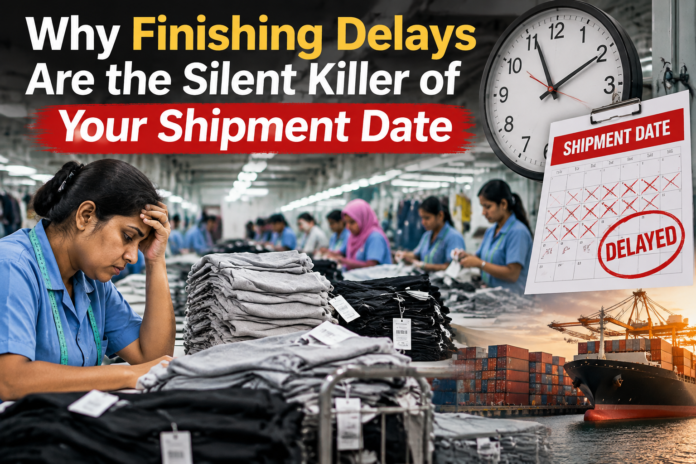
Then, eleven days before the vessel booking cutoff, the shipment collapsed. Not because of sewing. Not because of fabric. Because of a department that had barely appeared in her weekly tracker at all — finishing.
“How is this happening now?” she remembers asking the finishing in-charge, standing in a room stacked with garments waiting for pressing and folding, well behind schedule, with almost no cushion left before the ship date. “Sewing finished on time. Why are we behind?”
His answer was quiet, and it stuck with her far longer than she expected. “Apa, sewing finishing on time doesn’t mean finishing can start on time. And finishing starting on time doesn’t mean finishing can move fast.”
At the time, it sounded almost like a riddle. Looking back at everything that went wrong on that order, it was actually the whole explanation.
The Department Nobody Watches Closely Enough
Finishing sits at a strange spot in the production process. It’s the very last stage before a garment becomes shippable — pressing, folding, tagging, poly-bagging, cartoning — and precisely because it comes last, it tends to get the least attention throughout the order’s life. Merchandisers watch cutting closely, because cutting mistakes are expensive and hard to reverse. They watch sewing output daily, sometimes hourly, because sewing is where the bulk of the time and labor goes. Fabric and trims get chased relentlessly from day one, because everyone knows a shipment can’t even start without them.
Finishing, by comparison, often gets treated as the easy part. Press it, fold it, pack it, done. It’s the stage that looks simple from the outside, the one nobody imagines could actually be the reason a shipment misses its date.
Joya had genuinely believed that too, right up until the week she learned otherwise. Her weekly tracker had a single line for finishing, usually just marked “on track,” right up until the week it very much wasn’t.
The Bottleneck Hiding in Plain Sight
The first problem, once Joya actually walked the finishing floor instead of just reading a status update about it, was capacity. Her factory’s finishing section had a fixed number of pressing tables and a fixed number of workers trained to operate them. That capacity had been sized, reasonably, around the factory’s normal daily output.
But three other buyers’ orders were also moving through finishing that same week, all converging at roughly the same time, because sewing on all three had also finished around the same time. Nobody had actually planned for that overlap. Each merchandiser, including Joya, had been tracking their own order’s sewing completion date as if it existed in isolation, without checking whether finishing capacity could actually absorb four orders’ worth of pressing and packing landing in the same seven-day window.
It’s an easy trap to fall into, because sewing capacity gets planned carefully — line allocation, target pieces per day, all clearly mapped out weeks in advance. Finishing capacity, in a lot of factories, doesn’t get the same deliberate planning. It just absorbs whatever arrives, whenever it arrives, and when four orders arrive at once, something has to wait, whether or not anyone explicitly decided that it should.
The Second Delay Nobody Saw Coming
The second problem was more specific to this particular order, and even harder to predict in advance: a buyer compliance requirement for a specific type of anti-wrinkle finish treatment on this fabric, applied after sewing, before final pressing. It wasn’t a new requirement — it had been in the tech pack from the beginning — but it added an extra step, and an extra waiting period, between “garment is sewn” and “garment is ready to press,” that Joya’s timeline had never fully priced in as its own distinct stage.
She’d mentally filed that treatment under “finishing,” the same broad label she used for pressing and packing, without separating out that it actually required its own processing time, its own equipment availability, and its own quality check before the garment could even reach the pressing table. When she’d built her shipment timeline months earlier, she’d essentially counted that treatment as a rounding error inside the broader finishing window, instead of giving it real, dedicated days of its own.
That treatment step alone ended up consuming almost three full days that her original timeline hadn’t accounted for, days that came directly out of whatever buffer she thought she had left before the ship date.
The Rejection Nobody Budgeted Time For
The third problem was the one that actually broke the shipment. During final pressing and inspection, quality control found a recurring issue on a portion of the units — a pressing defect that wasn’t visible until garments were fully finished and folded, caused by a slightly incorrect steam setting that had been used for the first two days of pressing before anyone caught it.
That meant re-pressing a real percentage of an already-large order, from scratch, on a finishing floor that was already behind and already juggling other buyers’ work. In sewing, a defect discovered mid-process usually means fixing individual pieces as they’re found, spread out, absorbed gradually into the daily flow. A finishing defect discovered late means reopening a batch that was supposed to already be done, pulling it back out of cartons, re-processing it, and re-inspecting it, all under a deadline that was already tight before the rework was even discovered.
Joya’s shipment timeline, like most merchandisers’ timelines, had built in some rework allowance for sewing. It had built in almost none for finishing, on the unspoken assumption that finishing problems, if they happened at all, would be small and quick to fix. This one wasn’t.
Why Finishing Delays Feel So Sudden
Looking back at that week, Joya realized what made finishing delays feel so uniquely dangerous, compared to delays earlier in the process. A cutting delay shows up early, when there’s still weeks of runway left to recover. A sewing delay shows up gradually, day by day, visible in a daily output report long before it becomes a crisis, giving everyone time to add a shift, borrow a line, or renegotiate a date if needed.
A finishing delay shows up right at the very end, when almost no runway is left at all. By the time a problem surfaces in finishing, sewing is already done, fabric and trims are long since consumed, and there’s no earlier stage left to draw extra time from. Whatever slack existed in the schedule has typically already been spent absorbing smaller delays earlier in the process, which means finishing problems arrive with the least cushion and the highest pressure, at exactly the moment when a merchandiser has the fewest tools left to fix them.
That’s what her finishing in-charge had actually meant, standing in that room stacked with unfinished garments. Sewing finishing on time doesn’t guarantee finishing can start on time, because finishing might still be occupied with someone else’s order. And finishing starting on time doesn’t guarantee it moves fast, because compliance treatments, quality rework, and simple capacity limits can all slow it down in ways that never show up until it’s almost too late to fix them.
What Joya Changed After That Order
The order eventually shipped, four days late, on an airfreight upgrade that ate a meaningful chunk of the factory’s margin on that style, a cost nobody wanted to explain upward but everybody understood exactly where it had come from.
After that, Joya stopped treating finishing as a single line item on her tracker. She started asking three specific questions on every order, well before sewing was anywhere near complete.
What does finishing capacity actually look like the week this order is expected to land there, across every other buyer’s order also moving through that same section, not just this one in isolation?
Are there any post-sewing treatments — compliance finishes, special washes, embellishment processes — that need their own dedicated days, instead of being quietly folded into a general “finishing” estimate that doesn’t actually account for them?
Is there any real buffer built in for finishing-stage rework, the same way buffer already exists for sewing-stage rework, given that a defect caught here has nowhere left to hide and no earlier stage left to borrow time from?
None of these questions are complicated. They just require treating finishing as seriously as every earlier stage of production, instead of assuming, the way Joya once did, that the hard part of the order was already behind her the moment sewing wrapped up.
The Real Warning Buried in That Week
The lesson that stayed with Joya longest wasn’t really about pressing machines or compliance treatments. It was about where attention naturally goes, and where it quietly doesn’t. Every merchandiser watches the stages that feel risky by reputation — cutting, sewing, fabric sourcing — because that’s where the industry’s collective experience has taught everyone to look. Finishing rarely gets that same instinctive scrutiny, right up until it’s the reason a shipment is sitting in a warehouse four days past its vessel cutoff.
A shipment date isn’t actually protected by watching the biggest, most visible stages closely. It’s protected by watching every stage closely enough that none of them can quietly become the one nobody was checking. Finishing had always been that stage for Joya, hiding in plain sight, right up until the week it finally proved just how much damage a “simple” last step could do to an entire order.