
Nusrat had been costing garments the same way for six years, and she was good at it. Fabric cost, plus trims, plus CMT, plus overhead, plus margin, equals FOB price. Add it all up from the bottom, and whatever number comes out at the end, that’s what you quote the buyer. Simple. Logical. The way everyone taught her to do it.
So when a new buyer from a fast-growing European retail chain sent his first brief, she did what she always did. She pulled the tech pack, checked the fabric consumption, priced the trims, added CMT, added her margin, and sent back a number.
$7.85 per unit.
The buyer’s reply came back within an hour. Short, almost blunt. “We need this at $6.20. Can you work with that?”
Nusrat’s first reaction was the same one most merchandisers have in that moment — a small, tired sigh, followed by the thought, here we go again, another buyer who thinks fabric is free. She was ready to write back explaining, politely, that the numbers simply didn’t work, that fabric prices were what they were, that $6.20 wasn’t realistic for this construction.
But something made her pause before hitting send. She’d heard a phrase a few months earlier at a buying house training session, something the trainer called “costing backwards.” At the time it sounded like just another buzzword. Now, staring at a $1.65 gap between her number and the buyer’s number, she decided to actually try it.
What “Costing Backwards” Really Means
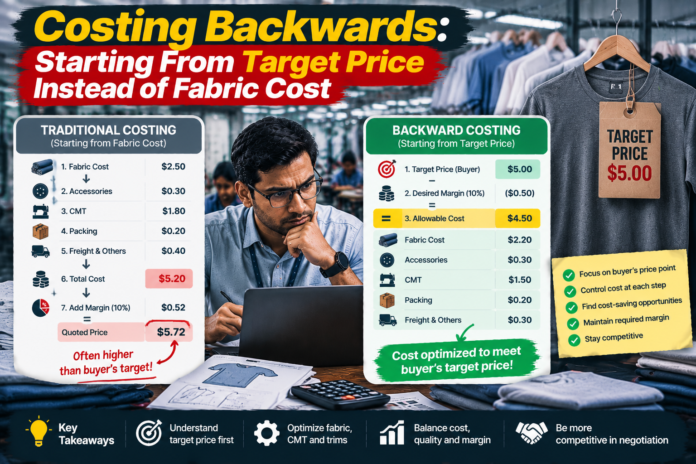
The way most merchandisers are trained to cost is what people call cost-plus costing, or costing forward. You start with what things actually cost — fabric, trims, labor, overhead — you add them all up, you add your margin on top, and whatever number falls out at the end is your price. It’s the natural way to think about it, because it starts from something concrete and real: the material sitting in front of you.
Costing backwards flips the order completely. Instead of starting with fabric and working toward a price, you start with the price the buyer needs, and work backward to figure out what the garment can actually be built from. The target price comes first. Everything else — fabric, trims, construction, even the CMT rate — becomes a variable you solve for, not a fixed starting point.
It sounds almost too simple when you say it like that. But the mental shift it requires is bigger than it sounds, because it means giving up the comfort of “this is just what it costs” and replacing it with a harder, more useful question: “what would this have to look like, to cost what the buyer needs it to cost?”
Nusrat Runs the Numbers Differently
Instead of writing back to explain why $6.20 wasn’t possible, Nusrat opened a blank sheet and started from the other direction.
If the final price had to be $6.20, and her CMT, overhead, and margin together needed roughly $2.40 to make the order worth running, that left $3.80 for fabric and trims combined, not the $4.60 her original costing had assumed.
That’s an 80-cent gap. Suddenly the question wasn’t “can we hit this price,” it was “what has to change to make $3.80 possible.” And that’s a completely different, much more solvable problem.
She went back to the tech pack with fresh eyes. The style called for a 220 GSM single jersey in a slightly unusual blend. She checked with her fabric supplier about a very similar 200 GSM option in a more standard blend, one that would still meet the buyer’s basic hand-feel and durability requirements but was available at a noticeably lower price per kilogram. She also looked at the trims — a metal zipper that could be swapped for a strong, buyer-approved plastic one without changing how the garment looked or performed.
Fabric substitution alone closed most of the gap. The trim change closed the rest. When she resent her costing, it landed at $6.15, five cents under the buyer’s target, with her margin fully protected.
The buyer didn’t just approve the order. He asked if she could apply the same approach to two other styles they’d been struggling to place with a different factory.
Why This Isn’t Just “Cutting Corners”
Here’s the part that makes people nervous the first time they hear about costing backwards, and it’s worth addressing directly, because it’s the honest concern underneath the whole idea: doesn’t starting from price just mean quietly lowering quality until the numbers work?
It can, if it’s done carelessly. That’s the real risk, and it’s a fair one. But that’s not actually what happened in Nusrat’s example, and it’s not what good backward costing looks like in practice. She didn’t cut GSM without checking whether it still met the buyer’s spec. She didn’t swap the zipper without getting it approved. Every change she made was still inside the boundaries of what the buyer actually needed, not just what was cheapest.
The real discipline in costing backwards isn’t finding ways to make things worse until the price fits. It’s figuring out, honestly, where the actual value is in a garment, and where it isn’t. A buyer rarely cares whether a zipper is metal or high-quality plastic, as long as it performs the same way and looks right. They often do care enormously about fabric hand-feel, colorfastness, or a specific finish that defines the whole collection. Backward costing forces you to separate those two categories clearly, instead of treating every spec line as equally untouchable, the way forward costing quietly tends to do.
The Old Way Hides a Blind Spot
There’s a reason forward costing feels safer, even though it often loses orders it didn’t need to lose. When you cost from the bottom up, you’re really just describing what a garment costs to make exactly as specified. You’re not actually asking whether it needs to be made exactly that way.
Nusrat realized, looking back at years of her own quotes, how many times she’d sent a “final” number and simply accepted rejection when it didn’t match the buyer’s target, instead of asking what flexibility might exist on the construction side. She’d treated her first costing as the only possible version of that garment, when really it was just one version, built around assumptions nobody had actually tested.
Costing backwards doesn’t remove those assumptions. It just makes you name them out loud, early, instead of discovering them too late, after a buyer has already walked away and placed the order somewhere else.
Where It Gets Harder — and Where It Actually Belongs
To be fair to the traditional method, costing backwards isn’t free of its own problems, and it isn’t the right tool for every situation.
It works best when there’s genuine room to adjust construction, fabric, or trims without damaging what the buyer actually cares about. On a highly technical, tightly specified style — a performance fabric with an exact certified composition, for example — there may be very little room to substitute anything at all, and backward costing simply confirms what forward costing already told you: the price and the spec don’t match, full stop, no clever substitution available.
It also requires real trust and real conversation with the buyer. Nusrat’s swap worked because she checked the trim substitution with the buyer before finalizing it, not after. Quietly changing specs to hit a price without buyer sign-off isn’t backward costing. It’s just a different, more dangerous way of cutting corners, and it tends to catch up with a factory eventually, usually at the worst possible moment, during a quality audit or a customer complaint.
And it demands something forward costing never really asks for: the merchandiser actually understanding why each cost exists, deeply enough to know which ones are negotiable and which ones aren’t. Nusrat could only make that fabric substitution confidently because she understood exactly what property the original GSM was protecting, and could judge, honestly, whether the alternative still delivered it. A merchandiser who doesn’t know their fabrics and trims that well can’t do this safely. They’ll either guess wrong and damage quality, or they’ll be too cautious to find any real flexibility at all.
What Changed for Nusrat
Nusrat still uses forward costing most of the time. It’s still the right tool for a lot of orders, especially the straightforward ones where the buyer’s target and her initial number are already close together.
But now, whenever a buyer comes back with a target price meaningfully below her first number, she no longer treats that gap as a wall. She treats it as the actual starting point of the real conversation. Instead of defending her original number or simply saying no, she goes back to the tech pack and asks the harder, more useful question: what would have to change, specifically, to make this price genuinely work, without quietly damaging what the buyer is actually paying for?
Sometimes the honest answer really is “nothing can change, the target isn’t realistic,” and she says so clearly, with the numbers to back it up. But increasingly, the answer is something closer to what happened with that first order — a fabric swap here, a trim adjustment there, small, defensible changes that close the gap without anyone having to compromise on what actually matters.
That one small shift in how she opens her spreadsheet, starting from the buyer’s number instead of her own, has quietly become the difference between losing orders to lower-cost competitors and keeping them, with her margin still intact.
The fabric didn’t get cheaper. The factory’s overhead didn’t change. What changed was the order she asked the questions in. And in merchandising, sometimes that’s the whole game.