
Mahin had made the same promise to a buyer three seasons in a row, and three seasons in a row, he’d broken it.
“PP sample by the 20th,” he’d write, confident, typing it into the email without really doing the math behind it. It felt like a reasonable date. There was still a month left before bulk cutting needed to start, and a month sounded like plenty of time to get through a few rounds of samples.
Except it never actually worked out that way. The proto sample would come back late from the sample room, because they were also working on three other buyers’ styles at the same time. The fit sample would get sent, and the buyer’s fit comments would take five days to come back instead of the two Mahin had quietly assumed. Revisions would take longer than expected because the pattern master was out sick for two days that particular week. And by the time the PP sample was actually ready, it was the 29th, not the 20th, and Mahin was writing an apologetic email trying to explain a delay that, from the buyer’s side, looked like his factory just couldn’t manage a simple timeline.
It took a conversation with an older merchandiser named Iqbal bhai, over cups of tea during a slow afternoon, for Mahin to realize the problem wasn’t that his factory was slow. The problem was that his timeline had never actually been a timeline. It was a hope, dressed up to look like a plan.
Three Samples, Three Completely Different Jobs
“You’re treating proto, fit, and PP like they’re the same task, just repeated three times,” Iqbal bhai told him, stirring his tea slowly. “They’re not. Each one is answering a completely different question. If you don’t know what question you’re answering, you can’t know how long it should honestly take.”
That distinction, obvious once someone says it out loud, was something Mahin had never really separated in his head before.
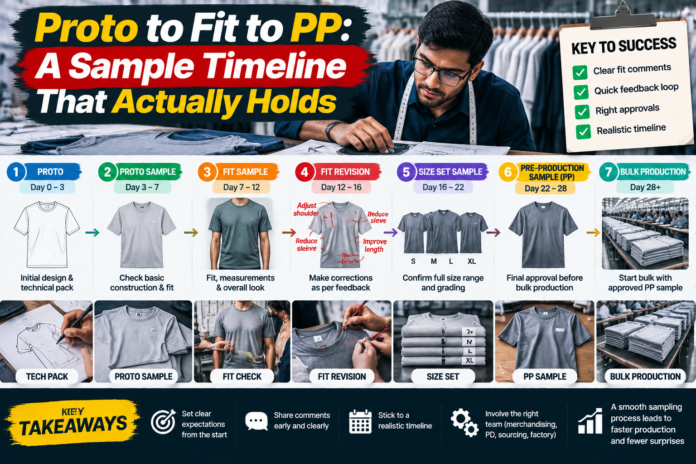
The proto sample — sometimes called the first sample — exists to answer one question: does this design actually translate into a real, three-dimensional garment the way it looked on paper or on a sketch? It’s rough by nature. Fabric might not be final. Trims might be placeholders. Its entire purpose is exploration, catching design problems early, before anyone invests real time refining something that might need to change shape entirely.
The fit sample answers a completely different question: does this garment actually fit a real body the way the spec sheet claims it should? This is where a fit model or fit technician gets involved, where sleeve length, chest ease, shoulder slope, and dozens of small measurements get checked against a living person, not just a spec sheet. A proto sample can look beautiful and still fail badly at the fit stage, because “does it look right flat on a table” and “does it fit correctly on a body” are genuinely different questions with genuinely different answers.
The PP sample, short for pre-production sample, answers a third and final question: if we made this exact garment, at bulk scale, using the actual approved fabric, actual approved trims, and actual approved construction methods, would it come out right? It’s the last checkpoint before bulk cutting begins, the sample that’s supposed to represent, as closely as possible, what thousands of units are about to look like.
Three different questions. Three different kinds of failure if something goes wrong. And Mahin had been planning all three as if they were identical, interchangeable blocks of time, just because they all had the word “sample” in the name.
Where Mahin’s Timeline Actually Broke
Once Iqbal bhai walked him through the distinction, Mahin went back and looked honestly at where his last three broken promises had actually gone wrong, stage by stage.
The proto stage had genuinely gone fine, most times. It was usually the fit stage where things quietly fell apart, and for a reason Mahin hadn’t clearly named before: fit comments depend on someone else’s calendar, not his factory’s. He’d been assuming buyer feedback would come back in two or three days, because that’s what had happened once, on one order, and he’d quietly treated that one lucky instance as the standard. In reality, fit comments from a buyer’s design or technical team routinely took closer to a week, sometimes longer if the comment needed internal sign-off from more than one person on the buyer’s side.
He’d been building his whole timeline around the fastest version of that step, not the realistic one. And when reality inevitably ran slower than his best-case guess, there was no cushion left anywhere else in the schedule to absorb it. Every single delay landed directly on the final PP date, because he’d never built in room for delay to exist at all.
The second real gap was smaller but just as costly: he’d been counting “PP sample sent” as the finish line, when the buyer actually needed “PP sample approved,” a different and later date, sometimes by several more days, depending on how quickly their comments came back. He was promising a date for an action, when what actually mattered to bulk cutting was a date for an outcome. Those two dates were never the same, and treating them as if they were had quietly cost him almost a week on every single order, without him ever noticing where the week had gone.
Building a Timeline Backward From What Actually Matters
Iqbal bhai’s method, the one he’d built over almost two decades of getting burned by exactly this problem, wasn’t complicated. It just started from the opposite end of the calendar than Mahin’s had.
Instead of starting from today and guessing forward — “proto should take about this long, then fit, then PP, and we’ll land somewhere reasonable” — he started from the date that actually mattered most: when bulk fabric needed to be cut, in order to hit the shipment date the buyer had committed to. That date doesn’t move. Everything else has to be built backward from it, with honest time estimates, not hopeful ones.
Working backward from that fixed cutting date, he’d block out real days for PP sample approval, not just PP sample dispatch, including a realistic buffer for the buyer’s review time, based on how that specific buyer had actually behaved on past orders, not on an average best-case guess. Before that, real days for fit revisions, plus the fit comment turnaround time, again based on real history with that buyer rather than hope. Before that, real days for the proto stage, including enough slack for at least one round of adjustment, because a design rarely survives its first physical sample completely unchanged.
And critically, at every single stage, a small built-in cushion — not because the sample room is slow, but because something always goes slightly wrong somewhere in a multi-week process involving several different people, several different departments, and at least one external party whose calendar the factory doesn’t control at all. A pattern master gets sick. A courier gets delayed. A buyer’s technical team takes an extra two days because of an internal holiday nobody on the factory side knew about. None of these individually are dramatic. All of them, unplanned for, add up to exactly the kind of slow bleed that had been eating Mahin’s timeline for three seasons straight.
The Buffer Isn’t Padding. It’s Honesty.
The idea of adding cushion time made Mahin uncomfortable at first, in a way he found hard to explain. It felt, somehow, like admitting his factory wasn’t fast enough, like he was quietly lowering the bar instead of confidently committing to a tight, impressive timeline.
Iqbal bhai’s answer to that stuck with him. “A buyer doesn’t actually want the fastest promise. They want the promise that’s true. You’ve already proven, three times, that the tight timeline isn’t true. A slightly longer date you actually hit is worth more to a buyer than a shorter date you keep missing.”
That reframing changed how Mahin thought about the whole exercise. Buffer time wasn’t him admitting weakness. It was him finally accounting, honestly, for parts of the process that were always going to take the time they took, whether or not his original email acknowledged it.
What the New Timeline Actually Looked Like
On the next order, Mahin built the schedule Iqbal bhai’s way, backward from the cutting date, with real buffers at each stage instead of best-case guesses.
The date he gave the buyer for PP approval was, on paper, four days later than what he would have promised the old way. He sent it feeling slightly nervous, half-expecting pushback.
None came. The buyer simply confirmed the date back, without comment, the way people do when a timeline looks reasonable rather than suspiciously optimistic.
And then something Mahin hadn’t fully expected happened: because he’d built in real buffer instead of hoping for the best, a two-day delay in fit comments coming back from the buyer’s side didn’t blow up his whole schedule the way it always had before. It simply used up part of the cushion he’d already planned for. The PP sample still went out on time. The buyer still approved it within the window Mahin had promised. For the first time in three seasons, he didn’t have to write an apology email.
The Real Lesson Buried in the Timeline
Looking back over those three broken promises, Mahin realized the honest problem had never really been speed. His sample room wasn’t unusually slow, and his team wasn’t unusually disorganized. The problem was that his timelines had been built on hope instead of history, optimism instead of evidence, and the gap between those two things had been quietly, predictably, showing up as a broken promise every single season.
A sample timeline that actually holds isn’t the one built around the fastest possible version of every stage going perfectly. It’s the one built honestly, backward from the date that truly matters, with real allowance for the parts of the process that depend on someone else’s calendar, and real acknowledgment that something, somewhere, in a multi-week, multi-department process, is going to take slightly longer than the best-case guess.
Mahin still wants to move fast. He still pushes his team to work efficiently at every stage. But he no longer confuses a hopeful date with a reliable one, and that single change, more than any improvement in actual sample-making speed, is what finally let him keep a promise he’d been quietly failing to keep for three seasons straight.