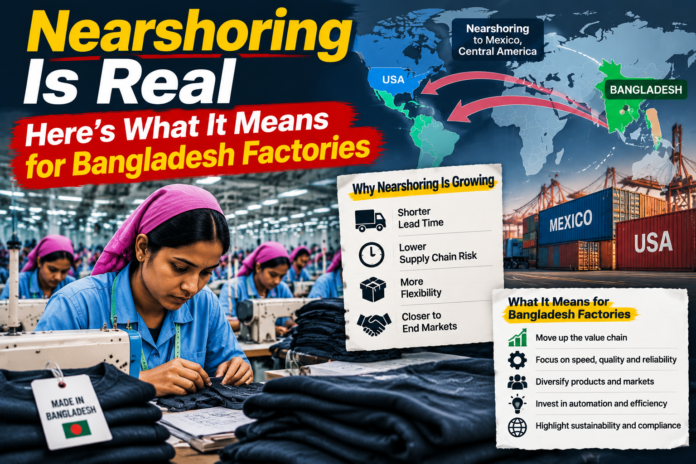

Mizan found out about the lost program from a slide in his own factory’s quarterly buyer review, of all places, not from any dramatic phone call or email. A recurring reorder line, a basic cotton fleece hoodie his factory had produced for a mid-size US retailer for almost three years straight, quiet and reliable, wasn’t on the forecast anymore. When he asked the buyer’s regional merchandiser about it, the answer came back simple and almost apologetic. “We’re testing this one out of Guatemala now. Faster replenishment. We’ll keep sending you the bigger seasonal drops.”
Mizan’s first reaction was the one a lot of people in his industry have when they hear a word like this. Nearshoring. He’d heard it mentioned at conferences, read it in a few trade articles, filed it away, vaguely, as a slow-moving trend affecting other people’s factories, in other product categories, not really his own reality. Watching one of his own steady programs quietly walk out the door to Central America made it feel a lot less theoretical.
He spent the following weeks actually digging into what nearshoring was, and more importantly, what it wasn’t, because the picture he found was considerably more specific, and considerably less alarming for his factory as a whole, than his first panicked instinct had assumed.
Nearshoring Isn’t Really About Being Cheaper
The first thing that surprised Mizan, once he actually looked into it properly, was that nearshoring’s main selling point isn’t cost. It’s speed. Brands moving production to Mexico, Central America, Turkey, or Portugal aren’t usually doing it because those countries are cheaper to manufacture in — in most cases, they genuinely aren’t. They’re doing it because goods made there reach the US or EU market dramatically faster.
A garment made in Mexico or Central America can reach the US market in three to four weeks using truck transport alone. A garment made in Bangladesh, by comparison, typically takes considerably longer once you add ocean transit time on top of production — in some cases, total lead time into a market like New York can stretch to more than twenty weeks when sampling, production, and shipping are all added together, against roughly six weeks for a nearshore option like Mexico, Morocco, or Turkey.
That gap in speed is the entire point of nearshoring. It’s not that Mexican or Turkish factories are undercutting Bangladesh on price — for basic cut-and-sew garments, total landed cost from Mexico or Central America can actually run five to twenty percent higher than the same product made in Asia. Brands are willing to pay that premium specifically for the replenishment and reorder programs where speed genuinely matters more than shaving a few cents off unit cost — a style that’s selling well and needs restocking on shelves within weeks, not months.
“That reorder program we lost,” Mizan realized, looking back at it honestly, “was never really about price. The buyer was managing a specific kind of risk — running out of stock on a fast-selling basic and having to wait twenty weeks to refill it. That’s exactly the kind of program nearshoring exists to solve.”
Where Bangladesh Still Wins, Clearly
The relief, once Mizan looked past that one lost line item, was that the broader picture wasn’t nearly as threatening as the initial scare had made it feel. Bangladesh remains one of the clearest cost leaders in the world for large-scale, commodity-level apparel production. For high-volume programs — generally anything above roughly ten thousand units per SKU — offshore production in Bangladesh still comes out meaningfully cheaper than nearshore alternatives, with Bangladesh’s CMT costs running some thirty to forty percent below Mexico’s at real production scale.
That’s not a small advantage, and it’s not one nearshoring is realistically positioned to erase anytime soon. The buyers moving programs to Mexico or Central America aren’t typically moving their big, confident, seasonal bulk orders — the ones Mizan’s factory still runs comfortably. They’re moving the smaller, faster, replenishment-driven slice of their business, where speed matters more than the last percentage point of cost.
Global sourcing data backs this up clearly enough. Bangladesh remains the world’s second-largest apparel exporter, and alongside China, Vietnam, India, and Turkey, still accounts for the large majority of total global apparel exports by value. Nearshoring, even with all its recent momentum, still represents a genuinely modest slice of total global apparel sourcing — real, growing, and worth paying attention to, but nowhere close to displacing Asia’s dominant position in volume terms.
The Tariff Swing That Changed the Math Again
Part of what had made nearshoring feel especially urgent over the past couple of years, Mizan learned, was a period of steep US tariffs that had briefly made Bangladesh-made goods significantly more expensive to import — at one point, a basic garment from Bangladesh carried tariffs high enough to meaningfully distort sourcing decisions, pushing some brands toward Mexico and Central America specifically to dodge that cost, not because nearshoring had suddenly become more attractive on its own merits.
A Supreme Court ruling earlier in the year had reshuffled that picture again, bringing Bangladesh’s tariff rate down sharply, restoring much of its earlier price competitiveness for basic garments and fast-fashion programs. Some of the volume that had shifted toward Mexico and Central America specifically to escape those earlier tariffs was, according to industry reporting, already being reconsidered and potentially routed back toward Asia once that pressure eased.
This was a useful reminder for Mizan, sitting with all of this new information: some of what looks like a permanent structural shift toward nearshoring is actually more reactive and situational than it first appears, tied closely to policy decisions that can shift again with relatively little warning. Buyers make sourcing decisions based on the conditions in front of them at the time, and those conditions, especially around tariffs, have proven considerably less stable in recent years than the underlying manufacturing economics ever were.
What’s Actually Real, and Worth Taking Seriously
None of this meant Mizan could simply shrug off the whole trend as overhyped, and he was careful not to let the relief tip into complacency. Some parts of the nearshoring shift are genuinely structural, not just reactive to short-term tariff swings.
Brands increasingly talk about multi-country sourcing as a deliberate risk-management strategy now, not just an efficiency choice — spreading production across at least three countries, with no single country holding more than roughly sixty percent of total volume, specifically to avoid the kind of concentrated exposure that made past disruptions, from pandemic shutdowns to labor unrest to tariff swings, so painful for buyers who’d built their entire supply chain around one or two countries. Under that kind of framework, a fairly common pattern industry-wide now looks something like a rough sixty-thirty-ten split — one primary sourcing country for volume, a secondary country for positioning or capability, and a smaller tertiary slice for nearshoring speed. Bangladesh, in that structure, usually still holds the primary volume role. But it’s no longer automatically the only name on a buyer’s sourcing map the way it might have been for some buyers a decade ago.
Fabric availability also shapes this more than Mizan had initially appreciated. Categories that source well from regional mills — certain cotton knits, denim, simple wovens, fleece — nearshore relatively easily to Mexico, Central America, and Turkey, because the fabric supply chain to support them already exists close by. Bangladesh’s advantage stays strongest specifically where the fabric itself is deeply rooted in Asian supply chains, meaning a switch to nearshoring would require shipping fabric across an ocean to a nearshore CMT operation anyway, largely erasing the speed benefit that made nearshoring worth considering in the first place.
What Mizan Actually Changed
Looking at his own factory’s specific product mix, Mizan realized the honest, useful question wasn’t “is nearshoring a threat to Bangladesh,” a question too broad to actually act on. It was “which specific parts of my own order book look like the kind of program that nearshoring is actually built to serve — and how much of that am I currently carrying.”
Going through his client list carefully, he found that the lost hoodie program had genuinely been an outlier in his portfolio, not a warning sign about his other business. Most of his factory’s volume sat in exactly the kind of large, seasonal, higher-quantity bulk programs where Bangladesh’s cost advantage at scale remained genuinely difficult for any nearshoring alternative to match. But a small handful of other accounts, he realized, looking honestly at their order patterns, did carry the same fast-replenishment profile as the one he’d just lost — frequent smaller reorders, driven by real-time sell-through data, exactly the kind of program where a buyer’s calculus might reasonably tip toward speed over cost, the same way it clearly had with that hoodie.
Rather than treating every buyer relationship identically, he started having a more honest, specific conversation internally about which accounts sat in which category — the safe, high-volume seasonal bulk business that nearshoring wasn’t realistically going to touch, and the smaller, replenishment-heavy pieces genuinely exposed to this shift. For that second, smaller category, he started exploring, cautiously, whether there was a legitimate case for his factory investing in faster internal turnaround specifically for those styles — tighter sample-to-bulk timelines, pre-approved fabric held in stock for known fast-movers, anything that could meaningfully close even part of the speed gap nearshoring was built to exploit, without pretending Bangladesh could ever fully match a Central American factory’s three-week truck route into the US.
The Reassurance That Came With Real Numbers
What ultimately settled Mizan’s nerves wasn’t optimism for its own sake. It was actually looking at the numbers honestly, rather than reacting to a single lost program as if it represented the whole industry’s direction. Bangladesh’s fundamental position — as one of the world’s largest, most cost-competitive sources for high-volume basic apparel — hadn’t meaningfully eroded. What had changed was that a specific, identifiable slice of global sourcing, the fast-replenishment, speed-sensitive slice, had genuinely found a better home elsewhere for buyers willing to pay a premium for it.
That’s a real shift, worth watching and worth adapting to where it actually touches a factory’s real business. It’s not the same thing as Bangladesh losing its place in the broader industry, and treating every lost account as proof of some sweeping, existential threat would have pushed Mizan toward exactly the kind of overreaction that wastes energy on the wrong problem.
What This Means Going Forward
Mizan still thinks about that lost hoodie program sometimes, not with resentment toward the buyer, who was simply making a reasonable decision for their own business, but as a useful marker of where his industry’s edges actually sit now. Bangladesh isn’t losing the war for global apparel manufacturing. It’s losing, selectively, a specific kind of order — small, fast, reorder-driven — to countries genuinely better positioned geographically to serve it quickly, while holding firm, and in many cases growing, in the large-scale, cost-sensitive volume business that has always been its core strength.
The merchandisers and factory owners who’ll navigate this well, Mizan has come to believe, aren’t the ones either dismissing nearshoring as irrelevant hype or panicking as if it threatens their entire order book equally. They’re the ones doing what he eventually did — looking honestly at their own specific mix of buyers and programs, understanding exactly which parts of that mix are genuinely exposed to this particular shift, and building real, targeted responses for those parts, while continuing to compete, confidently and on solid ground, in the large-scale volume business that nearshoring was never really built to take away in the first place.