
The question came near the end of the meeting, almost as an afterthought.
Shirin had spent forty minutes walking the buyer’s team through a spring program: fabric quality, trim approvals, a lab dip that had finally matched. Everything was going smoothly. Then the compliance manager, who had barely spoken, looked up from her notes.
“One more thing,” she said. “For the deliveries that land after 2028, which preference scheme are you shipping under? And what’s the origin rule you’re relying on?”
Shirin had been a merchandiser for eleven years. But the question hung in the air, and she realised she knew the name of the scheme without really knowing how it worked, who held the paperwork, or what would happen to her costing if the rules changed.
“Let me come back to you on that,” she said. It was the honest answer. It was also a little embarrassing.
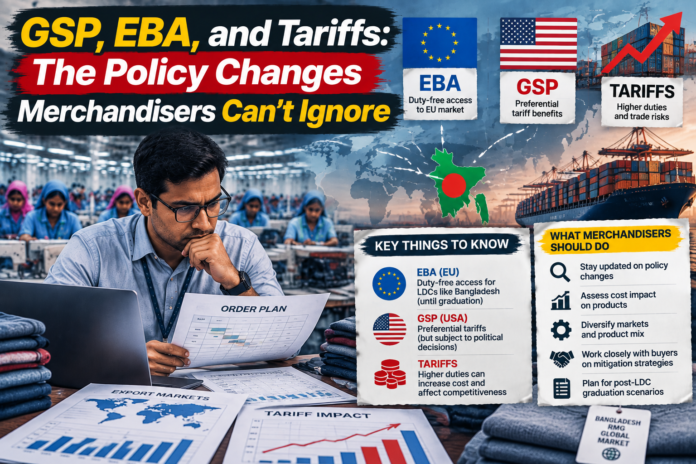
On the drive home she kept turning it over. For years, “duty” had been somebody else’s department. The buyer worried about it, the shipping team handled the certificates, and merchandisers got on with the product. That division of labour is breaking down. The rules that decide what a garment pays to cross a border are now moving fast enough to change who gets an order, at what price, and with how much margin left over.
This article is for every merchandiser who has nodded along when someone said “GSP+” or “EBA” or “Section 301” and quietly hoped nobody would ask a follow-up.
The alphabet soup, in plain language
MFN is the normal duty a country charges on imports when no special deal applies. For apparel entering the EU, one recent analysis puts it at 12 percent.
GSP is the EU’s Generalised Scheme of Preferences, reduced duties for developing countries. Under the standard tier the duty comes down but not to zero: the same analysis puts apparel at 9.6 percent.
GSP+ is the more generous middle tier, with zero duty on apparel but conditions about international conventions and tough technical rules.
EBA, Everything But Arms, is the top tier, reserved for Least Developed Countries (LDCs). It gives duty-free, quota-free access, and it helped build Bangladesh’s garment industry.
LDC is the UN category of the world’s poorest economies. Bangladesh is due to leave it on 24 November 2026, which is why all of this suddenly matters.
Rules of origin decide whether a garment “counts” as coming from Bangladesh for the purposes of a preference. This is the technical heart of the story, and it’s where merchandisers actually have influence.
Section 301 and TRQ belong to the United States, which doesn’t use GSP for Bangladesh.
The one-line version: the EU gives Bangladesh duty-free access because it’s an LDC. When that status changes, the access changes. The question is how, when and under what conditions.
Why a merchandiser should care
Duty is part of the buyer’s landed cost, and buyers compare landed cost between countries every time they place an order. A few percentage points can swing an allocation, and you won’t be told why. You’ll just see a smaller PO.
On a $3.20 T-shirt, 12 percent duty is about 38 cents. At 9.6 percent it’s about 31 cents. At zero, nothing. Thirty-one cents is more than the 19-cent profit a thin-margin factory might make on that shirt. When duty rises, buyers try to recover it, by moving volume or pressing you to absorb part of it.
Part one: the EU and 24 November
Where graduation stands
Bangladesh is scheduled to graduate from LDC status on 24 November 2026 and has asked the UN for a three-year deferral. The UN’s expert committee found an extension appropriate, though it suggested a shorter one might be the right length. A UN committee is set to discuss the request on 7 October, with the General Assembly expected to decide before 24 November. Bangladesh’s commerce secretary has said that without consensus the request would need a two-thirds majority. If approved, Bangladesh remains an LDC until 24 November 2029.
Even without a deferral, the EU has promised a three-year transition after graduation, keeping EBA benefits until around the end of 2029. So nothing changes in EU duty on 25 November. The cliff is further out. One open question: if graduation is deferred to 2029, does the EU’s transition clock start from that later date? I haven’t seen it answered clearly, so it’s worth confirming with your buyer’s compliance team or BGMEA.
What replaces EBA
When the transition ends, Bangladesh has to fit into the EU’s other tiers, governed by a new regulation. The EU adopted its new GSP Regulation, 2026/1395, in June 2026, applying from 1 January 2027 to the end of 2036. It also tightens conditions: the possibility of suspending preferences now extends to environmental, climate and governance conventions. For factories, compliance and sustainability evidence is moving from buyer preference to condition of market access.
Two obstacles decide Bangladesh’s future in Europe.
The graduation threshold. The scheme removes a product group from preferences once a country supplies too large a share of the EU’s GSP-covered imports in that category. One Daily Star analysis says that for apparel, the threshold falls from 47.2 to 37 percent. With Bangladesh’s share estimated near 50 percent, it concludes apparel would lose standard GSP preferences and revert to full MFN, and that GSP+ is effectively out of reach too. I need to be careful here, because not every analyst reads the final text the same way. Another commentary says the revised regulation removes the import-share safeguard that would have blocked Bangladesh even with GSP+. Both can’t be fully right, so treat any confident claim, including mine, with caution and ask someone who has read the regulation itself.
Double transformation. Under EBA, LDCs benefit from a flexible “single transformation” rule: import fabric, cut and sew in Bangladesh, and still qualify. Under GSP+, a stricter “double transformation” rule applies, meaning more of the production chain has to happen locally. For a woven shirt, the fabric itself, not just the stitching, must be made in the country or come from an approved source.
This hits the two halves of the industry very differently. Knitwear, where yarn, knitting, dyeing and sewing are often in the same country, is in decent shape. Woven garments are different: the garment makers’ association has said the industry relies on about 60 percent imported woven fabric.
Here is where it lands on a merchandiser’s desk. A decision you make routinely, local or imported fabric for a style, could soon decide whether that style qualifies for a duty preference. That’s no longer just a price and lead-time question. It’s a customs question.
Part two: the other markets
The picture elsewhere is more comforting. The UK has its own scheme, the Developing Countries Trading Scheme. A letter reported in the Financial Express says Bangladesh keeps its market access for three years after graduation, then moves to the Enhanced Preferences tier, with garment access under chapters 61 and 62 unchanged. That’s good news, though an ADB report suggests garments under Enhanced Preferences may require double transformation, so check the origin rules for your products. Canada, Australia and Japan are also reported to offer some continued access, worth verifying product by product.
So the real concentration of risk is Europe and the origin rules attached to its replacement schemes.
Part three: the United States, where preferences don’t apply
The US doesn’t give Bangladesh a GSP-style preference on garments, and its duties have been a rollercoaster. In February 2026 the two countries signed a trade agreement lowering the reciprocal tariff to 19 percent, with a promise of zero tariff on a capped volume of textiles and apparel linked to US cotton and man-made fibre. Then the Supreme Court ruled the emergency-powers tariffs unconstitutional. A temporary 10 percent surcharge took their place, and when it expired on 24 July, new Section 301 tariffs took effect.
Under the new system Bangladesh and India face 10 percent, while Vietnam faces 12.5 percent. There is also a plan for tariff-rate quotas on textile and apparel imports from Bangladesh, Cambodia, Indonesia and Malaysia, lasting an initial three years and tied to each economy’s imports of US-origin cotton and textile goods. Until the quotas are set up, the 10 percent rate applies.
Two things stand out. The gap between Bangladesh and Vietnam is only 2.5 points, about eight cents on a $3.20 T-shirt, but that’s exactly the sort of difference that shows up in allocation decisions. And the quota mechanism rewards US cotton, which could connect your spinning mill, your fabric buyer and your merchandiser directly to a tariff outcome. The details are still to be specified, so don’t build a costing on it yet, but keep an eye on it.
What it means for the costing sheet
Most costing sheets treat duty as the buyer’s problem. That is increasingly out of step with how buyers decide. You don’t need to price in the buyer’s duty, but you do need to see how your offer compares once it’s added. For each important buyer, sketch three scenarios.
| Scenario | EU duty | What it means |
|---|---|---|
| Today (EBA) | 0% | Current pricing logic holds |
| Standard GSP | about 9.5–9.6% | Buyer’s landed cost rises; expect price pressure |
| Full MFN | about 12% | Largest gap; other countries become attractive |
Then ask which styles stay competitive in each case, and which depend on zero duty to make sense at all. You may find knit basics with a strong local chain are safe, while woven items made with imported fabric are exposed.
A practical checklist
Know your scheme. For each major buyer, find out which preference scheme their shipments enter under, and who holds the origin documentation. If the answer is “I’m not sure”, that’s your first task.
Map your fabric origins. For your top styles, record where yarn and fabric come from, and flag anything woven and imported. When the rules tighten, this map becomes the foundation of any compliance discussion.
Keep clean records. Origin claims depend on paperwork, from yarn invoices to fabric purchases.
Build duty scenarios into pricing conversations. You don’t have to cover a duty you don’t pay, but on long-range programs you should be able to discuss how different outcomes change the picture, and perhaps agree how any change is shared.
Watch the dates.
| Date | What happens |
|---|---|
| 7 October 2026 | UN committee discusses the deferral request |
| Before 24 November 2026 | General Assembly decision expected |
| 24 November 2026 | Scheduled LDC graduation (unless deferred) |
| 1 January 2027 | EU’s new GSP Regulation starts applying |
| Around November 2029 | End of the EU’s transition (confirm if deferral changes this) |
| To be set | US tariff-rate quotas for textiles |
Talk to the right people. Your trade association, customs team and buyers’ compliance staff know things you don’t. A fifteen-minute conversation can save you a surprise.
The limits of what anyone knows
The UN decision hasn’t been made. The EU regulation is published, but analysts read its effect on Bangladesh’s apparel differently, and practical details will come through delegated acts and guidance. The US quota system is still being built. None of this is legal or customs advice. It’s a map of the terrain as of early October 2026, and parts of it will have moved by the time you read this. Verify the specifics for your own products and markets before relying on them in a quote.
Back to Shirin
A week after that meeting, Shirin did something she’d never done before. She asked her shipping manager to sit down with her for an hour, and together they built a single page. Down the left side, her top ten styles. Across the top, four columns: main market, scheme used today, where the fabric comes from, and what happens to the duty if the rules change. A few cells just said “check”. But for the first time she could see at a glance which parts of her business were sturdy and which depended on a rule she didn’t control.
When she went back to the compliance manager, she didn’t have every answer. But she had a page, a plan and questions of her own. The compliance manager smiled for the first time in the meeting. “Most suppliers just say they’ll get back to us,” she said. “Nobody has ever sent us a map.”
Policy will keep changing, and nobody can predict every twist. But the merchandisers who understand it, even roughly, will be the ones who can answer when the question comes. In a world where buyers quietly compare every country and every duty line, being the supplier who can answer is an advantage no tariff can take away.