
The salesman had left an hour ago, but the brochure was still sitting on Jashim’s desk, and he kept picking it up and putting it back down, the way you do when a decision feels bigger than the paper it’s printed on.
Automatic pocket-setting machines. Eight units, enough to convert one full line. The demo had been impressive — faster, more consistent, fewer defects than the manual operation his line was currently running. The salesman’s numbers looked good too, on paper. Payback in fourteen months, he’d said, tapping his own calculation sheet with confidence. Jashim, who managed machinery investment decisions for a mid-size woven factory, had heard numbers like this before, from other salesmen, for other machines. Some of those past purchases had genuinely paid off. A few, quietly, hadn’t, in ways that never quite made it into anyone’s year-end report.
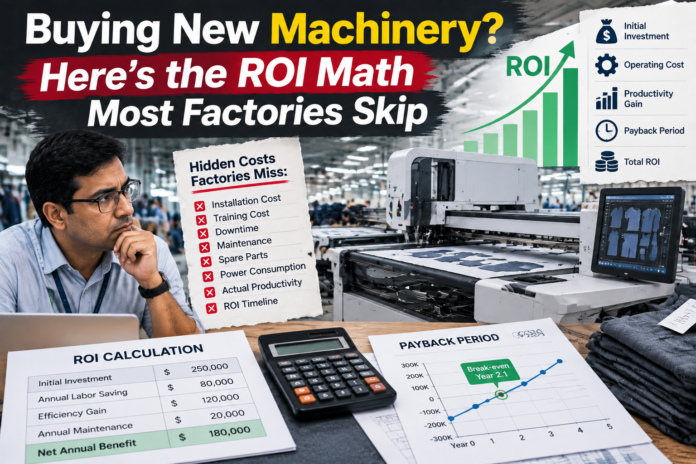
He decided, this time, before signing anything, to actually sit down and build the ROI math himself, from scratch, instead of trusting someone else’s version of it. What he found, working through it properly, taught him more about how his factory had been making these decisions for years than he expected.
The Number the Salesman Led With
The salesman’s math was simple, the kind of math that fits neatly onto a single slide. Eight machines, a total cost, and a labor savings figure based on replacing a certain number of manual operators with a smaller number of machine operators, since each automatic unit could handle output that previously required more hands.
Labor savings per month, divided into total machine cost, gave the fourteen-month payback period. Clean, straightforward, and, Jashim eventually realized, missing almost everything that actually determines whether a machine purchase is a good decision.
What “Labor Savings” Actually Left Out
The first gap Jashim found was in how narrowly “savings” had been defined. The salesman’s number compared old labor cost against new labor cost, full stop. It didn’t touch the training time needed to get his existing operators comfortable on entirely new equipment — genuinely comfortable, not just able to press the buttons, but skilled enough to hit the output numbers the salesman’s demo had shown.
Jashim talked to his production manager, who’d overseen a similar transition two years earlier on a different line, and got an honest answer: real proficiency, matching demo-level speed and defect rates, had taken close to six weeks, not the “operators will adapt quickly” line the salesman had casually mentioned. During those six weeks, output ran below both the old manual method and the new machine’s eventual full capability — a genuine dip, in the exact window the salesman’s payback calculation assumed was already running at full efficiency.
Six weeks of reduced output, on a line producing a meaningful volume daily, wasn’t a rounding error. It was real cost, sitting quietly in the gap between “machine installed” and “machine actually delivering its promised output,” a gap the fourteen-month payback number had never once mentioned.
The Maintenance Cost Nobody Priced In
The second gap was maintenance, and this one Jashim found almost by accident, calling a factory owner he knew who’d bought similar equipment from a different supplier two years prior.
“Ask about the service contract,” the owner told him, somewhat wearily. “And ask what happens after year one, when the free service period ends.”
It turned out the machines required a specific maintenance schedule, parts that weren’t always available locally, sometimes needing to be imported with real lead time if something failed. The first year often came with a service agreement included in the purchase price, quietly making that year’s true operating cost look lower than every year after it. From year two onward, ongoing maintenance, spare parts, and occasional technician call-outs added a real, recurring cost that the salesman’s payback slide, understandably from his position, hadn’t emphasized.
Jashim went back through the actual maintenance spending on his factory’s existing automated equipment, purchased a few years earlier, and found the annual maintenance cost ran to a real, non-trivial percentage of the original machine price, every single year, indefinitely. That number, spread across the machine’s realistic working life, changed the payback math meaningfully once it was actually included instead of assumed away.
Downtime: The Cost That Only Shows Up When Something Breaks
The third gap was harder to estimate precisely, but too important to leave out entirely: downtime risk. A manual operation, when something goes wrong, usually has some flexibility — another operator can sometimes step in, or the work can be redistributed, imperfectly but functionally, while a fix happens. A specialized automatic machine, when it breaks down and the right part or technician isn’t immediately available, often means that specific operation simply stops, with no easy manual fallback for a process specifically designed to remove the manual step in the first place.
Jashim’s factory owner friend had a downtime story of his own — a control board failure on a similar machine, three years earlier, that took nine days to resolve, because the replacement part had to be imported and customs clearance ran slower than expected. Nine days of that specific operation running at reduced capacity, or not at all, is real cost, and real risk to shipment dates, that a clean fourteen-month payback slide has no way of representing, because it assumes, implicitly, that the machine simply always works.
This didn’t mean the machine was a bad idea. It meant the true math needed some allowance for this kind of risk, rather than assuming, the way default payback calculations quietly do, that equipment performs perfectly, every single day, for its entire working life.
Currency and Import Costs, Landed Properly This Time
The fourth gap was one Jashim recognized immediately, because it echoed something Shuvo had learned the hard way about trim costing, on a completely different scale. The salesman’s total machine cost was quoted in the machine’s country of origin currency, converted to taka at a snapshot exchange rate on the day of the quote. It didn’t include import duty, shipping, installation, or the very real possibility that the exchange rate would move between quote date and actual payment date, months later, once financing and paperwork were finalized.
Jashim went back through his factory’s actual landed cost on its last major machinery import and found the gap between the quoted price and the true landed cost ran to a real, meaningful percentage on top — duty, freight, installation labor, and a currency shift that had moved against them during the gap between quote and final payment. None of that was dishonest on the supplier’s part. It’s simply not what a supplier’s quoted price is designed to represent. But it’s exactly the kind of gap that quietly inflates a payback period well beyond what the original slide promised, the moment someone actually adds it in.
Building the Real Number, From Scratch
Once Jashim had identified all four gaps, he rebuilt the ROI calculation himself, this time including everything the salesman’s version had left out.
He started with the true landed cost of the eight machines — quoted price plus duty, freight, and installation, not the quoted price alone. He adjusted the labor savings calculation to account for a realistic six-week efficiency ramp-up, during which output would run below both the old and new method’s steady-state numbers, rather than assuming full savings from day one. He added an ongoing annual maintenance cost, based on real data from his factory’s existing equipment, rather than assuming the free first-year service contract represented an accurate ongoing figure. And he built in a modest allowance for downtime risk, not as a precise number, since that’s genuinely hard to predict, but as an honest acknowledgment that specialized equipment occasionally fails in ways manual operations can partially absorb and automated ones sometimes cannot.
The result: instead of a fourteen-month payback, his honest number came out closer to twenty-two months. Not a rejection of the purchase — twenty-two months was still, by his factory’s own internal standards, a reasonable payback period for equipment with this kind of working life ahead of it. But it was a genuinely different number than what had been presented to him, and it was the number he actually trusted enough to bring to his factory owner for a final decision.
Why the Real Number Still Led to a Yes
Here’s the part of the story that matters just as much as finding the gaps: Jashim’s honest math didn’t kill the purchase. His factory owner looked at the twenty-two-month number, asked a few clarifying questions about the maintenance and downtime assumptions, and approved the purchase anyway, because even at twenty-two months, the machines still made clear financial sense over their realistic working life, and the quality improvement the demo had shown carried its own real value beyond pure labor savings, in fewer buyer complaints and rejected pieces.
What changed wasn’t the outcome. It was the confidence behind it. Jashim wasn’t walking into a purchase hoping a salesman’s optimistic slide would hold up in practice. He was walking in with a number he’d built himself, stress-tested against his own factory’s real history with similar equipment, that he could defend honestly if anyone asked him to explain it a year later.
What This Means for the Next Machinery Decision
Jashim didn’t turn this into an elaborate, months-long financial modeling exercise for every future purchase — most machinery decisions in a factory don’t need that level of depth, and demanding it every time would slow the business down more than it would protect it. But he did build a short, honest checklist for himself, one he now runs through before trusting any supplier’s payback number at face value.
Does the labor savings calculation account for a realistic ramp-up period, or does it assume full efficiency starting on day one, the same mistake Tariq had learned to catch in his own CMT costing. Does the total cost reflect the true landed price — duty, freight, installation, realistic currency movement — or just the quoted factory-gate number. Is there an honest, ongoing maintenance cost built in, based on real historical data from similar equipment, not just the artificially low first-year figure that often comes bundled with a free service contract. And is there some reasonable allowance for downtime risk, acknowledging that specialized machines, unlike flexible manual labor, sometimes have no easy fallback when something breaks.
The Real Lesson in the Fourteen-Month Slide
Looking back at that brochure still sitting on his desk, Jashim didn’t think the salesman had lied to him, exactly. The fourteen-month number wasn’t fabricated — it was simply built around the narrowest possible definition of cost and savings, the version that makes any machine look its most attractive, because that’s the version salesmen are naturally incentivized to present.
The responsibility for catching everything that number left out was never really the salesman’s. It was Jashim’s, as the person whose factory would actually live with the real consequences of that purchase for years, long after the demo, the brochure, and the salesman’s confident tapping on his own calculation sheet were all long forgotten. A payback period is only as honest as everything someone chose to include in it, and the gaps between an impressive slide and an actually reliable number are almost always exactly where the real ROI math is quietly hiding, waiting for someone patient enough to go looking for it.