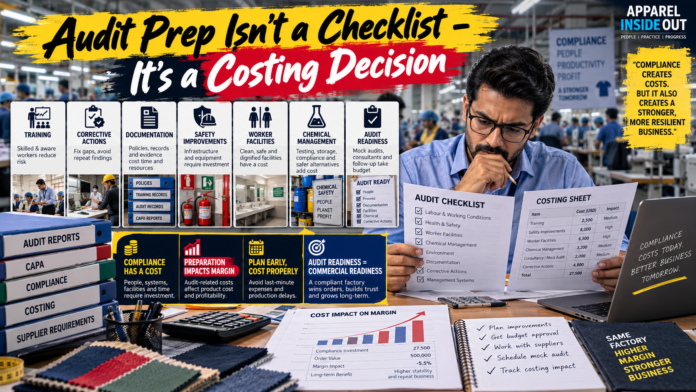

The audit notice arrived on a Monday, and by Tuesday morning the whole factory had changed shape.
Sabina noticed it first on the production floor. Two painters were touching up the yellow walkway lines that had faded months ago. A maintenance team was replacing exit signs. Someone in HR was frantically pulling together attendance sheets, and the compliance manager had moved a printer into his office so he could stay at his desk through the night.
Sabina was a senior merchandiser, and none of this was officially her job. But she had a buyer’s order of 80,000 pieces sitting in sewing, due to ship in twelve days, and she knew exactly what an audit finding could do to it.
On Wednesday she asked the compliance manager how things looked. He gave her a tired smile and held up a thick folder. “We’ll be fine. We have the checklist.”
The audit lasted two days. The walkways were perfect. The exit signs were lit. The fire drill went smoothly. Then the auditor sat down with three months of payroll, attendance and production records, laid them side by side, and asked a quiet question: “Can you explain why this line produced 1,400 pieces on a day when the overtime register says nobody worked past six?”
Nobody could. Because it wasn’t an error. Three weeks earlier, a rush request had come in, a buyer wanting an earlier ship date, and the factory had said yes. The lines had run late. The registers had been quietly tidied afterwards.
The report came back with a serious finding on working hours and records. The buyer placed the order on hold pending a corrective action plan.
Sabina sat at her desk that evening with an uncomfortable realisation. The checklist had been perfect. The audit had been failed anyway. And one of the decisions that caused it had been made at her own desk, when she said yes to the rush.
Why checklists fail
A checklist treats audit readiness as a list of things to have: exit signs, fire extinguishers, policies on the wall, forms in the folder. Those matter. But modern audits aren’t mainly looking at whether you have things. They’re looking at whether your factory’s records, practices and people tell the same story.
An experienced auditor cross-checks. Payroll against attendance. Attendance against production output. Production against order quantities and shipment dates. Interviews with workers against what management says. If the paper tells one story and the floor tells another, the gap is the finding.
That’s why last-minute preparation backfires. You can repaint a walkway in a night. You can’t rebuild three months of consistent records. A factory that treats audits as an event can fix the visible things and still fail on the invisible ones, because the invisible ones are produced by how the factory runs every day.
And how a factory runs every day is largely decided by orders, prices, lead times and capacity. Which means audit readiness is, at its root, a commercial question.
The three bills
Every factory pays for compliance in one of three ways, whether it admits it or not.
The steady bill is what it costs to run a compliant factory all year: compliance staff, training, safety equipment and maintenance, drills, welfare facilities, worker committees, record systems, and the audits and certifications themselves. It’s predictable, it spreads across the whole year, and it can be costed.
The scramble bill is what it costs to cram for an audit: overtime to repaint and repair, consultants brought in at short notice, production lost while lines are stopped for fixes, and the management attention burned in a week of panic. It’s more expensive per unit of improvement, and it only fixes the surface.
The failure bill is what it costs when the audit goes wrong: shipments on hold, discounts demanded, re-audit fees, corrective action plans, lost orders and, worst of all, a buyer’s loss of trust.
Here is an illustration, with numbers built to be realistic but not drawn from any real factory. Say a factory produces 1.2 million pieces a year and spends $96,000 annually on its steady compliance programme: compliance team salaries, audit and certification fees, safety maintenance and drills, training, welfare and committees, and documentation. That works out to 8 cents a piece.
| Scenario | Cost on an 80,000-piece, $256,000 order |
|---|---|
| Steady bill (8 cents a piece) | about $6,400 |
| Scramble bill (typical last-minute fixes) | perhaps $5,000–$10,000, and the root problem remains |
| Failure bill (two-week hold, 5% discount demand, re-audit) | $13,000 or more, plus damaged trust |
The exact numbers will differ everywhere. The pattern won’t. Steady spending is the cheapest of the three per order, and it’s the only one that actually builds a factory that passes. The scramble is a cost without a return, and the failure is usually larger than a year of prevention.
Yet most factories only budget for the first bill when they’re quoting, and often not even that. The scramble and the failure appear later as “unexpected” costs. They were never unexpected. They were just unpriced.
Where merchandisers leave fingerprints
Here’s the part that most compliance conversations skip. Many of the findings that fail audits are born in the merchandising office, not on the factory floor.
Lead times. When a buyer asks for a shorter lead time and a merchandiser says yes without checking capacity, the factory has one way to deliver: longer hours. Excessive overtime is among the most common audit findings, and it is created by an order decision, not a labour decision.
Capacity booking. Accepting more orders than a compliant schedule can carry in the same weeks is the same problem in slow motion. Peak-season overbooking doesn’t show up on the order sheet. It shows up in the working-hour records.
Subcontracting. When the factory is overloaded, the tempting shortcut is to send part of an order to another unit. Unauthorised subcontracting is something buyers treat very seriously, because it moves their product into facilities they haven’t approved or audited. The temptation starts at the same moment as the rush.
Price pressure. A price set below the cost of running a compliant factory has to be recovered somewhere. It tends to come out of wages, safety maintenance, training or the very record-keeping that audits examine.
Records. Order quantities, production plans, shipment dates and working hours all have to tell the same story. If the T&A promised the impossible, the records will show it eventually.
Sabina’s rush acceptance wasn’t a compliance decision when she made it. It was a commercial decision to please a buyer. It became a compliance failure three weeks later because nobody had priced it, and nobody had checked what it would do to working hours.
Putting compliance into the costing
If audit readiness is a costing decision, the fix starts in the costing sheet.
Give compliance its own line. In the cost breakdown of a basic T-shirt I used 8 cents for testing and compliance, plus a share of admin overheads. Your number will differ, but it should exist and it should be visible. Calculate your annual steady compliance spend, divide it by expected annual output, and put the result in every quote. A buyer can negotiate a number. They can’t negotiate a line you never showed.
Cost capacity at compliant hours. Work out your real capacity based on the working hours your law and your buyers’ codes allow, not on what the lines could produce if people worked indefinitely. Then quote and plan against that. A factory that sells capacity it can only deliver through excessive overtime is borrowing from its next audit.
Price the rush. A shortened lead time isn’t free. It has a cost in extra shifts, extra people, extra air freight or a larger buffer. Put a number on it, and if the buyer wants the earlier date, show the cost of reaching it within compliant hours. Sometimes the answer will be a split shipment. Sometimes it will be a polite no.
Budget for remediation. Findings will appear in even good factories. Keep a modest, standing fund for fixes so that a finding becomes a planned expense instead of an emergency.
Making readiness a daily habit
None of this means abandoning the checklist. It means moving it from an event to a rhythm.
Run mock audits, quietly and often. A monthly internal review, done by someone who doesn’t report to the production manager, finds problems when they’re cheap. The goal is to be bored by the real audit.
Reconcile the records weekly. Compare production output, attendance and overtime for each line. If a line’s output doesn’t match its hours, find out why that week, not three months later in front of an auditor.
Link the order book to the compliance calendar. Before accepting a rush or a peak load, check the planned hours for the weeks involved. A simple capacity sheet showing hours per line against the compliant limit gives merchandisers a quick way to say yes, no, or “yes, if”.
Fix root causes, not symptoms. If overtime keeps creeping up, the question isn’t how to record it better. It’s why the lines are consistently overloaded, and whether the orders, prices or planning are the cause.
Make someone own it. Compliance can’t live only in the compliance manager’s office. Merchandising, planning, HR and production all produce the evidence an auditor reads. Shared ownership, with merchandising at the table, changes the quality of the decisions.
Talking to buyers
This last part makes people nervous, but it matters. Buyers ask factories to be compliant, and many are serious about it. They also, sometimes, ask for shorter lead times, lower prices and more flexibility in the same email. Those requests can pull in opposite directions.
A merchandiser who can show the numbers is in a much stronger position. “Reaching this ship date within compliant hours would require a split shipment or an extra $X” is a very different conversation from “we’ll try”. It shows the buyer the trade-off they’re asking you to make, and many buyers would rather know than discover it in an audit report.
It also helps to raise audit fatigue early. If a factory faces many separate audits from different buyers, each with its own checklist and timing, the combined cost is real. Asking whether a buyer can accept a recent audit by another recognised programme, where their policy allows it, can save both sides time and money. Not every buyer will agree, but the question is reasonable.
The honest limits
None of this guarantees a clean audit. Standards differ between buyers and programmes. Auditors differ too. Some findings come from things outside any merchandiser’s control, such as building age, local infrastructure or a single worker’s interview. And the figures in this article are illustrative, so build your own from your own spending.
I’m also not saying commercial pressure disappears. Buyers will still push on price, and factories will still make trade-offs. What changes is that the trade-off is made on purpose, with the cost visible, instead of by accident.
Back to Sabina
The hold stayed on the order for nine days. The corrective action plan took two weeks of work, and the buyer eventually released the shipment with a price concession that stung. Sabina didn’t need anyone to tell her what the real cost had been.
Afterwards she did something unglamorous. She sat down with the compliance manager and built a one-page capacity sheet: hours per line per week against the compliant limit. From then on, every rush request went through it before she replied. She added a compliance line to her costing template, and she started attaching a short note to quotes showing what a shortened lead time would require.
Six months later, the buyer’s team asked for another early shipment. This time she answered within the hour. “We can do it within compliant hours if we split the shipment,” she wrote. “Here’s what each option looks like.” The buyer chose the split.
The next audit was quiet. The auditor spent less time on the records than the previous one had, because nothing in them needed explaining. Nobody painted a walkway the night before.
That’s what changed. Audit preparation stopped being something the factory did in the week before a visit, and became something it did every time it quoted, planned and said yes. The checklist is still there, and it still matters. But the factories that pass consistently learn the same thing in the end: you don’t prepare for an audit. You price, plan and run the factory in a way that has nothing to hide.