
The visitor from the buyer’s head office had been in the factory for two days, and he had asked one question four times in four different ways.
Farhan was a junior analyst on the buyer’s costing team. He had a notebook, a polite manner and a target price of $2.85 for a plain crew-neck tee. Faisal, the merchandiser hosting him, had quoted $3.20. They had been politely circling that 35-cent gap since lunch.
“I’m not trying to squeeze you,” Farhan said, and he meant it. “I just want to understand where the money goes. If I can’t explain your number to my boss, I can’t defend it.”
Faisal wiped a clean rectangle on the whiteboard behind Farhan and drew a rough T-shirt in the middle.
“Okay,” he said. “Let’s follow the shirt. From the cotton to the carton. Every cent.”
An hour later the whiteboard was full, and something had shifted. The gap hadn’t closed. But for the first time the two of them were arguing about the same numbers instead of each other’s price.
That’s what a good cost breakdown does. It doesn’t win the negotiation by itself. It changes the question from “your number is too high” to “which of these lines can move, and what does moving it do to the product?” This article is that whiteboard.
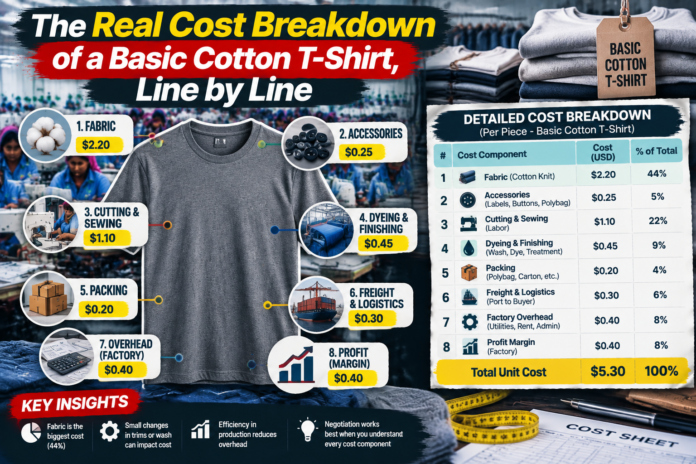
The shirt we’re costing
The shirt is a plain crew-neck tee in 180 GSM single jersey cotton, solid colour, with a simple label and polybag. Fabric consumption is about 219 grams per piece, including cutting wastage. The factory is in Bangladesh, the buyer is in Europe, and the price is FOB.
One thing I want to say clearly: these numbers are illustrative. They’re built to be realistic and internally consistent, not to describe any real factory. Your yarn, wages, energy bill and commission arrangements will differ. Treat the shape of the breakdown as the lesson, and plug in your own figures.
| Line | Cost per piece | Share of FOB |
|---|---|---|
| Yarn (including process loss) | $0.91 | 28.4% |
| Knitting | $0.10 | 3.1% |
| Dyeing and finishing | $0.35 | 10.9% |
| Fabric subtotal | $1.36 | 42.5% |
| Trims and packing | $0.21 | 6.6% |
| Cut and make (all-in) | $0.80 | 25.0% |
| Admin, sampling and overheads outside CM | $0.20 | 6.3% |
| Finance cost | $0.08 | 2.5% |
| Commercial and logistics to port | $0.12 | 3.8% |
| Buying commission | $0.10 | 3.1% |
| Quality allowance | $0.06 | 1.9% |
| Testing and compliance | $0.08 | 2.5% |
| Profit | $0.19 | 5.9% |
| FOB price | $3.20 | 100% |
Two things jump out. Fabric is nearly half the price, and profit is the smallest slice on the plate. Hold on to that second number, because everything that follows is a story about how easily it disappears.
Line one: the yarn
Yarn is the single biggest line: 91 cents, more than a quarter of the price. The shirt needs 219 grams of fabric, and the factory has to buy roughly 7 percent more yarn than the finished fabric weighs, because some is lost in knitting, dyeing and finishing. At about $3.90 a kilogram, that’s roughly 91 cents per shirt.
Published benchmarks vary a lot with count, spinning method and supplier. One September 2026 market overview puts the average for combed ring-spun cotton yarn at roughly $3.55 a kilo, within a global range of about $2.90 to $5.70. Combed yarn typically carries a premium of around 15 to 30 percent over carded yarn of the same count, so $3.90 for a decent tee yarn delivered to a Bangladeshi knitter sits comfortably inside that range.
This is the line you control least. A ten-cent change in the yarn price per kilo moves the shirt by about 2.3 cents. A ten percent rise, from $3.90 to $4.29, adds around nine cents. The profit is 19 cents, so one raw material just ate nearly half of it.
It’s also why carded versus combed is never just a technical choice. Switching to carded could save something like 15 cents on paper, but the fabric will feel, pill and wash differently. You haven’t cut the cost. You’ve changed the product.
Line two: knitting
Yarn goes onto circular knitting machines and comes off as rolls of grey fabric. Knitting is a small line, about 10 cents (roughly 45 cents per kilo of fabric), but it’s where GSM gets decided. Stitch length, gauge and tension determine how heavy the fabric ends up, which is why the tolerance conversation really begins on the knitting floor. And because fabric is priced by the kilo, the weight the knitter delivers multiplies every other fabric cost, so keep reading.
Line three: dyeing and finishing
This surprises people outside the industry. Dyeing and finishing costs 35 cents a shirt, more than three times the knitting, roughly $1.58 per kilo of fabric. Fabric is heated in huge machines with water, dyestuff and chemicals, rinsed many times, dried, stretched to width and set. Every step uses water, steam and power.
Energy is where this line is most exposed. A September Dhaka Tribune report cited industry figures showing industrial gas tariffs in Bangladesh up nearly 286 percent in recent years, electricity up 33 percent and the minimum wage up 56 percent, with overall production costs up around 40 percent. Those come from industry representatives, so treat them as direction rather than audited fact.
Colour matters too. A pale shade is cheaper than deep navy or black, which use more dye and rinsing, and a batch that comes out off-shade and has to be re-dyed can double that lot’s cost. If energy costs rise ten percent and the dyehouse passes them through, that’s about 3.5 cents on the shirt.
The fabric subtotal, and the hidden multiplier
The three fabric lines add up to $1.36, or 42.5 percent of the price. Now the multiplier. Every fabric cost is per kilo, and the weight per shirt depends on GSM and consumption. If the fabric comes in at 189 GSM instead of 180, the top of a typical ±5 percent tolerance, the fabric bill rises by about 6.8 cents. That’s more than a third of the profit, gone through a spec limit nobody thought of as a cost. GSM and consumption don’t have their own line on the cost sheet. They hide inside the biggest one.
Line four: trims and packing
Trims and packing come to 21 cents, a lot of small things: thread 5 cents, main, care and size labels 5, neck tape and miscellaneous 2, hangtag, string and stickers 3, polybag 2, and carton and packing material 4. This is where a buyer’s requests sneak in: a second hangtag, a custom polybag, an extra care label. Each adds a cent or two, and three of them add more than a fifth to the line. Read the trim requirements before quoting, not after.
Line five: cut and make
Cut and make (CM) is the charge for turning fabric into a finished, packed shirt, 80 cents here, the second-biggest line. Fabric is spread and cut, pieces are bundled and sewn, and shirts are trimmed, checked, folded and packed. Behind it all are supervisors, mechanics, inspectors, utilities, maintenance and rent.
CM is very sensitive to efficiency. If a line is planned at 55 percent and actually runs at 50, the labour part of the cost per shirt rises by roughly ten percent. If about 40 cents of the CM is that sensitive labour cost, that’s another four cents gone from a line having a rough week. Absenteeism, power cuts, breakdowns and late fabric all feed into it, which is why two factories with identical wages can quote very different CMs.
Lines six to eleven: the costs nobody photographs
The next six lines add up to about 64 cents, more than a quarter of the price, and none of them shows up on the factory floor.
Admin, sampling and overheads outside CM (20 cents). The merchandising team, accounts, HR, compliance staff, management, and all the samples that never turn into orders.
Finance cost (8 cents). Factories buy yarn and materials weeks before they get paid, and borrow against export orders. When rates rise or payment terms stretch, this line grows quietly.
Commercial and logistics to port (12 cents). Documentation, bank charges, inland transport, container handling and agent fees, all sensitive to port congestion.
Buying commission (10 cents). If the order comes through a buying house, there’s usually a commission of a few percent. Here it’s about three.
Quality allowance (6 cents). No factory makes every shirt perfectly. Seconds, rework and claims are real, and pretending otherwise just moves the loss to the profit line.
Testing and compliance (8 cents). Lab tests, third-party audits, certifications and increasingly the cost of proving traceability. This line has been growing as buyers and regulators ask for more evidence.
When a buyer says “your price is too high”, this is where a clear breakdown shows the factory isn’t padding. These costs are real. They’re just easier to ignore than a roll of fabric.
The last line: profit
After all that, the factory keeps 19 cents, 5.9 percent of the price. It’s thin on purpose, because competition in basics is fierce. But thin also means fragile.
| What changes | Effect per shirt | Share of the 19c profit |
|---|---|---|
| Fabric comes in at +5% GSM | +6.8 cents | about 36% |
| Yarn price rises 10% | +9.1 cents | about 48% |
| Dyeing energy cost rises 10% | +3.5 cents | about 18% |
| Line efficiency drops 5 points | +4 cents (approx.) | about 21% |
Stack two of them, a yarn rise and a heavy-GSM lot, and roughly 16 cents of the 19 is gone. And if duty arrives on the buyer’s side, it adds to the landed cost they see. Analysts estimate EU apparel duty at about 9.6 percent under standard GSP and around 12 percent at full MFN, against zero today. On a $3.20 shirt, 9.6 percent is about 31 cents, more than the factory’s entire profit, landing on the buyer’s sheet.
What a “target price” really asks you to do
Back to Faisal and Farhan. Where could 35 cents come from? Fabric is 42.5 percent of the price, so any big saving has to touch it, but every fabric lever changes the product.
- Lower the GSM from 180 to 170 and fabric weight falls about 5.6 percent, saving roughly 7.6 cents. But the shirt feels thinner and may fail the buyer’s weight specification.
- Switch from combed to carded yarn and you might save around 15 cents, but handfeel, pilling and appearance all change.
- Squeeze the CM by pushing efficiency, which only works until quality suffers or people burn out.
- Cut trims or packing, worth a few cents but not thirty-five.
- Reduce commission or profit. The commission isn’t the factory’s to cut, and profit is already thin.
Add up the realistic moves and you get part of the way. Getting all the way to $2.85 means changing the shirt. That’s the real insight of a line-by-line breakdown: negotiating a price down is almost always negotiating a product down, whether the conversation admits it or not. The honest question isn’t “can you do it for $2.85?” It’s “which $2.85 shirt do you want?”
When Faisal and Farhan reached that point, they stopped arguing about the price and started designing options: a 175 GSM version, a simpler packing method, a longer order window so the yarn could be bought in one block. By the end of the afternoon they had three possible shirts at three prices, each with an honest list of what changed.
How to use a breakdown like this
Build your own version, with your own numbers. Do it for your top three styles and update it every season. The first time takes hours. After that it takes minutes, and it changes how you quote.
Know your sensitivities. Work out what a ten percent yarn change, a five percent GSM change or a five-point efficiency drop does to each style. Then you know which risks are small and which can wipe out an order.
Separate what you control from what you don’t. Protect against yarn prices and gas tariffs with timing, buffers and price-adjustment terms. Manage GSM, consumption, efficiency and rework hard.
Share the breakdown when it helps. Showing a buyer where the major costs sit builds trust and moves the conversation from price to product.
Back to the whiteboard
On his last evening in the factory, Farhan photographed the whiteboard before Faisal could wipe it clean. “I’m going to show my manager this,” he said. “She’s going to ask why fabric is nearly half the price, and for the first time I’ll have an answer.”
Nothing had been settled, but the conversation had changed.
That’s the quiet power of a basic cotton T-shirt. It sells for a few dollars, but behind that price is a chain of decisions: which yarn, how heavy, how dyed, how sewn, how financed, how shipped, and how much margin is left to absorb a bad week. Once you can see every cent, you can talk about it honestly, and in an industry running on a few cents a piece, honesty about the cents is worth a great deal.