
The email was polite, which was the first warning.
Rahim had handled the same buyer’s basic knit program for four seasons. The relationship was good. Sampling was clean, shipments went out on time, and the buyer’s team had visited twice without a single complaint. So when the sourcing manager asked for a call on Tuesday morning, he assumed it was about next spring’s volumes.
“We love working with you,” she began. “We’re keeping the program with you. We’re just going to allocate it a little differently this time.”
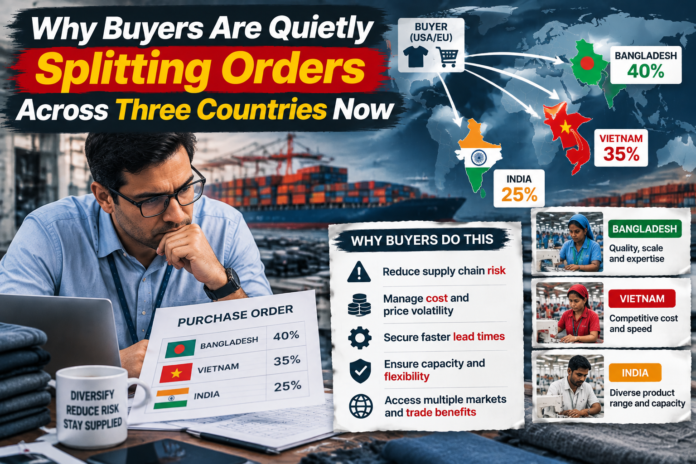
A little differently turned out to mean this. The polo and tee program, which last year had gone almost entirely to Rahim’s factory, would now be split three ways. About half would stay in Bangladesh. A third would go to a vendor in India. The rest would go to a small-lot supplier close to the buyer’s market, for quick-turn replenishment.
Nobody had complained about anything. No price had been challenged and no shipment had been late. There was no letter, no dramatic breakup. Just a different number on the purchase order, and a courteous request to keep the same quality standard across all sources.
Rahim hung up and looked through his office glass at the cutting floor. Same lines. Same people. And somehow a smaller future.
If you’ve been in merchandising for a few seasons, you’ve either had that call or you’re about to. Buyers aren’t leaving. They’re spreading, and they’re doing it so quietly that many factories only notice when the PO sizes shrink. This article is about why it’s happening now, and what it means for our side of the table.
It isn’t a breakup. It’s an allocation.
When a buyer is unhappy, they usually tell you, with a corrective action plan or a tense meeting. What’s happening now is different. The buyer is happy, the factory is performing, and the order still gets divided. Nothing is wrong with you, which is exactly what makes it hard to respond to.
Analysts describe this as a move from picking a country to managing a portfolio of countries. One market guide for 2026 says leading buyers are splitting volumes across three to five countries rather than leaning on one.
I want to be careful here. “Three countries” is a pattern merchandisers describe, not a measured statistic. Some buyers use two, some use five. But three is the shape I keep hearing, because it maps to three different jobs.
The three jobs
Think of it as a three-legged stool.
The volume base. This is where the big, steady, cost-driven programs live: basic tees, polos, fleece, denim, products where price per piece decides everything. For years, Bangladesh has been the default answer for knit basics.
The backup. A second country that can take real volume if the first one stumbles, whether from strikes, energy cuts, a political shock, a tariff change or a port jam. It doesn’t have to be the cheapest. It has to be dependable and already approved, with compliance done and quality familiar. India and Vietnam often play this role.
The flex. A smaller, faster source for fashion tests, quick replenishment and last-minute reorders, the things a 90-day supply chain can’t do. Often this is China, or a nearshore supplier.
H&M, for example, was sourcing from nearly 800 factories across 23 countries as of February 2026.
Seen this way, Rahim’s call was less a verdict than a role assignment. The buyer had told him he was the base, and that the base now shared the stage.
Why now? Four pressures at once
Dual sourcing has been in textbooks for decades. What’s changed is that four pressures have arrived together, and each makes betting on one country feel less sensible.
Pressure one: tariffs that won’t sit still
For anyone pricing garments for the American market, the last two years have been exhausting. The emergency-powers tariffs were ruled unconstitutional by the Supreme Court. A temporary 10 percent surcharge took their place, and when it expired on 24 July, new Section 301 tariffs followed. Trackers report a two-tier structure of 10 or 12.5 percent depending on the economy, with Bangladesh and India in the lower tier and Vietnam in the higher one. There is also a plan, still being implemented, for tariff-rate quotas on textile and apparel imports from Bangladesh, Cambodia, Indonesia and Malaysia, tied to their imports of US-origin inputs such as cotton.
A buyer’s sourcing team can’t be sure what the duty on a given country will be in twelve months, so instead of betting on a forecast, they build a spread. And small gaps matter in basics. A difference of 2.5 percentage points on a $3.20 T-shirt is eight cents a piece, or $6,400 across 80,000 pieces. Buyers will move volume for less. (Rates and quota details are still moving, so confirm the current position with your buyer’s compliance team.)
Pressure two: the EU cliff that’s still fuzzy
Europe is Bangladesh’s biggest market, and its duty-free access is tied to least developed country status, which is scheduled to end on 24 November 2026. Bangladesh has asked the UN for a three-year deferral. A UN committee is due to discuss it on 7 October, with a General Assembly decision expected before the date. If approved, Bangladesh stays an LDC until November 2029. If not, the EU has promised a three-year transition, so nothing changes overnight.
But analysts have warned that if Bangladesh ends up under standard GSP, apparel exports to the EU would face a duty of around 9.5 percent, and the better GSP+ tier comes with hard conditions, including stricter rules of origin. Orders placed now belong to relationships that will run into 2029. Nobody wants to be fully committed to one country on the day its duty position changes, so buyers build the second and third legs early. (Check the latest on the UN decision before relying on any of this.)
Pressure three: lead time, the new currency
This is the one that stings most for factories like ours, because it isn’t about politics. It’s about us.
For years Bangladesh won on price. Buyers now want speed and certainty too. A recent Dhaka Tribune report on falling work orders cited exporters and trade officials saying that gas and power shortages, port congestion and long delivery times are pushing some brands to move portions of their orders to India. It put typical order fulfilment at 60 to 95 days from Bangladesh, against 45 to 60 in India, about 60 in Vietnam and 32 in China.
| Country | Typical fulfilment time |
|---|---|
| China | about 32 days |
| India | 45–60 days |
| Vietnam | about 60 days |
| Bangladesh | 60–95 days |
The same report listed the pressures behind those delays: industrial gas tariffs up nearly 286 percent, electricity up 33 percent and the minimum wage up 56 percent, with around 400 apparel units closed over three years. Those figures come from industry representatives, so treat them as direction rather than audited fact.
A longer, less predictable lead time means more inventory risk, more markdown risk and more missed selling windows for the buyer, a cost that never shows up in our FOB price. Splitting the order is one way to manage it: if one shipment slips, another can cover.
Pressure four: the lesson buyers haven’t forgotten
Buyers have long memories. When Bangladesh’s political upheaval in 2024 disrupted factories and shipping, reports suggested a meaningful share of Western orders moved to competitors. Many buyers said they never wanted to be that exposed again. Since then there have been more shocks, and even Bangladesh’s own request to the UN cited economic fallout from the Iran war among its reasons. A buyer reading that doesn’t think “that’s unfair”. They think “we need a second option.”
The twist: fewer vendors, more countries
At the same time as buyers spread across countries, many are cutting the number of vendors they use. The 2026 benchmarking study by the US Fashion Industry Association found companies consolidating with fewer vendors, some with production in several countries, while tightening quality criteria. Respondents sourced from 49 countries in total, up from 46, yet only 21 percent planned to add more countries through 2027, down from 59 percent in 2025. This isn’t a retreat from diversification. It’s a different shape of it: spread across geography, concentrate on partners who can handle it.
For us, that is an important signal. The ideal supplier in a buyer’s mind is increasingly strong, compliant, flexible and present in more than one place. A single-country factory offers one leg of the stool. A group that can offer two or three offers the whole stool. The split we worry about may increasingly happen inside a vendor’s own network rather than between competitors.
What the split looks like on a costing sheet
Somewhere in the buyer’s office there’s a spreadsheet you’ll never see, with your factory’s landed cost in one column and two others beside it. The columns include more than FOB: duty, freight, expected lead time, the cost of extra safety stock, compliance and often a score for how reliably each source has delivered. A factory that is cheapest on FOB can lose a column to one that is slightly dearer but lands faster with less duty, and you won’t be told why. You’ll just see the allocation shift.
Two realities are worth remembering. First, moving cut-and-sew doesn’t automatically move the fabric mill, the dyehouse or the trim supplier. Some Southeast Asian producers rely heavily on imported fabric and yarn, while Bangladesh’s knit chain, with spinning, knitting and dyeing close to the sewing floor, is a real advantage for basics that newcomers can’t easily copy.
Second, the split cuts both ways. Earlier this year, when US tariff changes made Bangladesh relatively more attractive, factories reported a rush of enquiries from buyers previously sourcing elsewhere. Those buyers weren’t being loyal. They were optimising. The same logic that took a third of Rahim’s program to India brought new programs to other Bangladeshi factories.
How to be the leg the buyer can’t remove
You can’t fix national gas supply or change a tariff schedule. But you can control a surprising amount of how your factory looks inside a buyer’s comparison.
Find out which role you’re playing. Ask the buyer plainly: are we your base, your backup or your flex source? A base is judged on cost and consistency, a backup on readiness and quality parity, a flex source on speed.
Learn the landed-cost math your buyer is using. Cost your own offers the same way, with duty, freight, lead time and risk added. When you can say “our landed cost is competitive once you include X and Y”, you’re speaking the language of the spreadsheet you can’t see.
Sell reliability, with evidence. Everybody says they’re reliable. Track your on-time ship rate by buyer and season, and share a clean one-page record. It can do more than another round of price cuts.
Communicate energy and fabric risk early. If gas supply is shaky or fabric is delayed at the mill, say so on day one, with a plan. Buyers forgive problems they hear about early. What breaks trust is the surprise.
Hold quality parity across sources. Remember the instruction on Rahim’s call. When a buyer runs three countries, they compare your test results, shade consistency and GSM variance against the others, whether you know it or not.
Consider partnerships. If buyers are consolidating toward multi-country vendors, a single-origin factory might look for a partner that offers more than one origin.
The honest limits
Buyers haven’t abandoned Bangladesh. It remains one of the world’s largest apparel exporters, with knit depth few places can match, and Asia still supplies the large majority of US apparel imports. Much of the news in this space is also unsettled: the UN decision, the details of US quotas, the state of gas supply. Anyone who tells you they know exactly how it ends is guessing.
Back to Rahim
A week after that call, Rahim called the buyer back, not to argue about the split, but to ask a question.
“Which part of the program do you want to be sure of?” he said. “Tell me what you’re protecting, and let me show you how we help protect it.”
There was a pause. Then the sourcing manager, who had expected a defensive pitch, started talking. She was worried about lead times on second-half replenishment. She was worried about being caught short if a shipment slipped. The price, she said, had never been the issue.
The conversation didn’t win the whole program back, and it wasn’t meant to. But it moved Rahim from a supplier waiting to see what he’d be given to one the buyer was building the plan around. By the next season his factory had the replenishment orders too, because he’d shown he could hit the dates.
That is what I take from all of this. The quiet split isn’t mostly about price, and it isn’t a punishment. It’s a buyer protecting itself against a world that keeps surprising it. The factories that do well won’t resent the split. They’ll make themselves the safest, clearest and most reliable leg of the stool, and keep proving it, season after season.