
If you work in merchandising, you probably just smiled. Or winced.
It’s Friday, a little after five. The buyer’s email arrived at 4:40. They like the polo, but they want the price brought down to their target. Could you also quote the same style in a second fabric, and one more version with embroidery? By Monday morning, please.
You open the file. Fabric consumption is on one sheet, trims on another, and there’s a tab nobody has touched since a colleague left. The yarn price came from a WhatsApp message three weeks ago, and the exchange rate was typed in by hand. You open the other file to check which one has the latest CM, and now you have two windows, two numbers and a quiet feeling in your stomach.
You know how this ends. You’ll stay late, you’ll get it done, and on Monday you’ll send a quote that is probably right.
Probably. That one word is why I started building something.
What costing really involves
People outside the industry hear “costing” and imagine a simple sum: fabric plus labour plus profit. Anyone who has done it knows it is closer to assembling a puzzle out of pieces held by twelve different people.
For a single style you need fabric consumption, which depends on the pattern, the marker, the GSM and the width. You need the fabric price, which depends on yarn, knitting, dyeing and finishing, and which moves. Then come trims, the cut-and-make charge, wash or embroidery, testing, commercial costs, transport and a margin that has to be defended at the end. Each line has its own source. Fabric comes from a mill, trims from three suppliers, CM from the industrial engineering team, and the margin from management, in a mood that depends on how the month is going.
An experienced person can cost a basic tee fairly quickly. A detailed style with several trims, a wash and an embellishment can take an hour or more. And almost no quote is a one-off. The buyer comes back with “What if we change the fabric?” and “What if the quantity doubles?”
Multiply that by a few buyers and a few dozen styles, and much of a merchandiser’s week goes on arithmetic instead of merchandising.
I like Excel. That’s not the issue.
I want to be fair to Excel, because this isn’t going to be a post that sneers at spreadsheets. It is flexible, everyone understands it, and a skilled merchandiser can build a costing sheet in it that is a small work of art. Most of what I know about costing, I learned inside one.
The trouble is what happens when a spreadsheet becomes the only memory a business has.
One person builds the sheet. Another copies it, changes a few cells for a new style and saves it under a new name. A formula gets overwritten with a typed number during a rush, and nobody notices for six months. When the person who built it leaves, a piece of the company’s knowledge leaves too.
There’s also no history. When a buyer asks why you quoted a certain price last season, the honest answer is usually, “Let me look for the file.” And there’s no learning. A sheet doesn’t know that a certain mill’s fabric has run heavy on the last five orders, or that the quoted wastage was 7% while the actual was 9%. Each costing starts fresh, as if the factory had no past.
That costs time, but it also costs margin. A quote built on stale numbers, a copied formula or a forgotten tolerance can quietly give away thousands of dollars on a single order. I wrote recently about the GSM tolerance nobody puts into the costing, and it’s a perfect example. The information exists. It just doesn’t live anywhere the costing can see it.
The real price of slow
There’s a second cost that is harder to see, and it’s the one that finally pushed me to act.
Speed matters in quoting. When a buyer is comparing three or four suppliers, the one who responds first, with a clear and confident number, often gets the conversation. But a fast quote built on shaky numbers is worse than a slow one. So merchandisers live in a permanent tension: respond quickly, but don’t get it wrong. The only way out has always been to work harder and stay later.
Those hours have to come from somewhere. They come from the parts of the job that actually build a business: a call with the buyer to understand what they really need, a visit to the mill to talk about next season, a sit-down with the production manager to plan capacity.
That’s the real argument for automation. It isn’t about doing the same work with fewer people. It’s about getting people back to the work only people can do.
What I’m building
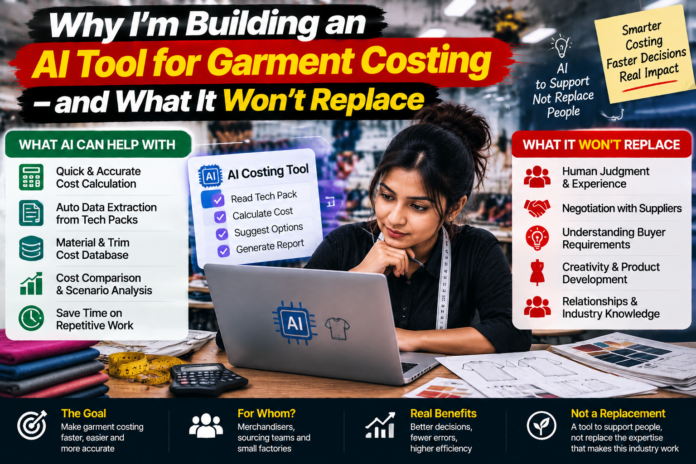
So I decided to build a tool. I’m calling it AutoCost.
The idea is simple to describe and hard to do well: a merchandiser should be able to put together a costing in minutes instead of hours, with numbers they can trust and a clear trail showing where each number came from.
In practice I picture it doing four things.
It holds your rates in one place. Yarn and fabric prices, trim costs, CM rates, wash charges, exchange rates. When a rate changes, it changes once.
It does the consumption maths properly, including the parts most sheets skip: wastage, marker efficiency and tolerances. If a buyer’s spec allows ±5% on GSM, the tool should show what happens to your margin at the top of that range before you commit to a price.
It lets you ask “what if” in seconds. A different fabric, 50,000 pieces instead of 30,000, higher freight. You change one input and see the answer instead of rebuilding the sheet.
And it remembers. Every quote is saved with its assumptions, so next season you can see what you charged and what the order really cost to make. Over time that history becomes the most valuable thing in the system, because it replaces gut feeling with evidence.
Where AI helps, and where I’m cautious
When I say “AI tool”, I don’t mean a magic box that spits out a price.
What AI is genuinely good at is reading and sorting. A tech pack is full of information that a person has to read and re-type: measurements, fabric details, the trim list, construction notes. A good model can read that document and pull out a first-pass bill of materials in seconds. It can suggest a rough consumption, and flag a special wash or an unfamiliar trim so nothing slips past. That saves real time on the dullest part of the job.
But I’m cautious, and I think everyone should be. AI makes mistakes, and it makes them confidently. A model might misread a measurement, assume the wrong fabric width or miss a note buried in a footnote. In costing, a small error is not a small matter. It can be a five-figure mistake on a large order.
So the rule I’m building around is that the AI proposes and the merchandiser decides. Every number the tool suggests should be visible, editable and explainable. If it says a style needs 0.24 kg of fabric, you should be able to see how it got there and change it with one click. A costing tool you can’t check is worse than a spreadsheet, because a spreadsheet at least shows its formulas.
I would rather build something slightly less impressive in a demo and completely trustworthy on a Friday evening.
What it won’t replace
This is the part I care about most, and it’s why it’s in the title.
Every time automation comes up, someone asks the same question, sometimes out loud and sometimes only with a look: “So, will this take our jobs?”
It’s a fair question, and I won’t brush it off. My honest answer is no, and I owe you the reasons.
A costing is a number. A price is a conversation. Software can produce the number. It cannot have the conversation.
Think about what happens when a deal gets made. The buyer says the price is too high. A good merchandiser doesn’t just recalculate. They listen. Is the buyer really under pressure from their own management, or is this the usual opening move? Is this order a one-time chance, or the start of a bigger programme? Would they accept a slightly different fabric, or a longer lead time, in exchange for a better price? That is judgment, built from years of knowing people, and no tool I build will have it.
Think about the factory floor. A costing sheet doesn’t know that line four is underloaded next month and a lower-margin order might be worth taking to keep the workers busy, or that one mill delivers on time and another only promises. Those facts live in a merchandiser’s head.
Think about trust. When something goes wrong, and in this industry something always does, the relationship is what carries you through. The buyer who forgives a late shipment does it because of the person who called first and told them honestly. No software makes that call.
If a merchandiser’s value were only the arithmetic, then yes, a tool could replace them. But arithmetic was never the real job. It was the toll we paid to get to the real job.
The principles I’m holding myself to
Since this is a public promise of sorts, here are the rules I want the tool to live by. If I break them, remind me.
Show the working. Every figure should trace back to its source, so the merchandiser can always say where a number came from.
Keep the merchandiser in charge. The tool suggests, the person approves. Nothing becomes a final quote without a human having looked at it.
Build for the real work, not the demo. The tool has to survive last-minute buyer changes, odd trims and half-finished information, not just clean examples.
Take the data seriously. Your rates, margins and supplier prices are among the most valuable things your business owns, and how they’re handled has to be right from day one.
Be honest about limits. If the tool isn’t sure, it should say so.
An honest word to my colleagues
I know some merchandisers reading this feel uneasy, and I understand why. Technology has a habit of arriving with big promises and landing on the people who weren’t asked.
So let me say clearly what I’m trying to do. I’m not trying to make merchandisers unnecessary. I’m trying to build something I would want on my own desk, something that gives me back my Friday evenings and my focus. CAD didn’t end pattern making; it gave pattern makers speed. I expect the same here. The merchandiser who negotiates well, reads buyers well and knows their mills well becomes more valuable when the arithmetic takes ten minutes instead of two hours, not less.
Back to Friday night
Let me return to that Friday evening and imagine it differently.
The buyer’s email arrives at 4:40. You open the style. The tool has already read the tech pack and drafted the bill of materials. You check it, fix two lines and add the embroidery. The current rates are already loaded. Within minutes you have three versions side by side, each showing margin at nominal and at the top of the tolerance.
You notice that the cheaper fabric saves a little, but that mill’s lots have run heavy lately, which the history shows. So you do something arithmetic could never do for you. You pick up the phone and call the buyer. You explain the trade-off, hear what they actually care about, and shape an offer that works for both sides.
You’re home by six.
That’s the future I’m building toward. It isn’t a world without merchandisers. It’s a world where a merchandiser’s evenings belong to them, and their working hours belong to the part of the job that matters.
Where I’d like your help
I’m building this in the open, and I’d like to build it with the people who will use it. If you’re a merchandiser, a costing manager or a factory owner, tell me how you do your costing today. What eats the most time? What would make you trust a tool like this, and what would make you throw it out in the first week?
Tell me where the pain really is, not where I think it is. The best version of this tool will come from experienced merchandisers telling me what a good costing looks like.
Until then, if you ever find yourself staring at Costing_FINAL_v9_REAL.xlsx at six on a Friday evening, you’re not alone, and you’re not doing it wrong. You’ve just been doing a machine’s work with a human’s time. It’s time to give some of it back.