
Exclusive content
Farzana had built what she genuinely believed was her best production plan yet, the kind of plan she was almost proud enough to print out and pin to her office wall. Every line allocated. Every date mapped from cutting straight through to shipment. Every dependency accounted for, down to the day. It was, by any normal standard, an excellent plan.
It survived exactly nine days before the buyer’s email arrived.
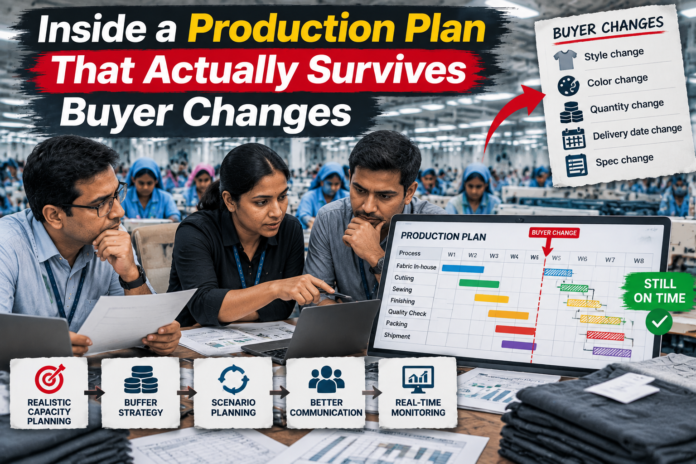
“We’d like to change the pocket detail on Style 4471, and split the color ratio differently across sizes. Can you confirm revised timeline?”
Nine words of buyer request, and Farzana’s beautifully built plan, the one with every date locked precisely against every other date, came apart almost immediately, not because the request itself was unreasonable, but because her plan had never actually been built to survive a request like this in the first place. It had been built to survive nothing changing at all — which, she realized later, sitting with the wreckage of her revised timeline, is almost never what actually happens on a real order.
The Plan That Was Really a Guess Dressed as Certainty
Looking back honestly at that original plan, Farzana could see what it had actually been: not a plan so much as a single, best-case prediction, formatted to look precise and confident. Every date followed the one before it in a straight, unbroken chain — cutting finishes exactly on day twelve, sewing starts exactly on day thirteen, no room anywhere for anything to shift even slightly without knocking over every date that came after it.
It looked professional. It looked controlled. But a chain like that isn’t actually a plan for managing an order — it’s a bet that nothing about the order will change between the day you build it and the day it ships. And on real orders, with real buyers, something almost always changes. A color ratio shifts. A trim gets swapped. A quantity moves between styles within the same PO. Buyers revise things constantly, not out of carelessness, but because their own customers, their own sell-through data, their own internal decisions keep evolving right up until the last responsible moment.
Farzana’s plan hadn’t failed because the buyer’s request was unusual. It failed because her plan had zero capacity to absorb an entirely normal, entirely expected kind of change.
What She Learned From a Planning Manager Who’d Seen This Before
She brought the mess to Kamal bhai, a planning manager who’d been building production schedules for almost eighteen years, across dozens of buyers and hundreds of styles. He looked at her original plan for a while, quietly, before saying something that reframed the whole problem for her.
“You built a plan for the order you hoped you’d get,” he said. “Not the order you actually have. Those are almost never exactly the same thing, and a plan that only works for the hoped-for version breaks the moment reality shows up instead.”
What Kamal bhai actually built, on the orders he managed, wasn’t a single confident chain of dates. It was something closer to a plan with deliberate flexibility built into specific, chosen places — not everywhere, which would just create chaos and unpredictability, but at the points where change was most likely to actually happen.
Building Flexibility Where Change Actually Lives
The first thing Kamal bhai taught her was to separate every order into what he called “locked” elements and “likely-to-shift” elements, before building any dates at all.
Locked elements were things extremely unlikely to change once confirmed — the base garment construction, the core fabric, the overall order quantity in most cases. These could be planned tightly, because history showed they rarely moved once a buyer had reached this stage.
Likely-to-shift elements were the ones experience had taught him to watch carefully — color ratios, specific trim details, sometimes size-quantity splits, occasionally minor construction tweaks requested after initial sample approval. These weren’t random guesses. They were based on actual patterns Kamal bhai had tracked, informally at first and then more deliberately, across years of orders with this same buyer and similar ones.
For locked elements, he built tight, efficient timelines, the same way Farzana originally had. For likely-to-shift elements, he built in explicit buffer, not vague extra time scattered everywhere, but a specific, sized cushion at the exact stage most affected by that particular kind of change.
Why the Buffer Has to Live in the Right Place, Not Just Somewhere
This was the part that genuinely surprised Farzana, because she’d tried adding buffer before, on other orders, and it hadn’t actually helped much. She’d usually just tacked a few extra days onto the very end of the timeline, a general cushion before the shipment date, hoping it would absorb whatever went wrong anywhere in the process.
Kamal bhai’s approach was more specific, and it’s what made the real difference. A color ratio change, like the one the buyer had just requested on Style 4471, mainly affects cutting and fabric allocation — it doesn’t touch sewing capacity or finishing capacity at all, since the total garment count usually stays the same, just redistributed differently across colors and sizes. So the buffer that actually mattered for that kind of change needed to sit specifically around the cutting and fabric-booking stage, not generically at the very end of the whole timeline where it wouldn’t actually help absorb this particular type of disruption.
A trim change, by contrast, might affect sourcing lead time and, depending on the trim, potentially sewing if the attachment method changes. That called for buffer positioned differently — around trim procurement specifically, sized based on how quickly the factory’s trim suppliers could realistically turn around a revised order.
“Buffer at the end of the timeline,” Kamal bhai told her, “protects you from a general, vague sense that things might go wrong somewhere. Buffer at the specific stage a specific kind of change actually affects protects you from that change itself, directly, when it actually happens. Most planners only know how to do the first one. The second one is where a plan actually survives contact with a real buyer.”
Rebuilding the Style 4471 Timeline
Working through the buyer’s actual request with Kamal bhai’s framework in hand, Farzana found the revision far less catastrophic than her first panicked read of the email had suggested. The pocket detail change affected sewing operation sequence slightly, but not dramatically — a modified attachment step, not an entirely new operation. The color ratio split mainly touched cutting and fabric allocation, exactly the kind of change Kamal bhai’s framework already anticipated needing dedicated buffer for.
Because she’d built this particular order — almost by instinct this time, having just been through this lesson — with a few extra days of flexibility specifically around the cutting and fabric-booking stage, the revised color ratio didn’t actually blow up her whole downstream schedule the way it would have against her original, fully rigid plan. It used up part of the buffer she’d deliberately placed there, and the rest of the timeline held.
The pocket detail change required a slightly longer conversation with her sewing supervisor, confirming the revised operation could still fit within the existing SMV assumptions without triggering a meaningful new learning curve, since it was a small modification to an operation the line already knew well, not an entirely unfamiliar construction. That confirmation took twenty minutes, not two days, precisely because she asked the right specific question upfront instead of assuming the change was either trivial or catastrophic without actually checking.
The revised timeline she sent back to the buyer showed a shipment date only two days later than her original plan, not the full week she’d initially, anxiously, assumed she’d have to request.
The Deeper Pattern Kamal Bhai Pointed Out
Looking at the finished, revised plan together, Kamal bhai made an observation that stuck with Farzana longer than the specific mechanics of buffer placement.
“Every merchandiser we’ve talked about in training sessions this year,” he said, “Rumana’s lost order, Joya’s finishing crisis, Mahin’s broken sample promises, Sabbir’s hidden checkpoints — they’re all really the same lesson wearing different clothes. Somebody built a plan, or a costing sheet, or a promise, around the version of reality that was easiest to imagine, instead of the version that was actually likely to happen. And then reality, being reality, showed up anyway, and the plan had nowhere to put it.”
He wasn’t wrong. Farzana’s rigid chain-of-dates plan had the same underlying flaw as Rumana’s uncorrected fabric estimate, the same flaw as Mahin’s hopeful sample dates built on best-case buyer turnaround. All of them had mistaken a clean, confident-looking number for an accurate one, without building in any real space for the ordinary uncertainty that every single order actually carries.
What Actually Makes a Plan Survive
The lesson Farzana carried forward wasn’t “add more buffer everywhere,” which would have just made every timeline slower and less competitive without actually protecting against anything specific. It was something more deliberate: before building any production plan, spend real time asking which elements of this specific order are genuinely locked, based on this buyer’s actual history and this style’s actual complexity, and which elements are realistically likely to shift, and where, specifically, that kind of shift would actually hit the timeline if it happened.
Locked elements get planned tightly, efficiently, without wasted slack the factory can’t afford to give away for free. Likely-to-shift elements get deliberate, sized buffer, placed exactly where that particular kind of change would actually land, not scattered vaguely across the whole schedule in a way that looks protective but doesn’t actually absorb anything specific.
It requires more thinking upfront than Farzana’s original approach did. Her first plan had taken an afternoon to build, clean and confident. This new approach took closer to a full day, because it meant actually sitting with the order’s history, this buyer’s known patterns, and this style’s specific risk points, instead of just drawing one straight, hopeful line from PO to shipment.
But that extra day, spent once at the start, saved her from the kind of chaotic, reactive scramble that used to follow every buyer revision under her old approach — the kind where a single unexpected email could knock over an entire carefully built schedule, simply because the schedule had never been built to survive anything except the version of the order that existed only in the best possible version of events.
The Real Shift in How Farzana Plans Now
What changed for Farzana wasn’t really about production planning software, or a new template, or any tool at all. It was a shift in what she actually considered a “finished” plan. Her old definition of finished meant every date filled in, every box checked, a clean unbroken line from start to end. Her new definition meant something different: has she actually thought through where this specific order is likely to change, and does her plan have real, deliberate room to absorb that change without collapsing everything that comes after it.
A production plan that only works if nothing changes isn’t really a plan. It’s a hope, formatted carefully enough to look like certainty. The plans that actually survive contact with a real buyer, Farzana has come to understand, are the ones built honestly around the fact that change is not a disruption to the process — it’s simply part of what the process actually is, every single time, on almost every real order that exists.