
Exclusive content
Mizan had the numbers on a sheet of paper, and he didn’t enjoy reading them out.
“Digital sample for the polo took three days,” he told the room. “Last year, the physical one took twelve. So the sample room is faster. I want that on record.”
Nusrat, the factory’s merchandising manager, looked at her own sheet. It had a different column, one the sample room didn’t track: days from receiving the buyer’s tech pack to receiving the buyer’s pre-production approval. For the pilot style, that number was 58 days. For a comparable style, sampled the traditional way the previous season, it had been 61.
“Three days,” she said.
“It’s still faster,” Mizan said, a little defensively.
“It is. But the owner paid for the software, the licences and two weeks of training, and the buyer is waiting for almost the same sixty days as before. You saved nine days in the sample room and three on the calendar. Where did the other six go?”
Nobody had an answer. The 3D samples had been faster to make. The development hadn’t been faster to finish.
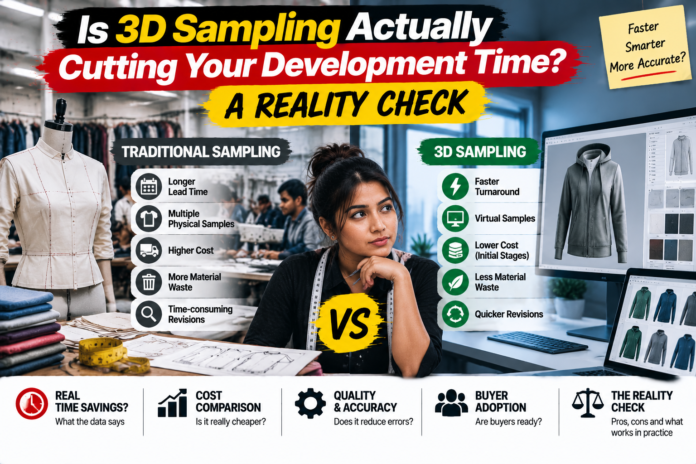
That gap, between how quickly a sample can be made and how quickly a style can be approved, is where almost every claim about 3D sampling quietly falls apart. This article is a reality check on what the technology actually does to development time, what the evidence says, and what decides whether you get the savings.
What the claims say
The marketing is consistent. Browzwear says its users create 50 to 80 percent fewer physical samples, and publishes a testimonial from a brand that cut its timeline from three or four months to about two. Style3D reports that revision rounds drop by 40 to 60 percent, and that a digital sample takes four hours to two days against a traditional cycle of one to three weeks.
Independent and academic sources are broadly positive, with caveats. A 2025 review of 3D sampling in the Bangladeshi RMG industry reports physical sampling taking 20 to 40 days against 2 to 4 days for digital sampling in CLO 3D, and a higher sample acceptance rate for the digital route. A factory profile in Bangladesh describes a CIEL subsidiary using CLO 3D and Browzwear to replace physical sampling at proto stage, and in some cases for salesman samples.
Notice what those figures actually measure. Almost all of them describe how long it takes to make a sample, or how many physical samples are made. Very few describe how long it takes to get a style approved and into production. Those are different clocks, and a factory pays for one and is judged on the other.
Where development time actually goes
To see why, look at where the days in a development cycle go. Here is an illustrative breakdown of a traditional three-round sampling process for a woven shirt. The numbers are made up but typical in shape.
| Stage | Days per round | What’s happening |
|---|---|---|
| Interpret tech pack, make pattern | 3 | Pattern maker and merchandiser |
| Sew the sample | 4 | Sample room |
| Courier to buyer | 4 | Waiting in transit |
| Buyer review and comments | 4 | Waiting for the buyer |
| Receive and interpret comments | 2 | Merchandiser and pattern maker |
| Total per round | 17 |
Three rounds, plus a pre-production sample, can take close to two months. Notice how little of that is actually making the sample. Sewing is four days out of seventeen. Courier and buyer review together take eight. If 3D sampling speeds up the pattern and sewing steps, you’re improving about 40 percent of the round. If the buyer’s review and the courier time stay the same, the round gets shorter but not dramatically.
3D sampling only changes the whole picture when it changes the buyer’s part of the clock.
Three versions of the same pilot
Here’s an illustration of how the same technology produces very different results depending on how it’s used. The assumptions are mine, for the shirt above, and are not measurements.
| Scenario | How 3D is used | What changes in the calendar | Approximate days saved |
|---|---|---|---|
| Internal only | The factory fits and corrects digitally, then sends physical samples to the buyer as before | Fewer wasted internal iterations; first physical sample is closer to right | 5 to 10 days |
| Partial buyer engagement | The buyer reviews a digital sample for early fit and colour, then approves physical samples | One or two physical rounds replaced by digital ones, with faster review | 12 to 20 days |
| Full engagement | The buyer approves most development digitally; one physical top sample before production | Courier and much of review time removed | 20 to 30 days |
Nusrat’s factory was in the first row. They had bought the tool and used it well internally, and the sample room did indeed work faster. But the buyer was still receiving physical samples at the same cadence, so the calendar barely moved.
What 3D adds, not just what it removes
Most claims describe the time removed. Rarely do they count the time added.
Fabric digitisation. For a simulation to behave like your fabric, the software needs to know how that fabric stretches, bends and hangs. That means testing or scanning the fabric and entering the parameters. One vendor blog describes fabric parameter calibration as the typical first friction point when importing a pattern, and another source notes that digitising fabrics requires specialised equipment and can be time-consuming and resource-intensive. For a new fabric on a new style, this is real time.
Pattern and avatar setup. Patterns need to be imported cleanly, and avatars need to match the buyer’s fit model or size spec. A mismatch here produces confident-looking but wrong results.
Learning time. A review of Bangladeshi RMG adoption lists expensive setup costs, a lack of realistic materials and training needs as continuing problems, and describes software adoption taking two to four years. The first few styles in any new tool are usually slower than the old way.
Parallel work. Many factories end up doing both: the digital sample and the physical sample, because the buyer insists on the physical one. In that case 3D adds a step instead of replacing one.
None of this makes 3D a bad idea. It means the net saving is smaller in the first season than in the third.
Where the simulation is trustworthy, and where it isn’t
Even the strongest advocates are candid about the limits, and independent research supports them.
An academic comparison of physical and virtual drape tests using commercial 3D garment software found differences between real and virtual drape, and concluded that the simulation was insufficient to reflect drape area. A study on predicting garment fit in digital development notes that current limits in simulation accuracy mean physical prototypes are still indispensable. Vendor sources themselves say that fabric simulation still has limits when a garment depends on layered structure, extreme stretch, bonded seams or very specific hand-feel that only physical handling reveals, that performance knits can look right in one pose and behave differently when worn or washed, and that digital approval should be treated as a filter, not a final substitute. Another notes that most brands using digital sampling still ask for one physical top sample before launching production.
From all that, here’s a rough map of where 3D tends to help most and least.
| Tends to work well | Tends to need physical confirmation |
|---|---|
| Basic and familiar silhouettes | Performance and compression knits |
| Familiar fabrics already in your digital library | New or unusual fabrics |
| Colour and print placement | Layered, bonded or heavily structured garments |
| Fit-driven pattern corrections | Hand-feel and drape-dependent decisions |
| Early proto and salesman samples | Final top-of-production approval |
This is my own summary from the sources, not a rule, and it will shift as the software improves.
How to find out whether it’s working for you
Don’t trust anyone’s percentage, including mine. Measure your own, and measure the right thing.
Measure calendar days to approval, not hours in the sample room. The only number that matters to a buyer and to your T&A is the days from tech pack received to pre-production approval. Record it for pilot styles and for matched styles done the old way.
Match your comparison. Compare similar styles, fabrics and buyers. A basic tee isn’t a fair comparison for a tailored jacket.
Track the supporting numbers. Physical sample rounds per style, first-time-right rate on the first physical sample, hours spent on each digital sample, and the proportion of buyer comments received digitally.
Count the full cost. Software, training, fabric testing, avatar setup and staff time, spread across the styles you actually do digitally.
Ask the buyer what they’ll accept. Before you start, find out whether they’ll approve fit or colour on a digital sample, how fast they’ll respond, and what still needs a physical sample. A 48-hour digital response target changes the calendar more than any feature of the software.
The honest limits
I haven’t run a 3D pilot myself, and the evidence is lopsided. Most of the quantitative claims come from software vendors, whose figures are best cases. The academic work I found is a mix of reviews and small studies, and some of it is a few years old. The sample time and acceptance figures in the Bangladesh review are compiled results, not a controlled trial in your factory. The three-scenario table above is an illustration of how the logic works, not data. Your results will depend on your buyers, your fabrics and your skills, and a technology that disappoints in the first season can pay off in the third, or vice versa.
Back to Nusrat
After the meeting, Nusrat didn’t cancel the pilot. She did something more useful: she called the buyer.
She asked a direct question. “We can now show you a digital fit sample within three days of the tech pack. If we send you the link, how quickly can you give us comments, and what would you need to approve fit without a physical sample on this style?”
The buyer’s technical designer said she could comment within 48 hours, and that for a familiar block in a woven fabric the factory had already supplied, she was happy to approve fit digitally, as long as a physical top sample followed before production.
So the next pilot style ran differently. Mizan’s team made a digital sample in three days. The link went to the buyer the same afternoon. Comments came back in two days. A second digital round took three more. Then one physical sample, which arrived, was checked against the digital version, and passed on its first review. The tech-pack-to-PP-approval count that season was 44 days, against 61 for the comparable style the year before.
It wasn’t an eighty percent miracle, and it wasn’t the “10 minutes” some brochures promise. It was seventeen days saved on one style, traceable to a specific change: the buyer reviewing digitally, on a clock both sides had agreed to.
Mizan, to his credit, was the first to say it. “The software didn’t save the time,” he told the room. “The agreement did.”
That’s the reality check. 3D sampling is a real tool that can cut real days, but only if the whole development loop changes, not just the sample room. The software makes the sample. The calendar changes when the people on both ends of the email decide to use it.