
Exclusive content
The screen in the reception area was the first thing every visitor saw.
It was enormous, mounted above the sofa, and it glowed with coloured charts: output by line, efficiency percentages, a world map with a pulsing dot over the factory. Above it, in clean white letters, were two words: Digital Factory. The owner had commissioned it six months earlier, after returning from a trade fair, and he was proud of it.
On a Tuesday in September, a sourcing director from one of the factory’s largest buyers sat under that screen waiting for her tour to begin. Dilruba, a senior merchandiser, was sent to bring her upstairs.
“Impressive,” the director said, nodding at the wall. Then, as they climbed the stairs, she asked a simple, friendly question. “For the order we shipped in July, what was the actual fabric consumption per piece against the quoted number?”
Dilruba knew the quoted number. It was in her costing file. The actual number would be somewhere in cutting records, store issue slips and a spreadsheet kept by the planning team, and she would have to assemble it by hand.
“I can get that to you,” she said. “Give me until Thursday.”
The director smiled politely. It was a good answer. It was also, Dilruba understood, the wrong one. In the building behind her, eleven people could have told her how many pieces line four had sewn at ten o’clock that morning. Nobody could tell her what the order they had shipped in July had actually consumed, without a three-day hunt.
The screen showed the factory. It didn’t know the factory.
That distinction is what this article is about. “Digital factory” is one of the most used and least defined phrases in the industry. It appears on banners, in brochures and on lobby walls. What it should mean is much more specific, and much more useful, than a dashboard.
The buzzword problem
Ask five people what a digital factory is and you’ll get five answers. A technology vendor will describe sensors and cloud platforms. A consultant will mention Industry 4.0. An owner may point to the screen in reception. A merchandiser might say “no more Excel.”
They’re all describing pieces. None of them is describing the thing.
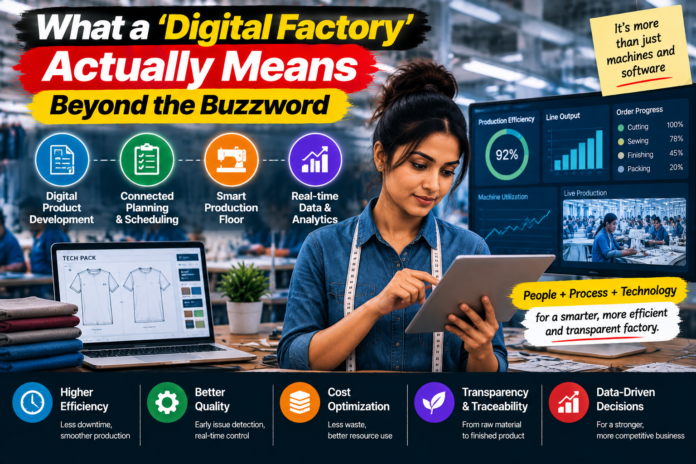
My working definition is this: a digital factory is one where data is captured once, at the point where the work happens, flows to everyone who needs it without being retyped, and is used to make decisions while there is still time to act.
Three parts to that. Captured once at the source, so nobody copies numbers from a paper slip into a spreadsheet at the end of the day. Flowing without retyping, so the merchandiser, the planner, the store and the accounts department are looking at the same number. And used in time, so the answer to “are we on track?” arrives before the problem does, not after the shipment.
Notice what’s not in that definition: any specific technology. A factory can be more digital with a well-run barcode scanner and a clean database than another with a glass-walled control room and a hundred sensors that nobody acts on.
The five layers
It helps to think of a digital factory as a stack of five layers, each depending on the one below it.
1. Capture. Data enters the system at the point of work: a scan when a bundle leaves cutting, a tablet tap when a line finishes a size set, a machine counter, a lab result entered once in a standard format. The enemy of this layer is paper and delay.
2. Connect. The data is stored in a form other systems can use. There’s one style master, one list of colours, one supplier list. The ERP, the planning tool and the quality system recognise the same order number. This is where most factories discover that “Navy”, “NAVY” and “Navy Blue 19-3832” are three different colours in the database.
3. See. People can view what’s happening, in time. A line’s progress against plan, the stock of a trim, the status of an approval. This is the layer most people picture when they think “digital”, and it’s the one that fits on a wall screen.
4. Decide. The system helps people choose. It flags that a line is falling behind, that a fabric lot is heavier than costed, that a buyer comment is eating the float in the T&A. It might simulate the effect of a rush order on overtime. Sometimes this uses AI, but often it’s a simple rule and an alert. The human decides.
5. Learn. What happened feeds back into what’s planned next. Quoted consumption is compared with actual and the next costing starts from evidence. Delay patterns by mill, approval times by buyer, efficiency by style type: the factory gets smarter with each order.
Dilruba’s lobby screen lived entirely in layer three, and only for production output. Layers one, two, four and five were mostly missing, which is why a simple question about consumption took three days.
Where factories actually are
The honest picture, based on what research is available, is a patchwork.
A World Bank firm-level survey of Bangladesh found that around 80 percent of RMG firms use semi-automated technology in sewing, but that frontier Industry 4.0 technologies are rare. A readiness study of Bangladeshi apparel factories found most at an intermediate level, with infrastructure readiness lagging behind strategy, and no factory having achieved mastery of data-driven services. Both of those are older studies, so the picture will have moved. More recent research describes ERP adoption in the sector as still uneven, with one paper citing a digital divide in which around 15 percent of SMEs adopt digital technologies against 65 percent of large firms. And a 2026 review notes that factories using automated cutting, ERP and digital quality processes have seen improved production efficiency, inventory control and supply chain coordination, while adoption remains limited among smaller enterprises.
And what stops factories? Cost matters, but in one study of Bangladesh’s RMG sector the barriers that scored most significant were training, lack of motivation and resistance to change. Lack of a digital strategy and weak data knowledge sat among the root causes, alongside high investment and skills gaps. In other words: people and plans as much as gadgets.
Buzzword decoder
A short translation guide for the next brochure you read.
| The phrase | What it usually means | What it should mean |
|---|---|---|
| Smart factory | Lots of screens and sensors | Data from the floor changes decisions in time |
| Industry 4.0 | A bundle of technologies | A factory where systems share data and learn |
| IoT | Sensors on machines | Reliable signals tied to specific orders and styles |
| Paperless | No printed forms | Data captured once, at the source |
| Dashboard | Charts on a wall | The answer to a specific question you actually ask |
| Digital twin | A 3D model or simulation | A live, accurate model used to test decisions before making them |
| AI-powered | A vendor’s feature | A suggestion a person can check and override |
Not every term is empty. A real digital twin can be valuable for testing a line change or a rush order before you commit. But it sits at the top of the pyramid. Without layers one to three, there’s nothing for it to model.
Why a merchandiser should care
You might be tempted to leave this to the IT department and the owner. But a digital factory changes your job more than almost anyone’s, in five ways.
Quotes you can trust. When actual consumption, efficiency and cost flow back into the costing, your next quote starts from facts instead of memory. The costing engine I described earlier stops being a spreadsheet idea and becomes a feedback loop.
A T&A that updates itself. If approvals, fabric arrivals and line progress feed the plan, the float and the baseline are live, not retyped on Fridays.
Answers in minutes, not days. When a buyer asks what happened on a past order, you can respond before the conversation moves on. That’s the difference between looking organised and looking like you’re hunting.
Records that tell one story. Audits cross-check payroll, attendance and production. When all three come from the same source, there’s nothing to reconcile.
Readiness for what’s coming. Product passports, traceability requests and sustainability claims all depend on batch-level data about fibre, mills and certificates. A factory that already captures and connects its data can answer; one that doesn’t will build a spreadsheet in a hurry.
Four questions to test your own factory
Forget the maturity models. Ask these four questions about your own business, and be honest.
- Can I see today’s output for any line without calling anyone? If not, layers one to three are weak at the floor.
- For any shipped order, can I see quoted cost against actual cost in under an hour? If not, layers two and five are missing.
- When a buyer comment arrives, does it show up in the T&A automatically, or does someone retype it? Retyping is the clearest sign of disconnection.
- Can I list the fibre, mill and dyehouse for any style by tomorrow? If not, you’re not ready for the data requests that are coming.
Count the yeses. Four means you’re further along than most. Zero or one means you have a clear map of where to start.
Where to start, without a big budget
A digital factory isn’t built by buying a platform. It’s built by fixing a few unglamorous things in a sensible order.
Clean the master data first. One list of colour names. One format for style codes. One supplier list. This costs time, not money, and every later step depends on it.
Measure retyping. For one order, count how many times the order number, quantity or style details are typed by hand. The number is usually shocking, and every retype is a place for an error.
Capture at the source. Pick one point, such as end-of-line output or fabric receipt, and replace paper with a scan or a tablet entry. Do it on one line before you do it on twenty.
Close one loop. Start with the easiest: compare quoted and actual fabric consumption for every order, and feed the result into your next costing. A single working feedback loop teaches more than a large implementation.
Invest in people, not just tools. The research is consistent that training and resistance to change are the real blockers. Involve the supervisors and store staff who will enter the data, and make sure the system saves them time rather than adding to their load.
The honest limits
This is my own definition and framework, not an industry standard, and the five layers are a simplification. The research I found on Bangladeshi factories is a mix of surveys and academic studies, several of them a few years old, so treat the percentages as indications. Different factories will rightly choose different paths: a factory making simple basics in huge volumes will benefit from different digital investments than one making complex, small-batch styles. And technology can bring real concerns for workers about jobs and skills, which deserve honest conversation, not a footnote.
Back to the lobby
Dilruba spent that Thursday assembling the answer by hand. Actual consumption was 2.9 percent above quoted. It took her most of two days, three spreadsheets and a call to the store manager. She sent it to the director with a short note and one line she hadn’t planned to write: “This took us longer than it should have, and we’d like to fix that.”
The director’s reply came the next morning. “Thank you. That’s the first honest answer I’ve had from a supplier on this. What would you need to make it a five-minute answer?”
It was the right question, and it led to a better conversation than the factory tour had. Over the next six months, Dilruba and the planning team did the unglamorous work. They cleaned the colour and style lists. They replaced paper issue slips in the store with a scan. They set up one simple comparison: quoted against actual consumption, calculated automatically at the end of each order and filed against the style.
The big screen in reception stayed. But when the sourcing director returned in March and asked her old question about a different order, Dilruba opened a laptop and answered it in four minutes.
“That’s a digital factory,” the director said, and she wasn’t looking at the wall.
It isn’t the screen, or the sensors, or the platform. It’s the moment someone asks a real question about your factory and the answer is already there, because the data was captured once, connected, and waiting for someone to look.