
Exclusive content
The technology expo had a hall the size of a football pitch, and by eleven in the morning Ayesha had collected a tote bag full of brochures and a growing sense of unease.
She was a merchandising manager, sent by her factory owner with a short brief: “Find us something modern. Our competitors are talking about technology. I don’t want to be the last.”
Three booths had stopped her.
The first showed a designer rotating a 3D avatar wearing a virtual polo shirt, the fabric draping and stretching on screen. “Cut your physical samples by up to eighty percent,” the banner said.
The second had a glass cage in which a pair of robotic arms fed fabric into a sewing machine, slowly, carefully, a T-shirt hem taking shape under a camera. A small crowd had gathered. A man in a polo shirt with the company’s logo was explaining, to nobody in particular, that this was the future of garment manufacturing.
The third was a quiet booth, a screen showing a map with lines connecting a cotton farm to a spinner to a mill to a factory to a shop. “Every garment, fully traceable. Immutable. Trusted.” The sales manager gave her a card and a smile.
Ayesha stood in the aisle and realised she had no idea how to compare them. One saved money on samples. One looked like the future and cost like a house. One she couldn’t tell what it did, or for whom. All three had impressive numbers, and she couldn’t tell which meant anything.
That is the real problem with emerging technology in our industry. It isn’t that the tools are bad. Some are excellent. It’s that the claims come from the people selling them, and the person deciding is usually a merchandiser or an owner without a framework for sorting what’s useful from what’s theatre.
This article is that framework, followed by a verdict on five technologies you’ll hear about this year.
Why the numbers in the brochure don’t help
Before any technology, three things to remember about the figures you’ll be shown.
They’re usually best cases. A vendor quotes its most successful customer, not its average one. A “60 to 80 percent reduction” almost always means “up to”, and “up to” is doing a great deal of work.
They’re measured in the wrong place. A saving in a brand’s design studio isn’t a saving in your factory.
They’re a pilot, not a production result. Pilots run with the vendor’s best engineers, clean data and willing staff. Production runs with everyone else, on a Thursday afternoon, with a power cut.
Treat the numbers as the ceiling, then ask for the floor.
A five-question test
When any technology is pitched to you, ask these five questions in order. Most hype fails at the first or second.
- Which specific cost, delay or risk does this remove in my factory or on my orders? Not “efficiency”. A named thing: sample rounds, fabric defects, overtime, lead time.
- Who benefits? The factory, the buyer, or the brand’s marketing team? A technology that benefits someone else may still be worth doing, but then someone else should pay for it.
- What does it need to work? Clean data, trained people, steady power, minimum volume, a certain fabric type? Many tools work beautifully in a demo and badly without their hidden prerequisites.
- What’s the independent evidence? A reference factory similar to yours, one that went live more than a year ago, and numbers you can check with them directly.
- What’s the payback, and how do we exit? How long until it pays for itself, how much is sunk if it doesn’t, and what happens to your data if you stop?
Hold those up against the five technologies below.
The verdicts
| Technology | My verdict | Where it fits |
|---|---|---|
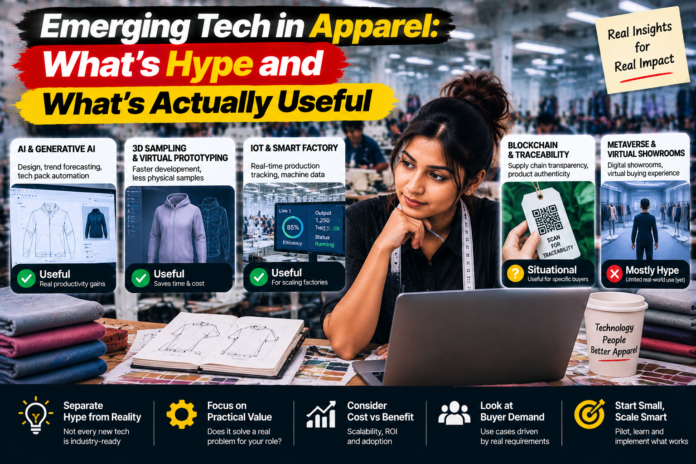
| 3D and digital sampling | Useful now, as a hybrid | Cuts sample rounds on suitable styles; doesn’t remove physical samples |
| AI fabric inspection (computer vision) | Useful where fabric volume is high | Mills and large cutting operations |
| RFID | Useful, but often a buyer’s requirement rather than your saving | Retail inventory; item-level tagging programmes |
| Sewing robots | Watch, don’t plan around | Simple products, very high volumes, well-funded pilots |
| Blockchain traceability | Mostly hype today; the useful part is the data, not the chain | Pilots; regulation-driven data needs |
These are my own judgements from the evidence below, not scores. Your product mix, buyers and scale will shift them.
3D and digital sampling: useful, as a hybrid
This is the strongest case on the list, and also the most oversold.
The idea is straightforward. Instead of cutting, sewing and shipping a physical sample for every fit or design question, you build the garment digitally, check drape and fit on a virtual body, and send a link. Fewer physical rounds means less fabric, less courier cost and less waiting.
The published claims vary enormously. One review of the Bangladeshi garment industry reports a 40 percent reduction in lead time from digital sampling, while commercial sources say brands reduce physical samples by 60 to 80 percent and some claim sampling cost cuts of up to 90 percent. Major brands including Adidas, Nike, Tommy Hilfiger and Hugo Boss are reported to use 3D digital sampling.
The more careful summaries are noticeably more modest. Digital workflows often reduce sample iterations rather than eliminating physical development, and most apparel businesses use a hybrid model. Critical styles, new fabric types and final production approvals typically still need a physical sample. And for factories, there’s a cost barrier: the same review says adoption among small and medium manufacturers in Bangladesh and Vietnam has been slow, with high costs among the obstacles.
My verdict: worth a serious pilot, especially if your buyers already work in 3D. Use it to reduce rounds on fit questions for familiar fabrics. Don’t expect it to replace the gold-seal sample, and don’t believe an eighty percent figure until you’ve measured your own.
AI: useful in specific places
“AI” covers too much to judge as one thing, so split it.
Computer vision for fabric inspection is the most mature use. Cameras and software scan fabric at production speed and flag defects. One vision system is described as identifying over 40 defect types with over 90 percent accuracy, and another source claims 95 to 99.3 percent. Those numbers come from sellers and should be treated that way, but the logic is sound: an older survey reports that fabric defects cause about 85 percent of garment defects, and that off-quality fabric sells at a 45 to 65 percent discount, so catching defects early has real value. It fits best where volume justifies the equipment, such as mills and large cutting operations, and less well for a small factory inspecting a few thousand metres.
AI as an assistant for office work is a different thing. Reading a tech pack, drafting a reply, summarising an email thread: these save time, and mistakes are visible. The risk is that AI makes errors confidently, so a person has to stay in charge of every number that matters.
AI forecasting and design generation come with the boldest claims, such as 20 to 30 percent less overproduction and unsold inventory. Those figures appear mainly in vendor-written material, and forecasting mostly benefits brands and retailers, not the factory taking the order.
RFID: real, but check who benefits
RFID tags let items be counted and tracked without scanning each one. In retail, the evidence of value is the strongest: one industry guide reports apparel inventory accuracy rising from 65 to 75 percent to 95 to 99 percent, and says over 80 percent of the top 100 global apparel retailers use item-level RFID. That guide comes from an RFID supplier, so take the precision with care. But the direction is widely accepted.
For a factory, the question is usually “who asked?” Often it’s a buyer requirement: tag the garment at packing, in a specific format. That’s a cost to you and a benefit to them, so it belongs in your costing and in a pricing conversation. RFID for your own use, such as tracking bundles through your floor, is a separate case to build on your own numbers.
Sewing robots: watch, don’t plan around
This is the technology with the best theatre and the weakest near-term case for most factories.
The progress is real. SoftWear Automation closed a $20 million Series B1 round in August 2025, led by Bestseller, and its third-generation T-shirt line was expected to reach commercial availability in the first half of 2026, though I couldn’t confirm that it has. There are reasons for caution. The company once projected 30 million pieces a year by the end of 2017, and it is unclear whether that was ever reached. Robots have difficulty handling pliable materials, so full automation of sewing remains confined to the simplest product categories, and one market report puts premium multi-head systems at $350,000 to $500,000, a barrier for small manufacturers.
My verdict: interesting to follow, but no sensible factory should build its costing or capacity plan around robot sewing yet. If you make high-volume basics and have capital to spare, a pilot with defined measures is reasonable. Everyone else can wait for evidence from factories like theirs.
Blockchain traceability: the data matters more than the chain
Blockchain traceability promises an unalterable record of a garment’s journey from fibre to shop. There are credible pilots, such as an organic cotton project that combined on-product markers with blockchain to track cotton from farm to consumer. But a study of the Australian fashion and textiles industry found blockchain poorly understood, and the cost of immutable records not seen as valuable enough to justify adoption.
The deeper problem is that a blockchain can only guarantee a record hasn’t been altered after it was entered, not that it was true when entered. Ensuring the information logged on the chain is accurate is a recognised challenge, and it is about audits, suppliers and discipline, not the ledger.
My verdict: don’t buy blockchain because it sounds modern. Do build clean, batch-level data on fibre, mills, chemicals and certificates, which regulations like the EU’s Digital Product Passport will require regardless of what technology stores it. If a buyer wants to record that data on their chosen platform, fine. Your job is to have the data ready.
How to run a pilot
If a technology survives the five questions, don’t buy it. Pilot it.
- Pick one narrow use. Two styles, one line, one buyer.
- Measure before you start. Current sample rounds, current defect rate, current time. If you don’t have the baseline, you can’t prove the gain.
- Choose two or three numbers. For 3D sampling: physical sample rounds per style and days to approval. For vision inspection: defects caught before cutting and fabric rejected.
- Set the end date and the decision rule in advance. “If rounds fall from three to two on at least five styles, we expand.”
- Count the whole cost. Software, training, staff time, hardware, power and the hours people spend fixing what the tool gets wrong.
The honest limits
I haven’t tested any of these products myself. The evidence I found was a mix of academic papers, trade articles and, especially, vendor-written material, and many figures are best-case claims. The right answer depends on your buyers, product, volume and people, and it will change as the technology improves. A tool I call “hype” today may earn a place in three years, and one I praise may disappoint on your floor.
Back to Ayesha
Ayesha went home from the expo with three plans, and a rule for herself: no technology until she could answer the five questions.
For the 3D sampling vendor, she could answer all five. The cost she wanted to remove was sample rounds. Her two largest buyers already worked in 3D. She’d need pattern files and trained staff. She asked for a reference factory in Dhaka, spoke to its merchandising head for an hour, and learned that rounds had fallen on fit-driven styles but not on new fabrics. So she proposed a small pilot: two styles, one buyer, three months, with sample rounds and days-to-approval measured against the last season.
For the robots, she couldn’t answer the third question or the fifth. She thanked the sales team, took the brochure, and put a note in her diary to check again in a year.
For the blockchain booth, she asked a different question first. She called her buyer’s sustainability contact and asked what data they’d need from her in the next two years. The answer, a spreadsheet of fibre, mill and certificate data, was something she could start collecting that month, with no new platform at all.
When she told her owner, he asked, a little disappointed, “So we’re not buying anything modern?”
“We’re buying one thing,” she said, “and we’ll know in three months if it worked.”
Three months later, rounds on the pilot styles had fallen from three to two on average. It wasn’t an eighty percent miracle. It was a measured, repeatable gain she could take to her owner and her buyer with the numbers attached. That is what separates a useful technology from a hyped one: not how impressive it looks in the hall, but whether you can show, with your own figures, what it changed.