
Exclusive content
Three months after the dashboard went live, the factory owner asked a question that nobody in the room wanted to answer.
“We paid for visibility,” he said, tapping the screen. “Orders, fabric, lines, shipments, all in real time. So why is our lead time exactly the same?”
Tamanna, the senior merchandiser, looked at the dashboard. It was genuinely impressive. Every order had a coloured bar. Fabric in transit showed a little truck icon. Each sewing line reported output by the hour. The buyer’s team had logins and loved it.
And the average time from PO to ex-factory was still ninety days. Not eighty-five. Not eighty. Ninety.
The IT manager began to explain that visibility takes time to show results. The vendor’s account manager, on a video call, said the factory should expect improvements “as adoption matures.” The owner folded his arms.
Tamanna had been thinking about this for weeks, and she finally said what she believed. “I think we bought something that shows us the delays. We never decided who would remove them.”
Nobody spoke. But it was the most useful sentence of the meeting, because it contains the honest answer to the question in this article’s title.
The short answer
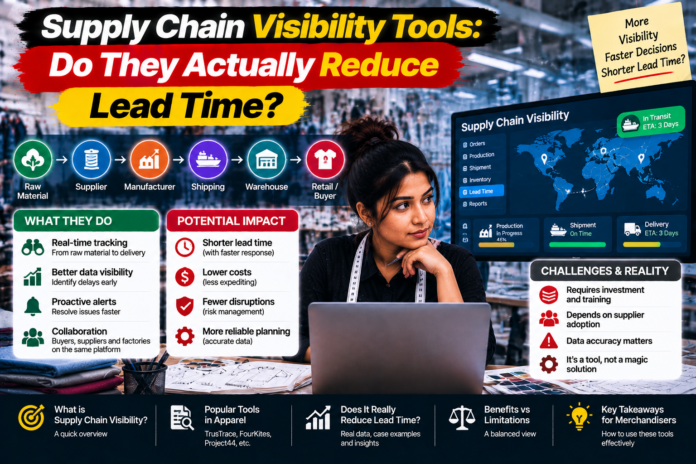
Supply chain visibility tools do not reduce lead time on their own. They reduce uncertainty, which is a different thing, and sometimes a precondition for reducing lead time. Whether they actually shorten the calendar depends on what you do with what they show.
That’s not a popular answer in a vendor presentation. But it matches the little independent evidence there is. A quantitative study of increased supply chain visibility found no strong evidence of improved performance from establishing visibility with first-tier partners alone. Seeing more is not the same as performing better. And a case study of a Bangladeshi garment factory, where executing one order took 208 days, found through root cause analysis that the lack of process data visibility was the most significant issue. It’s a single, older study, but it shows both sides of the point: invisibility is a real problem, and fixing it is where the work starts, not where it ends. sciencedirectresearchgate
Meanwhile, the claims in the marketing material are strong. One vendor of RFID-based factory tracking reports client deployments with up to 40 percent fewer production delays and 30 percent faster turnaround. A software vendor’s guide cites an analyst survey in which companies combining visibility, analytics and AI achieved a 30 percent reduction in new-product lead times. These may be true in the cases described. But they’re vendor-reported, they describe the best deployments rather than the average, and they don’t tell you what the factories did with the data. Treat them as the ceiling, not the forecast. fibre2fashionoracle
What lead time is actually made of
To understand why visibility alone doesn’t shorten it, look at what a 90-day lead time contains. Here’s an illustrative breakdown for a knit basics order. The numbers are made up but typical in shape.
| Stage | Days | Mostly working or waiting? |
|---|---|---|
| PO confirmation to fabric booking | 5 | Waiting (approvals, decisions) |
| Yarn, knitting, dyeing and finishing | 28 | Working |
| Fabric testing and approval | 6 | Waiting |
| Pre-production sample and approval | 10 | Waiting |
| Cutting, sewing and finishing | 22 | Working |
| Inspection and documents | 4 | Working |
| Inland transport, port and loading | 7 | Waiting |
| Unexplained gaps | 8 | Waiting |
| Total | 90 |
Add it up. About 54 days are real work. About 36 are waiting: for a buyer’s answer, for a lab result, for a truck, for a decision, for someone to notice a delay. Visibility tools mostly can’t make the 54 days shorter. A dye bath takes as long as a dye bath takes. But they can expose the 36, and the 36 is where most factories have room to move.
There’s also a structural part that no dashboard touches. Older studies of the Bangladeshi industry, mostly describing woven programs and the industry as a whole, found that imported fabric adds a month or more to lead time. One put the time added by fabric at 30 to 40 days, and another linked heavy import dependence to delays of 55 to 75 days. Those figures come from older research and vary with the product, but the lesson holds: if your lead time is long because fabric comes from abroad, a very good tracking screen will show you exactly how long the ship takes. It won’t make the ship faster. austinpublishinggroupacademia
Where visibility genuinely helps
So where do these tools earn their keep? In four places, and each works through a different mechanism.
1. Approvals and comments. This is often the biggest pool of waiting time, and the one most invisible in email and chat. A tool that logs every sample, comment and approval, with dates and owners, shows exactly how long things sit. In my earlier piece on T&As, the lesson was that approve-by dates and float tell you where a delay will hurt. Visibility is what lets you see, day by day, that a comment is eating that float.
2. Material tracking. “Where is my fabric?” is the most common question in a merchandising office, and the most expensive when answered late. Tracking fabric and trims from supplier to store lets you spot a late delivery while there’s still time to expedite or re-sequence, instead of discovering it on cutting day.
3. Shop-floor bottlenecks. Real-time output by line and by style shows where work is piling up. A line that quietly falls behind at ten in the morning can be helped by two in the afternoon, rather than being found at the end of the day. That doesn’t make sewing faster, but it prevents a small delay from compounding into a large one.
4. Shipment and port stages. Knowing which containers are where, and which documents are stuck, shortens the tail of the process, which is often full of avoidable waiting.
Notice the pattern. In every case the tool does not remove time. It finds time, and then a person has to act.
Where visibility doesn’t help
It’s equally important to know where the benefit is zero, or negative.
When no one owns the response. A red cell that nobody is responsible for clearing is just decoration. This was Tamanna’s point at the meeting. A dashboard without owners becomes a more expensive way to watch the same delays.
When the delay is structural. If fabric must be imported, if the port is congested, or if the buyer’s approval process takes two weeks, seeing it clearly doesn’t shorten it. Structural problems need structural answers: nearer sourcing, earlier booking, different approval agreements.
When the data is poor. A tool is only as good as what goes into it. If the floor enters output at the end of the shift, the “real-time” dashboard shows yesterday. If statuses are updated only when someone remembers, it will confidently show the wrong picture, and false confidence is worse than honest uncertainty.
When it creates reporting work without decisions. Some deployments add data-entry burden to supervisors and merchandisers without changing any decision. People quietly stop updating, and the tool decays.
What visibility points you toward
Once the waiting time is visible, the fixes tend to fall into a few familiar groups:
- Run steps in parallel. Book fabric testing slots when you book the fabric, and start trim orders as soon as artwork is approved, instead of waiting for everything in sequence.
- Set response times. A buyer comment or internal approval with an owner and a one-day target rarely sits for four.
- Reserve capacity early. Transport, lab and finishing slots booked against the plan cost little. Booked after the goods are ready, they cost days.
- Shrink the batch. Where the buyer allows it, shipping in two lots can pull the first delivery forward.
None of these needs software. All of them need to know where time is actually going.
How to judge a visibility tool
Before buying, or when deciding whether the one you have is working, I’d ask five questions.
- Which specific decision will this change? If the answer is “we’ll have better visibility”, push further. Name the decision: reorder fabric earlier, reroute a line, escalate a comment, rebook a truck.
- Who acts, and how fast? Every alert needs an owner and a response time. If nobody can name them, the tool will produce noise.
- How fresh is the data, and who enters it? Ask how data is captured: scanning, automatic feeds, manual entry. The more manual the capture, the more you should doubt the “real-time” label.
- What’s our baseline? Measure waiting time per stage before you start. If you don’t know how long approvals sit today, you can’t tell whether the tool helped.
- What will we measure afterwards? Pick two or three numbers: average days from sample submission to approval, percentage of stages completed on their planned date, days between a delay occurring and someone knowing about it.
That last one, the gap between a delay happening and someone knowing, is the cleanest measure of what visibility does. If it drops from three days to three hours, the tool is working, whether or not average lead time has moved yet.
The honest limits
I haven’t tested any specific product, and I’m wary of general claims either way. The research on visibility is mixed, a lot of the published numbers come from vendors, and the Bangladesh-specific studies I found are mostly older. Real results depend on your product mix, your buyers, your suppliers and, above all, your discipline in acting on the data.
I’m also not arguing against these tools. In most factories, better visibility is a sensible investment, because you can’t fix what you can’t see. The argument is that it’s the first step of a loop, not the whole loop. Seeing, deciding and acting all have to happen, and the tool only does the first.
Back to Tamanna
After the meeting, Tamanna did what the dashboard hadn’t. She took the last twelve orders and drew the timeline for each, marking every stretch where nothing was happening. It wasn’t sophisticated. A whiteboard and a lot of coloured pens.
The pattern was clear. The longest waits weren’t on the floor. They were in the gaps between stages: buyer comments sitting for four days because nobody had assigned a response time, fabric tests waiting for a lab slot nobody had booked in advance, and trucks booked only after the goods were ready.
The dashboard had shown all of this the whole time. Nobody had looked at it that way.
So they made small, unglamorous changes. Every buyer comment got an owner and a one-day response target. Lab slots were booked when fabric was booked, not after. Transport was reserved against the planned finishing date, not the actual one. And on the dashboard, the first thing anyone saw each morning was no longer the colourful bars, but a short list: what has been waiting the longest, and who is on it.
Over the next four orders, average lead time dropped from ninety days to eighty-one. Not dramatic. Not the 40 percent in a brochure. But real, repeatable, and traceable to specific decisions.
The owner asked her, a little sheepishly, whether the dashboard had worked after all.
“Yes,” she said. “Once we started treating it as a list of things to fix, instead of a picture of things to watch.”
That’s the answer to the question in the title. Visibility tools don’t reduce lead time. People reduce lead time, using what the tools reveal. The tool decides whether you see the delay. You decide whether it stays.