
Exclusive content
At ten past four on a Friday afternoon, two merchandisers received the same email.
The buyer wanted an 8,000-piece order, due to ship in three weeks, brought forward by one week. The email was polite, and ended with “please confirm by end of day.”
Rafiq, three years into the job, felt his stomach drop. He read it twice, then forwarded it to the production manager with one line: “Buyer wants a week earlier, can we do it?” Then he walked to the production office, stood waiting, and rehearsed what he would say to the buyer if the answer was no.
Two desks away, Shahana read the same email and did something that looked, from the outside, like nothing. She opened three files. The first was the T&A for the order. The second was the factory’s capacity sheet for the next four weeks. The third was her costing for the style.
Ninety seconds later she knew four things. The fabric was already dyed, so the colour-dependent steps were safe. The final inspection buffer was five days, so the week could come out of there, but it would leave nothing for a re-inspection. Line three was running at its compliant hour limit, so overtime wasn’t an option. And a partial air shipment of 2,000 pieces would cost about the same as the factory’s whole profit on those pieces.
She picked up the phone, called the buyer’s merchandiser and said: “We can’t pull the whole order forward without breaking our working-hour limits. But I can offer two options. We ship 6,000 on the original date minus a week, by sea, and the balance on the original date. Or we ship everything on the original date and I send 2,000 by air at the buyer’s cost, which I can quote you in the next hour. Which fits your launch better?”
The buyer chose the split. The whole conversation took nine minutes.
Rafiq was still waiting outside the production office.
Both of them were good merchandisers. Both worked hard. Both cared about the buyer. But they were operating at different levels, and the difference had very little to do with how many years each had been in the job. This article is about that difference, because it’s the gap most merchandisers want to cross and few get a clear map for.
It isn’t years, and it isn’t title
First, what the gap is not.
It isn’t time served. Plenty of merchandisers have ten years of experience that is really one year repeated ten times. Seniority is built by what you learn from the years, not by how many you collect.
It isn’t volume. Handling more orders makes you busier, not more senior.
It isn’t working late. A merchandiser who stays until nine every night is often a merchandiser whose process creates emergencies. The senior version usually leaves earlier, because they’ve removed the causes.
And it isn’t a title. Some people with “Senior” in theirs still work like a junior, and some without it already work like a senior. The title follows the behaviour, usually late.
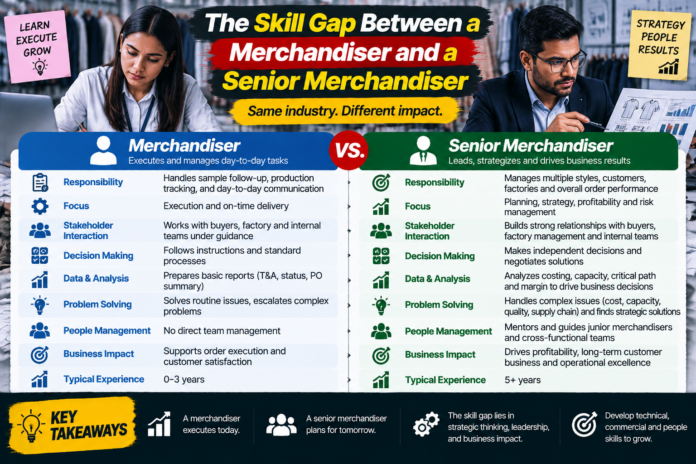
So what is the gap? I’d describe it as seven shifts in how a merchandiser thinks and works.
Shift one: from tasks to outcomes
A merchandiser is given tasks and completes them. Book the fabric. Chase the sample. Send the comments. Update the T&A. Each task gets done, and the merchandiser’s job feels finished when the list is.
A senior merchandiser owns outcomes. The outcome isn’t “fabric booked”. It’s “the order ships on time at the quoted margin.” That one change in definition changes everything, because outcomes have dependencies that tasks don’t. The fabric booking matters only if it arrives in time for knitting, with the GSM that won’t blow the consumption, from a mill that can hit the shade.
When Shahana looked at the buyer’s email, she didn’t think “what should I do next?” She thought “what is this order supposed to deliver, and what puts that at risk?” The first question produces action. The second produces judgment.
Shift two: from reporting problems to bringing options
Rafiq’s email to production was reasonable. He asked a real question. But it passed the problem along without adding anything, and it left him waiting for someone else’s answer.
A senior merchandiser rarely forwards a problem without a view. They arrive at a conversation with the facts, the constraints and at least two ways forward, each with its cost. It’s the pattern from the T&A article: reply quickly, with the impact in plain numbers, and offer options.
A production manager can answer “can we do a split shipment of 6,000 and 2,000?” in thirty seconds. “Can we do it?” can take an hour of back and forth.
Shift three: from knowing the process to knowing the money
Almost every merchandiser knows the process: sample, approve, book, produce, ship. The gap opens when one starts to understand the money moving through it.
A merchandiser might know that fabric is booked at a certain price and consumption. A senior merchandiser knows what a 5 percent GSM tolerance does to that: on an 80,000-piece order, nearly $5,430 in extra fabric cost, a third of the profit. They know that a 10 percent rise in the yarn price eats nearly half of it. They know why a buyer’s costing template shows a different fabric number, and how to reconcile the two in a sentence.
They also see the costs nobody puts in the quote: the compliance line, the testing line, the finance cost, the data and traceability work that buyers will increasingly expect. They understand that audit readiness and overtime are costing decisions, and that an early ship date has a real price even when nobody writes it down.
You don’t need an accounting degree. You need to look at a quote and say, with reasons, where the margin is safe and where it isn’t.
Shift four: from reacting to anticipating
A merchandiser fixes problems that have appeared. A senior merchandiser prevents the ones that haven’t.
That sounds abstract, so here’s what it looks like. Before cutting begins, they test the actual fabric GSM and width and rebuild the consumption. They notice that a dark shade needs wet-rubbing and skew tests, because they’ve seen what happens when it doesn’t get them. They check the capacity sheet before accepting a rush. They know the approve-by dates in the T&A, and call the buyer when a comment is eating the float, not after it has eaten it.
Anticipation isn’t psychic. It’s pattern recognition, built by keeping a record of what went wrong, why, and what would have caught it.
Shift five: from handling people to building relationships
Every merchandiser deals with the buyer, the mill, the production team and the quality department. Many treat these as transactions: ask, receive, move on.
Senior merchandisers invest in the relationship, because they know the transaction will fail someday and the relationship is what carries it. They know the buyer’s real priorities, not only the ones in the email. They know which mill delivers on time and which only promises. They know the production manager’s constraints well enough to ask for things that are possible, which is why they get more cooperation.
They also tell the truth early. Bad news is worse the later it arrives, and a senior merchandiser tends to call first. It costs a little comfort and earns credibility for years.
Shift six: from saying yes to knowing when to say no
Early in a career, “yes” feels safe. The buyer is happy, the manager is happy, and the consequences are somebody else’s problem later.
A senior merchandiser has seen where yes leads: overtime that becomes an audit finding, a rush that becomes a quality failure, a price that becomes a loss. So they say yes carefully, with conditions, and sometimes no, with alternatives. “We can’t do that within compliant hours, but here’s what we can do” is a stronger sentence than “we’ll try.”
This isn’t about being difficult. It’s about protecting the order, the factory and the relationship from a promise nobody could keep.
Shift seven: from doing the work to multiplying it
The last shift is the one many people miss. A merchandiser does their own work well. A senior merchandiser makes other people’s work better.
They write down what they learn, so the next person doesn’t repeat the mistake. They build templates, such as a costing sheet that matches buyer formats or a data sheet for new styles. They coach juniors through their first difficult buyer call instead of taking over. They raise a recurring problem with the right department, not just work around it.
A team with one senior merchandiser should get better over time. That’s the test.
The gap at a glance
| Area | Merchandiser | Senior merchandiser |
|---|---|---|
| Focus | Tasks completed | Outcome delivered, at margin |
| Problems | Reports them | Arrives with options and costs |
| Money | Knows the process | Knows where margin is made and lost |
| Timing | Reacts | Anticipates |
| Relationships | Handles contacts | Builds trust, delivers bad news early |
| Requests | Says yes | Says yes with conditions, or no with options |
| Team | Does own work well | Makes others better |
How to close the gap
You can’t acquire seniority by waiting. But you can practise it deliberately.
Build your own cost breakdown. Take one style and itemise every line, from yarn to profit. Then check it against the actual cost after shipment. Doing this once teaches more than a year of using someone else’s template.
Track outcomes, not just tasks. For every order, note the quoted margin, the actual margin and the reasons for the difference. Over a dozen orders, patterns emerge.
Ask “what happens next?” three times. When something goes wrong, don’t stop at the first answer. If the fabric is late, what happens to cutting? What happens to the ship date? What happens to the buyer’s launch? You’ll start to see consequences before they arrive.
Write option-based messages. For a month, never send a problem without at least two ways forward and the cost of each. It will feel slow at first and quickly become automatic.
Spend time on the floor. Know how long a line really takes to change a style, what makes it fall behind, and what overtime does to the records.
Learn the adjacent topics. You don’t need to be an expert in tariffs, audits, testing or data, but you do need to know enough to ask the right question. Many of the biggest recent shifts in the industry, from preference rules to product passports, will land first on the merchandiser’s desk.
Review your mistakes. After a problem, write down what happened, what you missed and what would have caught it. Do it without blame. It’s the cheapest training available.
Teach someone. Explaining a concept to a junior is the quickest way to find out whether you really understand it.
The honest limits
Not every company defines “senior merchandiser” the same way, and some organisations promote on tenure rather than skill. You may have a manager who doesn’t give you exposure to costing or buyer calls, and some of these shifts are hard to make without it. If so, ask for it directly: a seat in a cost discussion, a chance to run a buyer call, a review of a past order’s margin. Also, not everyone wants to be senior, and that’s a perfectly good choice. A brilliant merchandiser who loves the work at their current level is not “stuck”.
And these seven shifts are my own description, drawn from how the work tends to look, not a formal competency model. Treat them as a mirror, not a scorecard.
Back to Friday afternoon
At twenty to five, Rafiq finally got an answer from the production manager. “We can do 6,000 early if the cutting plan changes. But why did you send me the whole order? Tell me what you actually need.”
He walked back to his desk, a little embarrassed. Shahana looked up.
“How did it go?”
“They said they can do part of it. Which, I think, is what you offered the buyer.”
She nodded. “Want to see how I got there?”
She showed him the three files: the T&A with its float, the capacity sheet, the costing. She walked him through the nine minutes, one decision at a time, and what each one had been based on. Nothing she did required genius. It required knowing where to look, and having looked at those things before the email arrived.
“Open the capacity sheet before you do anything else next time,” she said. “You’ll see most of the answer in two minutes.”
The following month, a different buyer sent Rafiq a similar email. He opened the capacity sheet first.
That’s what the gap really is. Not a mystery, and not a quality you’re born with, but a set of habits: look at the whole outcome, bring options, know the money, see it coming, tell the truth early, say no with an alternative, and pass it on. Every one of them can be practised, starting with the next email.