
Exclusive content
Two messages arrived on Rubina’s phone within ten minutes of each other, and together they told the whole story of the autumn.
The first was a link from her managing director, sent without comment. The headline: Govt mulls wage increase for RMG workers. The second was an email from a European buyer, polite and brisk. They were ready to confirm the spring program, and could she please reconfirm the prices as “flat to last season”?
Rubina, a senior merchandiser, set her phone down and opened her costing sheet. She had spent the last six weeks in a factory where the dyeing section had run on and off with gas pressure near zero, the generators had burned diesel by the thousand litres, and two shipments had been air-freighted to hold their dates. And now the buyer wanted last season’s price, and the government was talking about the first wage rise in nearly three years.
She did what experienced merchandisers learn to do when too many numbers are moving at once. She stopped reacting and started listing. What exactly has changed in our costs, by how much, and which of those changes are permanent?
This article is that list, as of early October 2026. It’s a snapshot, not a forecast, and several of these numbers will move before you finish reading. But a snapshot is exactly what you need when you’re about to be asked to hold a price.
The wage line: a new board is coming
Start with the cost everyone is talking about this week.
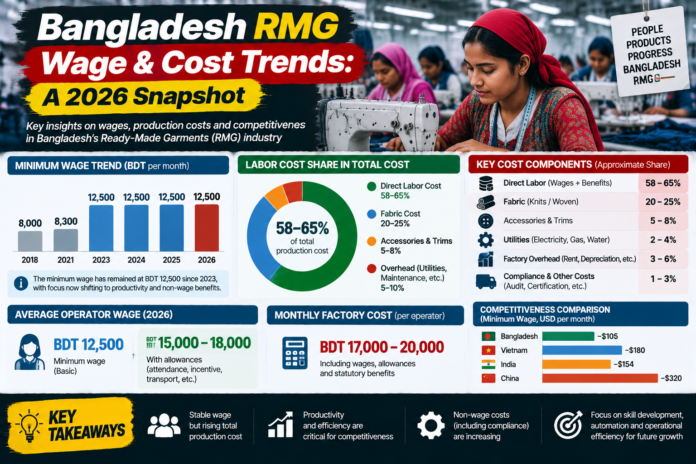
The government raised the minimum wage for garment workers to Tk12,500, about $100, in December 2023, an increase of more than 56 percent on the previous level. Since then, the Business Standard reports, inflation has remained persistently above 9 percent, which has eroded much of that gain in workers’ purchasing power.
Now the government is considering forming a new wage board. The labour ministry’s secretary said that owners’ association leaders “didn’t disagree” in an informal meeting, and that the board would hopefully be formed by October. In late 2025 the interim government amended the Labour Act to shorten the interval between minimum wage revisions from five years to three, and labour leaders argue that the next wage is therefore due by December 2026. They want a new minimum by December so that workers can receive it from January.
Owners have raised an objection on timing. The president of BKMEA said this isn’t the right time to increase wages, citing declining export orders, rising production costs and the fact that factories aren’t receiving corresponding prices from buyers. He also disputed the way the amended law is being read, arguing that a legal change can’t apply retroactively.
Two things for a merchandiser to take from this. First, a wage increase isn’t a sure thing yet, and its size and date are unknown. The process of forming a board, holding meetings, receiving proposals and getting approval and a gazette previously took about six months, so a December decision would be fast. Second, even a modest rise will arrive in the middle of a spring or summer program you’re quoting now.
The energy line: the biggest swing factor
If wages are the cost that’s coming, gas is the cost that’s already here.
Bangladesh’s gas crisis has been running since 21 July. By mid-August, gas supply to the national grid had fallen to around 2.03 billion cubic feet a day against demand of about 3.85 billion, a shortfall of roughly 1.77 billion. A fire at an LNG terminal at the end of July was reported to have cut supply by about 40 percent. BGMEA data cited at the time suggested that production at many garment factories had fallen to around 50 percent, and one large industrial group said its factories needed around 65,000 litres of diesel a day, costing about Tk70 lakh.
The textile base is where it hurts most, because dyeing, finishing and captive power run on gas. In Narsingdi, over 100 textile factories halted production, and one mill reported it had shut seven of its ten units while receiving a fraction of the gas it needs. In September, four trade bodies, BGMEA, BKMEA, BTMA and the terry towel association, petitioned the gas transmission company for a weekly zonal rationing scheme, noting that around 6,500 textile and garment factories, 94 percent of the country’s total, sit within the Titas Gas area.
Fuel costs for factories forced onto alternatives have risen sharply, with one report describing a fivefold jump. And one headline quotes an official saying the power and gas crisis may take at least two years to resolve. That is an opinion, not a forecast I can verify, but even a fraction of that timeline changes how you should price.
For merchandisers, energy matters in three ways at once. It adds to cost: diesel and other substitutes for gas are far more expensive. It adds to time: dyeing delays push back cutting, sewing and shipping, which can mean air freight. And it adds to risk: a lead time you quoted in good faith may no longer be realistic.
The money line: financing and the taka
Two quieter lines complete the picture.
Financing. The weighted average lending rate of scheduled banks stood at 11.86 percent in June 2026, with the deposit rate at 6.16 percent. The central bank held its policy rate at 10 percent for the first half of this fiscal year, aiming to restrain inflation. Analysts expect weak loan demand to pull lending rates down in the short term, but persistent government borrowing and rising import costs could push them up later. For a factory that finances yarn and fabric weeks before it gets paid, every extra week of delay, whether from gas or from port, quietly adds to the finance line in the cost sheet.
The taka. The taka has been trading around Tk122 to Tk123 to the dollar, averaging about 122.88 in September after a peak near 123.29 in July. A weaker taka raises the local cost of imported fuel, machinery and raw materials. For an exporter it also raises the taka value of dollar earnings, so the net effect depends on your import content, which is high for factories buying imported fabric or yarn. The US Federal Reserve’s September increase to 3.75 to 4.00 percent adds a further layer of uncertainty, because a stronger dollar can push up import costs and the cost of dollar-denominated loans.
What it does to one T-shirt
Numbers are easier to feel when they’re attached to a garment. Here’s an illustration using the same plain tee used throughout this series: $3.20 FOB, a 19-cent profit, a cut-and-make cost of 80 cents of which about 40 cents is sensitive labour cost, a dyeing and finishing cost of 35 cents and a finance line of 8 cents. The scenarios below are illustrative, not forecasts.
| What moves | Illustrative assumption | Extra cost per piece | Share of the 19c profit |
|---|---|---|---|
| Wages | Labour-sensitive cost up 15% | about +6 cents | about 32% |
| Energy | Dyeing and finishing cost up 30% from fuel substitution | about +10.5 cents | about 55% |
| Financing | Lending rate up 2 points (finance line 8c) | about +1.3 cents | about 7% |
| All three together | about +17.8 cents | about 94% |
The point isn’t that any specific scenario will happen. It’s that the margin on a basic tee is so thin that three ordinary-looking cost movements can consume nearly all of it. And the energy line, which was not in anyone’s plan a year ago, is the largest.
What buyers are saying, and what they aren’t
Rubina’s buyer wanted flat prices. That’s not unusual, and it’s not necessarily unreasonable from their side: their own costs and consumer price pressures are real. Meanwhile BKMEA’s president says factories aren’t getting corresponding prices from buyers, while exports in the first quarter of the new fiscal year did grow, as I covered in the first issue of this newsletter. A growing export number and a squeezed margin can coexist. Volume isn’t profit.
It’s also worth being honest about the buyer’s perspective. Buyers know about the gas crisis; they read the same news. What they often don’t see is the detail of how it hits a specific order: the diesel, the delayed dyeing, the air freight. That’s the part a merchandiser can supply.
What a merchandiser can do about it
You can’t fix the gas grid or set the minimum wage. You can change how you quote, plan and communicate.
Date your quotes. A price quoted today for a shipment in four to six months should say what it assumes and how long it’s valid. Shorter validity windows, for example 15 or 30 days instead of 90, are reasonable in a volatile year.
Itemise the volatile lines. Show labour, energy and fabric separately in the costing, so that when one moves you can discuss that line, not the whole price. This is the same logic as itemising sustainability costs: a buyer can discuss 4 cents for energy more easily than “costs have gone up”.
Build price-adjustment terms. For longer programs, propose a clause that ties part of the price to a defined trigger, such as a gazetted wage increase, rather than renegotiating from scratch each time. Many buyers will resist, but putting it on the table starts the conversation.
Plan for disrupted lead times. Add buffer before dyeing and before ex-factory, as in the T&A article. Ask the dyehouse how it will handle low gas pressure, and whether it has alternative capacity or a fuel plan. A lead time that assumes normal gas is a promise you may not be able to keep.
Cost the rescue before you need it. Know the price of air freight and of a split shipment before the order slips, not after. If the buyer wants an early date, you can show the cost of reaching it.
Tell buyers early and with numbers. A short note explaining the specific disruption, what it does to your lead time and what you’re doing about it builds more trust than silence followed by a late shipment. Where the buyer is open to it, share the cost lines that have moved.
Track a monthly cost snapshot. A simple one-page sheet with the key inputs: minimum wage, diesel and gas assumptions, lending rate, exchange rate, yarn price. Update it monthly. When a buyer asks for flat prices, you’ll have a reasoned answer rather than a feeling.
The honest limits
This is a snapshot built from news reports and published data as of early October 2026, and much of it will change: the wage board may or may not form on schedule, the gas supply may recover faster or slower than officials expect, and the taka and interest rates could move. Some of the figures, such as the fivefold fuel cost jump and the two-year timeline, come from single reports and I haven’t been able to confirm them independently. The T-shirt scenarios use the same illustrative cost structure as earlier pieces and are not predictions. And I’m not an economist, so treat the way I’ve linked these factors together as a merchandiser’s reading, not an economic model.
Back to Rubina
Rubina spent that evening building a single page. It had five rows: wages, gas and diesel, financing, the exchange rate, and lead time risk. Next to each she wrote what had changed since the last season, whether it was already in the cost or still to come, and what it was worth per piece on the buyer’s style.
The next morning she called the buyer instead of replying by email. She didn’t ask for a higher price. She walked through the page.
“We can hold the price for the fabric and trims,” she said. “The pressure is in energy and in timing. We’d like to quote the spring program with a defined validity until the end of the month, and we’d like to discuss a trigger clause if a new minimum wage is gazetted during the program. Separately, I want you to know our dyehouse has been running on reduced gas since July, so I’d suggest we add five days to the lead time to protect the date.”
The buyer was quiet for a moment. “That’s the clearest account of the situation I’ve had from anyone in Dhaka,” she said. “Send me the page.”
The prices weren’t flat in the end. They moved by a few cents on two lines, with a review clause agreed for the wage board’s outcome. It wasn’t a victory. But it was a negotiation about specific, visible numbers rather than a standoff about a feeling, and it left Rubina’s factory with a lead time it could actually keep.
That’s what a good cost snapshot is for. Not to predict what happens next, which nobody can, but to make sure that when the next message arrives asking you to hold the line, you know exactly what the line is made of.