
The hangtag mock-up was beautiful. Soft green paper, a small leaf icon, and three bold words across the front: Planet-Friendly Cotton.
Imran held it between two fingers while the buyer’s sustainability lead walked the room through the new capsule. Twenty thousand organic-leaning basics, launching in the spring, with a campaign built around the claim on that tag. The buyer’s team was proud of it, and Imran, a senior merchandiser who had spent three weeks costing the program, understood why.
Then the buyer’s merchandiser turned to the commercial slide. “Our target FOB for this program is the same as last season’s basic tee,” she said. “Sustainability is a core value for us, but the margin structure has to hold.”
Imran looked at his costing sheet, which he had printed and folded into his notebook. The certified yarn alone added eighteen cents a piece. Add certification, chain-of-custody paperwork and extra testing, and the shirt cost about twenty-six cents more to make than the one it replaced.
“May I ask what the tag will legally be allowed to say?” he said.
The room went quiet. It wasn’t a hostile question. It was the one nobody had asked yet.
The buyer’s legal counsel, who had been silent in the corner, cleared her throat. “That’s actually the right question,” she said. “As of last week, ‘planet-friendly’ might not survive.”
That moment contains the whole subject of this article. There is what a garment claims, and there is what it costs to make that claim true and provable. For years the first was cheap and the second was ignored. That is changing, and merchandisers are standing exactly where the two meet.
Two different things
A sustainability claim is something said about a garment: on a hangtag, in a campaign, in a product listing. “Eco-friendly.” “Made with recycled fibres.” “Carbon neutral.”
A sustainability cost is everything it takes to make such a statement true, and to be able to prove it. The fibre itself, the certification, the segregation of certified material from ordinary material, the testing, the audits, the data, and sometimes investment in a cleaner process.
Claims cost almost nothing to write. Costs land on the factory floor. And for a long time, nobody had to connect the two.
The rule that changed in September
On 27 September 2026, a new set of EU rules started applying. The Empowering Consumers for the Green Transition Directive prohibits generic environmental claims made without proof, and self-created or self-certified sustainability labels, and bans product-level “carbon neutral” claims based on offsetting. There is no transition period.
It’s worth getting the picture right, because it’s often muddled. A separate proposal, the Green Claims Directive, which would have set the proof and verification rules, has been paused since June 2025. That doesn’t loosen anything. The Empowering Consumers Directive is already adopted and applies on its own.
It also doesn’t ban green messaging. A specific, substantiated claim, such as a stated share of recycled content backed by a certificate, is a very different thing from a vague adjective on a tag. But it does mean that every claim now needs a paper trail, and the paper trail starts upstream, in the data that factories and their suppliers hold.
For merchandisers, the practical effect is a change in the buyer’s questions. They used to ask “can you make it greener?” They are starting to ask “what exactly can we say, and can you prove it?”
What consumers say, and what they pay
The commercial logic behind sustainability programs usually rests on consumer willingness to pay. The numbers are encouraging at first glance. One widely cited survey found that more than 80 percent of consumers said they would pay more for sustainably produced goods, with an average stated premium of 9.7 percent. A market analysis suggests the committed “sustainability seekers” are roughly a quarter of fashion consumers and willing to pay about 15 percent more.
Notice the word stated. Surveys capture intentions, and what people say in a questionnaire and what they put in a shopping basket are not the same thing. Buyers know this. It’s one reason they’re cautious about passing cost increases through to the shelf, and one reason the commercial slide in Imran’s meeting looked the way it did. The marketing team wanted the claim. The commercial team wanted the old price. Neither was being unreasonable, and the gap between them lands on the supplier.
What it actually costs: four layers
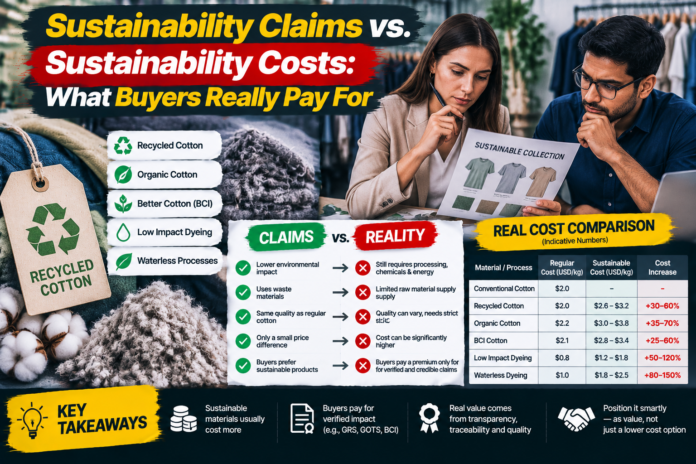
Here is how the cost of a sustainability claim breaks down on a garment. The numbers are illustrative, built on the same $3.20 plain tee used elsewhere in this series, and your own figures will differ.
| Layer | What it is | Illustrative cost per piece |
|---|---|---|
| Material premium | Certified organic or recycled fibre instead of conventional | +18 cents (assuming yarn costs 20% more) |
| Proof | Certification, chain-of-custody paperwork, segregation, audits | +3 cents |
| Testing | Extra lab tests to support the claim | +2 cents |
| Data | Traceability systems and staff time | +2.5 cents |
| Total | about +26 cents |
That is roughly an 8 percent rise on the FOB. If the buyer holds the price at $3.20, the factory’s 19-cent profit becomes a loss of about 7 cents a piece. The shirt only works commercially if the premium is shared, funded or declined.
Two things about this table are easy to miss. First, the material premium is the part everyone expects. The proof layers are the ones that get underestimated. One industry guide on sustainable fibre sourcing makes the point that the big cost driver is often not the fibre price alone but the “compliance stack” of certification, traceability systems, audits, testing, segregation and documentation, which adds a hidden premium that procurement teams underestimate.
Second, there’s a fifth layer that doesn’t appear per piece at all: process investment. Cleaner energy, water treatment, chemical substitution, new equipment. One industry article estimates $500,000 to $2.5 million per factory for energy transition, $50,000 to $300,000 for chemical compliance, and $20,000 to $150,000 a year for digital traceability, with the bill falling overwhelmingly on suppliers today. These are one author’s estimates and will vary enormously by factory, but the direction matches what many merchandisers describe: the benefits show up in brand reports, and the investment shows up in factory accounts.
What buyers really pay for
If buyers are cautious about paying for claims, what do they pay for? Reading across the evidence and the way these conversations tend to go, four things stand out. This is my interpretation, not a survey result.
Proof that survives scrutiny. With the new rules in force, a claim without evidence is a legal risk. Buyers will pay, or at least negotiate, for the documentation that makes a specific claim defensible. The value they’re buying isn’t greenness. It’s protection.
Risk reduction. Chemical compliance, traceability and clean audit records reduce the chance of a recall, a regulatory problem or a reputational crisis. At least one industry account says suppliers with strong traceability documentation are winning contracts that less transparent competitors lose.
Supply continuity. A supplier who knows exactly where every input comes from is easier to rely on when disruption hits, and buyers value that quietly.
Efficiency that lowers cost. Energy and water savings that reduce the factory’s costs are the easiest to agree on, because both sides benefit.
And what do buyers resist paying for? Generic claims they can no longer legally make. Duplicate audits for the same standard. And the stack of overlapping requirements from different customers. One industry piece describes how a factory producing for 10 to 20 brands faces conflicting expectations, which forces suppliers to aim for the highest standard at their own expense.
How to price it
Once you see the layers, you can negotiate them separately. A few approaches that help.
Itemise, don’t absorb. Put each layer on its own line in the quote: material premium, certification and chain of custody, testing, data. A buyer can discuss 3 cents for certification. They can’t discuss “sustainability costs a bit more”.
Use a formula for fibre. Index-linked pricing ties fibre cost to a benchmark such as a cotton or polyester index, with a defined premium for sustainability compliance: base commodity index plus certified premium plus conversion margin. It keeps the premium visible, and it moves with the market instead of being renegotiated blindly every season.
Separate one-off from recurring. A one-time investment in a water treatment system is a different conversation from a per-piece certification fee. Spread the first over a committed volume or several seasons. Charge the second per piece.
Ask for commitment in return. If you invest to make a claim possible, ask for volume or season commitments that make the investment worthwhile. A premium on a one-season trial order rarely pays back.
Know your walk-away line. If the buyer won’t fund the premium, decide in advance what you can do without it, such as a smaller certified share, or no claim at all, rather than agreeing and absorbing the loss.
Five questions before you quote
For any sustainability request, I’d ask these before touching the costing sheet.
- What exact claim will appear, and where? Specific and substantiated is cheap to defend. Vague is now risky.
- What evidence supports it? Which certificate, test or document, and who holds it?
- Who pays for the proof? Certification, chain of custody, testing and audits each need an owner.
- For how many seasons and what volume? A premium needs a horizon.
- Who owns the data afterwards? The data you collect may become part of the buyer’s own compliance record.
The honest limits
Much here is uncertain. The consumer figures are stated intentions from surveys, which tend to overstate real behaviour. The cost estimates come from industry commentary and vary widely. The legal picture is also still settling, with member states applying the new rules nationally, and how far enforcement will go remains to be seen. And I’m not a lawyer, so when it comes to what a particular tag can say, your buyer’s legal team is the authority.
I’m also not suggesting that sustainability is merely a cost to be passed along. Some of it genuinely saves money, and some of it protects the business from larger costs later. The point is narrower: if the claim is cheap and the proof is expensive, the price of the proof has to be on the table.
Back to Imran
Imran asked for twenty minutes with the buyer’s legal counsel after the meeting. Together they looked at the tag. “Planet-Friendly Cotton” couldn’t be proven and would be hard to defend. What could be proven was narrower: the share of certified recycled content, backed by a certificate that Imran’s mill already held.
So the tag changed. It would state the recycled content percentage, and the certification, and nothing more. It was less poetic and far easier to defend. The shirt would use a 30 percent recycled blend rather than fully certified fibre, which also made it cheaper to produce.
The commercial discussion got easier too, because now there was something specific to price. The recycled content added about nine cents a piece, including certification and the extra testing. Imran showed the buyer each line. In exchange for a commitment across two seasons, the buyer agreed to cover that premium in full.
It wasn’t the buyer’s original plan, and it wasn’t Imran’s. But the claim on the tag was true, the proof sat in a folder the factory could produce in an afternoon, and nobody was absorbing a loss to make a leaf look good.
That’s the pattern worth remembering. In a market that’s now policing what garments say about themselves, the claim is the cheap part. What buyers really pay for, and what merchandisers need to price, is everything that makes it true.