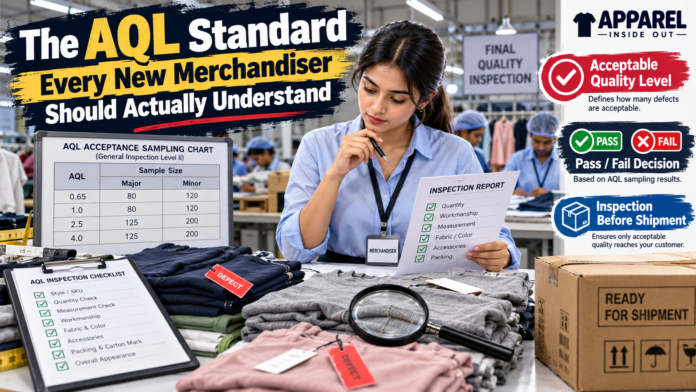

Sohel had been a merchandiser for six weeks when he stood next to a packing table and watched an order he’d nursed from sample to shipment fail its final inspection.
The inspector, a calm man in his fifties, had pulled 315 pieces from cartons across the warehouse, laid them out in rows, and gone through them one by one with a tape measure and a torch. When he finished, he wrote a number on his clipboard, looked at it for a moment, and turned to Sohel.
“Sixteen major defects. This lot does not pass.”
Sohel did the maths in his head. Sixteen out of 315. That was about five percent. The buyer’s spec said AQL 2.5, and 5 percent was only two and a half points above 2.5. Surely that was close enough to argue about?
“Sir,” he said carefully, “can I ask what the limit was?”
“Fourteen. Fifteen means reject.” The inspector tapped the page. “You were one defective piece over the line.”
One piece. Out of twenty thousand. And the shipment, due to sail in five days, would now be held for rework and re-inspection.
Sohel spent that evening trying to understand what had just happened. He had always thought of AQL as a defect rate, something like “2.5 percent is acceptable.” That reading was wrong in at least three different ways, and most new merchandisers make the same mistake. This article is the explanation he wishes he’d had on his first day.
What AQL actually is
AQL stands for Acceptable Quality Limit (some people say Level). It comes from a sampling standard, ISO 2859-1, and the idea behind it is simple. You can’t inspect every garment in a shipment. So you inspect a random sample, count the defective pieces, and use a table to decide whether the whole lot passes or fails.
That’s all it is: a rule for deciding, from a sample, whether to accept a lot. It is not a promise about how many defective pieces are in the shipment, and it is not a quality target for the factory. It’s a rule for the inspector.
The process has four steps.
- Find your lot size. The number of pieces being inspected for that inspection, such as a style or PO.
- Choose an inspection level. For garments, General Inspection Level II is the usual default.
- Look up the sample size. The lot size and level give you a code letter, which gives you the number of pieces to inspect.
- Compare defective pieces with the accept and reject numbers for each defect category.
The numbers that matter
Here are a few rows from the single-sampling table for normal inspection at Level II, using the most common apparel AQLs: 0 for critical defects, 2.5 for major, 4.0 for minor.
| Lot size | Sample size | Critical (AQL 0) | Major (AQL 2.5) | Minor (AQL 4.0) |
|---|---|---|---|---|
| 501–1,200 | 80 | accept 0 / reject 1 | accept 5 / reject 6 | accept 7 / reject 8 |
| 3,201–10,000 | 200 | accept 0 / reject 1 | accept 10 / reject 11 | accept 14 / reject 15 |
| 10,001–35,000 | 315 | accept 0 / reject 1 | accept 14 / reject 15 | accept 21 / reject 22 |
Larger lots use bigger samples, and the tables continue upward. If the sample size equals or exceeds the lot size, the inspector simply checks every piece.
Look at Sohel’s case. His lot of 20,000 pieces sits in the last row: a sample of 315, a limit of 14 major defective pieces, and a hard line between accept and reject. The inspector found 16. The difference between a pass and a fail was two pieces, and the line is not a judgement. It’s a table.
Three things people get wrong
1. “AQL 2.5 means 2.5 percent defects are fine”
This is the big one. It isn’t true, and if you believe it you’ll misjudge every inspection.
AQL describes the quality level at which a lot has a high chance of passing. It doesn’t mean a lot with 2.5 percent defects is guaranteed to pass, or that a lot with 5 percent is guaranteed to fail. Because the inspector looks at only a sample, luck is involved. Here is roughly how that works for the 315-piece sample with a limit of 14 major defective pieces (the numbers are approximate, calculated from basic probability):
| True share of defective pieces in the lot | Chance the lot passes |
|---|---|
| 2.5% | about 99% |
| 4% | about 72% |
| 5% | about 39% |
| 6% | about 15% |
| 8% | about 1% |
So a lot that really is 4 percent defective passes seven times out of ten. A lot with 5 percent defective passes about four times in ten. Meanwhile a lot at 2.5 percent almost always passes, but it is not impossible to fail it, and a very small sample makes the picture blurrier still.
For the factory, the lesson is uncomfortable. Passing an inspection doesn’t prove the lot was good, and failing doesn’t prove it was terrible. It proves that the sample, on that day, landed on one side of a line. The only way to be safe is to be comfortably better than the line, not hovering near it.
2. “Defects” and “defective pieces” are the same thing
They aren’t. AQL counts defective garments, not individual defects. A shirt with three flaws counts as one defective piece. A shirt with a single flaw also counts as one. That means the number on the inspector’s clipboard is about how many pieces are bad, not how many problems exist.
It also means a garment can be sorted into only one category: the most serious defect it has decides whether it is critical, major or minor.
3. “The classification is obvious”
Look at the three categories.
- Critical defects are those that could make the product unsafe or break a law: a broken needle fragment inside a garment, a sharp edge, a restricted substance. These get AQL 0, which means zero tolerance. One critical piece found fails the lot.
- Major defects are those likely to make the product unsellable or unusable: a hole, a wrong size label, a seam that opens, a serious stain, wrong colour.
- Minor defects are small departures that wouldn’t stop a customer buying: a loose thread, a slightly uneven hem, a small mark that comes off.
Notice what’s missing from those sentences: specifics. A stain “this big” on this part of the garment could be major to one buyer and minor to another. A measurement 1 cm out of tolerance may be major in one program and minor in the next. Every buyer has their own defect list, and a merchandiser who hasn’t read it is guessing.
Why this is a merchandiser’s problem
You might think inspection belongs to the quality team. But much of what decides the result is set before anyone touches a tape measure, and a lot of it is yours.
Agree the terms in writing. Before production starts, confirm the inspection level, the AQL for each category, the buyer’s defect definitions, and what the lot actually is: a style, a colour, a PO or a shipment. Ambiguity here turns into arguments on inspection day.
Know the re-inspection rules. What happens after a fail? Is it a full sort, a re-inspection at a bigger sample, or both? Who pays? A failed lot can cost far more than a few reworked pieces. As an illustration, if a failed 20,000-piece lot needs a full sort at 10 cents a piece, that’s $2,000 of labour, plus a re-inspection fee, plus the delay.
Protect the schedule. In my piece on T&As, I said the buffer between final inspection and ex-factory is among the most valuable ones in the plan. This is the reason. A fail eats days, and a shipment with no buffer after inspection is a shipment that depends on luck.
Cost for it. Quality isn’t free. If your factory’s real defect rate is 4 percent, you’ll fail a lot of inspections, and the rework and delays belong in the costing. The quality allowance line in a cost breakdown, which was about 6 cents in my example, is where that lives. If you leave it out, the cost shows up later as an emergency.
How factories actually pass
The factories that pass consistently don’t rely on the final inspection. They run quality earlier and tighter.
Inline checks. Defects found at the sewing line cost cents to fix. Defects found at final inspection cost much more.
An internal AQL stricter than the buyer’s. If the buyer’s limit is 2.5, a pre-final inspection at 1.5 gives a cushion against sampling luck. A lot that passes comfortably at the tighter level is very likely to pass the real one.
Random, honest sampling. The sample has to come from across the whole lot, from different cartons and sizes, not from the cartons that were packed carefully. A pre-selected sample isn’t just dishonest. It produces a pass that means nothing, and the buyer’s inspector will find the truth anyway.
Root cause on repeat defects. If the same defect keeps appearing, such as open seams on one line, fix the line, not the count.
Zero tolerance for critical items. Needle control, metal detection and chemical compliance exist because AQL 0 leaves no room for luck.
The honest limits
AQL is a useful tool, but it has well-known limits. It’s a statistical rule, so it can pass bad lots and fail good ones. It tells you nothing about what the defects are, only how many pieces had them, and a lot can pass with a worrying pattern hidden in the numbers. Some buyers use different plans, special inspection levels, tightened or reduced inspection rules, or their own proprietary systems. The tables here are for the common single-sampling, normal-inspection case at General Level II. Always check your buyer’s own quality manual.
Back to Sohel
After the fail, Sohel did three things.
First, he read the buyer’s quality manual all the way through, which nobody had asked him to do. It had a defect list with photographs, and he saw that the defect that had failed his lot, a small stain near the hem, was classified as major, not minor. Nobody on his team had realised.
Second, he sat with the quality manager and set up an internal pre-final check at a tighter limit. If the internal check found more than the cushion allowed, the lot didn’t go to the buyer’s inspector until it had been fixed.
Third, he added a line to his T&A: final inspection five days before ex-factory, not two.
The next order passed on the first attempt, with eight major defective pieces found in the sample against a limit of fourteen. The inspector wrote the number down, signed the form and, for the first time in Sohel’s experience, smiled.
“Good lot,” he said.
It wasn’t luck. It was a lot that sat comfortably under the line instead of hovering next to it. That’s what AQL is really asking of a factory. Not “avoid defects”, which is impossible, but “be so far below the limit that a sample can’t hurt you.” The table decides whether you pass. Everything you do before the inspector arrives decides whether the table matters.