
Rafiq bhai has been in this business for twenty-six years. He started as a floor supervisor when the factory only had ninety machines and no computer in the office. Now he sits on the second floor of a compliance-certified factory with three hundred machines, a proper merchandising team, and a wall full of buyer audit certificates. And still, almost every quarter, the same email lands in his inbox from a long-time buyer.
“Can you match Vietnam’s price?”
He used to have a simple answer for that. For twenty years, the answer was yes, because Bangladesh’s labor was cheaper, full stop. That was the pitch. That was the whole pitch. You didn’t need a fancy deck or a sustainability report. You needed a good price and a factory that could ship on time.
That world is quietly ending. And a lot of people in this industry haven’t fully accepted it yet.
The Number That Used to Explain Everything
For decades, one number did almost all the talking for Bangladesh: wage per hour. It was the lowest in the region, and that was enough. Buyers came because Dhaka, Chattogram, and Gazipur could make a t-shirt cheaper than almost anywhere else on earth.
That advantage still exists — Bangladesh’s average labor cost per hour, at around $0.95, is still noticeably lower than Vietnam’s $1.40 and India’s $1.20. On paper, that still sounds like a strong hand to play.
But Rafiq bhai has learned the hard way that “still the cheapest” and “still winning” are not the same thing anymore.
A few years ago, when the minimum wage jumped by 65 percent in one move, factory owners across the country did the math and realized their FOB costs had gone up by around 6 percent just to cover it. Buyers, the same buyers who had spent years demanding better wages and safer factories, only agreed to raise their prices by 1 to 3 percent in return. The rest of that gap didn’t disappear. It landed directly on factory margins, the same margins that were already thin to begin with.
Today, the minimum wage sits at 12,500 taka a month, a little over a hundred dollars — the lowest in the region, still, but not by the wide gap it used to be, and workers, buyers, and civil society groups are all pushing for it to rise further. Every time that number goes up, and it will keep going up, the old pitch gets a little weaker.
A Quarter That Told the Real Story
If you want proof that “cheap” alone isn’t carrying the industry the way it used to, look at what happened in the most recent quarter. Bangladesh’s RMG exports actually grew, rising 11 percent year-on-year to reach $10.10 billion. That’s a genuinely strong number, the kind that makes headlines and gets shared in WhatsApp groups across Motijheel and Gulshan offices.
But sitting right next to that good news, Bangladesh Bank’s own review carried a warning: the sector is facing rising production costs and tougher competition from rival exporting countries, all while the global economy stays shaky and unpredictable. And in a detail that says more than any headline number, the RMG sector’s actual share of Bangladesh’s GDP quietly slipped, from 8.52 percent down to 7.82 percent, even in a quarter where exports were growing.
Growing revenue, shrinking share of the national economy. That’s not a contradiction. That’s what it looks like when an industry is running fast just to stay in place, while other sectors, and other countries, start moving faster.
The central bank’s own review said the quiet part out loud: going forward, it’s export diversification, value-added production, and better productivity that will decide whether this growth holds up. Not another wage cut. Not another round of squeezing costs a little further. Something else.
What Karim Bhai’s Factory Figured Out By Accident
Down the road from Rafiq bhai’s factory, there’s a smaller unit run by a man everyone just calls Karim bhai. His factory isn’t bigger, and it isn’t newer. But two years ago, almost by accident, he stumbled onto something that changed how his buyers talked to him.
One of his regular clients, a mid-size European brand, started asking for something they’d never asked for before: not just a lower price, but proof. Proof of where the cotton came from. Proof of water usage in the dyeing unit. Proof that the factory could actually produce the sustainability report the brand needed to show its own customers back in Europe.
Karim bhai almost said no. It sounded like extra paperwork for no extra money. But he said yes, mostly because he didn’t want to lose the order. It took him almost a year to get the systems in place — tracking water, tracking waste, working with a smaller recycled-cotton supplier for one line of products.
And then something interesting happened. That buyer didn’t just keep placing the same orders. They placed more orders, and brought two new orders from sister brands under the same parent company, specifically because Karim bhai’s factory could already produce the documentation they needed. He wasn’t competing on price for those orders anymore. He was competing on being ready, when most factories around him weren’t.
That’s the shift happening quietly across the industry right now. Buyers aren’t only asking “how cheap.” They’re asking “how ready” — ready with compliance, ready with transparency, ready with sustainability numbers they can actually defend to their own customers.
The Pitch That’s Replacing “Cheapest”
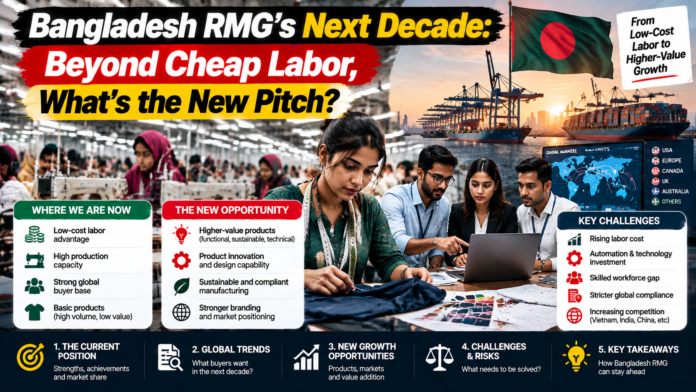
If you sat Rafiq bhai and Karim bhai down together and asked them what the new pitch for Bangladesh actually is, it wouldn’t be one thing. It would be a combination, stacked on top of the old advantage instead of replacing it entirely.
The first piece is still price, because Bangladesh genuinely hasn’t lost that edge yet. It’s just no longer enough on its own.
The second piece is speed and reliability — lead times, on-time shipment, and a track record buyers can actually trust when they’re placing large volume orders and can’t afford delays.
The third piece, and the one growing fastest in importance, is exactly what happened to Karim bhai: compliance and sustainability that can be proven, not just claimed. Ethical sourcing pressure from younger, more conscious consumers is pushing brands to demand real evidence of fair wages and safe, responsible manufacturing, not just a certificate hanging on a wall that nobody checks.
And the fourth piece, the one still missing in most factories, is value-added production — moving up from simple basics into more complex, higher-margin garments where price competition matters less, because fewer factories can actually do the work well.
None of these four pieces are new ideas. People in this industry have been talking about “moving up the value chain” for at least a decade. What’s changed is that it’s no longer a nice ambition for the future. It’s becoming the actual line between which factories keep growing and which ones slowly get squeezed out.
The Uncomfortable Truth Nobody Likes Saying Out Loud
Here’s the part that’s hard to say in a meeting room full of factory owners: the cheap labor pitch was never something Bangladesh chose to build. It was something that happened because wages started low and stayed low for a long time. It wasn’t a strategy. It was a starting condition.
The next decade is going to demand an actual strategy, built on purpose, not circumstance. That means factories investing in the kind of transparency Karim bhai’s factory built, even before a buyer explicitly demands it. It means merchandisers who can talk to a buyer about more than just unit price, who can speak the language of sustainability reporting and compliance documentation as comfortably as they speak the language of CMT costing. It means owners willing to put money into moving even a portion of their production toward more complex, higher-value garments, instead of staying comfortable in the basics that are getting more competitive every year.
None of this is easy, and none of it happens overnight. Karim bhai’s shift took him almost a year of real work, real cost, and real uncertainty before it paid off. There were months where it genuinely looked like a mistake, extra expense with no guaranteed return.
But the wage numbers aren’t going to reverse. The gap with Vietnam and India isn’t going to widen back in Bangladesh’s favor. And the buyers who used to be satisfied with just a low price are already, quietly, moving toward the factories that can offer them something more.
Where This Leaves Rafiq Bhai
That email is probably sitting in Rafiq bhai’s inbox again this week. “Can you match Vietnam’s price?” And for the first time in twenty-six years, he’s started answering it differently.
Instead of just cutting the number, he’s started replying with a second question of his own: what else matters to you on this order? Compliance documentation? Faster turnaround? A more complex construction his factory can handle but a cheaper competitor can’t? Sometimes the buyer doesn’t have an answer yet. But increasingly, they do.
Bangladesh’s garment industry didn’t get built by accident, and it’s not going to survive the next decade by accident either. The cheap labor pitch bought this country thirty years of growth, real jobs, and a place on the global map. But that pitch is aging out, one wage revision and one rival country’s rising minimum wage at a time.
The question every merchandiser, every factory owner, and every young professional entering this industry should be asking isn’t whether Bangladesh can still be competitive. It’s what, specifically, they’re each going to build now, so that when the price alone stops being enough, they already have something else worth saying yes to.