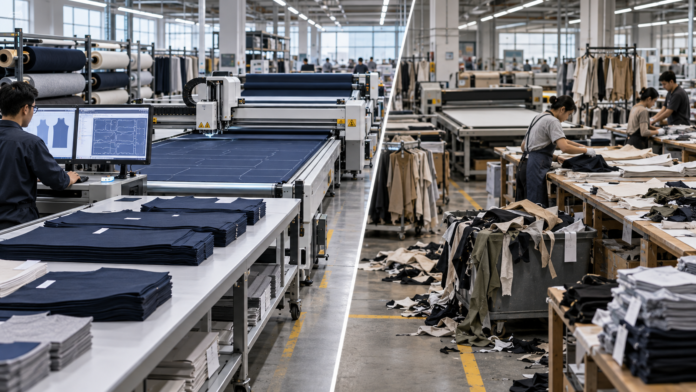

Field notes from ten years on the merchandising side of the table, on what a “smart factory” really costs, and what it actually buys you.
It was around six in the morning when I first understood what a cutting room really is. Not from a textbook, not from a training session, but from watching a cutting master named Nazrul bhai run his hand along a stack of grey fabric like he was reading braille. He was checking for shade variation before the lay even went down. No machine had told him to do it. Nobody had scheduled it into the SOP. He just did it, because twenty-two years on that floor had taught him that a shade problem caught here cost nothing, and a shade problem caught after sewing cost the whole lot.
I was a junior merchandiser back then, sent down to the cutting section to “understand the process,” which in practice meant standing quietly and trying not to be in anyone’s way. I remember asking him, half out of curiosity and half because I genuinely didn’t know, why the factory hadn’t bought an automatic cutter yet, since I’d seen glossy brochures for one in our GM’s office. He laughed, not unkindly, and said something I’ve never forgotten: “Machine cuts fabric. It doesn’t cut losses. Only thinking does that.”
I’ve spent the better part of the last decade thinking about that sentence, because I’ve now watched both sides of it play out. I’ve seen automation transform a cutting floor into the most disciplined, most profitable department in a factory. And I’ve seen factories spend six or seven figures on equipment that sat half-idle, impressing visiting buyers on a factory tour while quietly bleeding money nobody wanted to talk about in the monthly review.
This article is my attempt to lay out, honestly and without the marketing gloss that usually surrounds this topic, where cutting floor automation actually pays for itself, and where it doesn’t. Not because I’m against automation — I’m not, and you’ll see why by the end — but because I’ve sat in too many meetings where the question being asked was the wrong one.
The Question Nobody Asks First
Every automation conversation I’ve ever been part of in an apparel factory starts the same way. Someone — usually a sourcing head, sometimes a factory owner who just came back from an exhibition in Germany or Turkey — walks in and asks, “Should we buy this machine?” And the room spends the next hour talking about specifications. Cutting speed. Laser accuracy. Software compatibility. Brand reputation. Whether a competitor factory already has one.
Almost nobody asks the question that actually matters, which is simpler and much less exciting: where, specifically, are we losing money, time, or quality today — and would this machine actually fix that?
It sounds obvious when you write it down. It is almost never how the decision actually gets made. I’ve sat through capital expenditure discussions where the strongest argument in favor of a six-figure investment was “our competitor already has one, and buyers ask about it during factory audits.” That is a real reason factories buy machines. It is not a good reason, and it rarely shows up as a positive number on a P&L a year later.
Fabric is, in almost every garment I have ever costed, the single largest line item on the cost sheet. Depending on the product — a basic cotton tee versus a heavily embellished jacket — fabric can sit anywhere from forty to sixty percent, sometimes more, of the total cost of making a garment. Everything else on that sheet — labor, trims, overhead, commercial charges — is fighting over what’s left. When you understand that one fact deeply, in your gut and not just on paper, you start to see the cutting room differently. It stops being “the department before sewing” and becomes the single biggest lever a factory has over its own profitability.
And here is the part that took me longer to really internalize: fabric waste is one of the only losses in a garment factory that is completely irreversible. A stitching defect can sometimes be repaired. A finishing problem can sometimes be pressed out or reworked. A shipment delay can sometimes be negotiated with a buyer, even if it costs goodwill or an air freight bill. But fabric that has already been cut wrong cannot be uncut. The moment the knife or the laser passes through that lay, whatever value was lost in that decision is gone permanently. There is no downstream department that gets it back.
That is why, when people ask me where automation “actually pays off” in a factory, I always start the conversation in the cutting room, and I always start with fabric.
A Morning Tour Through the Cutting Floor Ecosystem
If you have never spent real time in a modern cutting department, it’s worth walking through what actually happens there, because “cutting room automation” is not one machine. It’s a chain of decisions, and each link in that chain is a separate technology with its own economics.
It starts before any fabric is touched, in the pattern room, where CAD systems have been standard for so long now that most people don’t even think of them as “automation” anymore — they’re just how patterns are made. From there, the pattern pieces move into marker planning, which is the art — and increasingly the science — of arranging pattern pieces on a length of fabric so that as little of it as possible goes to waste. Then comes fabric inspection, where rolls are checked for defects and shade variation before they’re ever laid down. Then spreading, where multiple layers, or “plies,” of fabric are stacked precisely on top of each other, sometimes forty, fifty, even over a hundred layers deep depending on the order. Then cutting itself, whether by hand-guided knife, a straight-knife machine, or a fully automated cutter. And finally, bundling and tracking, where cut pieces are sorted, numbered, and fed into the sewing line in a sequence that determines how smoothly — or chaotically — the rest of production goes.
Six links. Six different technologies. Six different investment cases. And this is exactly where I’ve seen so many factories go wrong — they evaluate “cutting automation” as a single yes-or-no decision, when in reality it’s six separate questions, each with a different answer depending on what that specific factory actually produces.
Let me walk through each one the way I would if a factory owner asked me to sit down with them and actually think it through, instead of just signing a purchase order because a supplier gave a good demo.
Marker Making: The Quietest, Highest-Return Investment on the Floor
If I had to point to one place on the cutting floor where automation creates value almost every single time, regardless of factory size, it’s marker planning software.
Traditional marker making depends on the skill of an experienced marker maker — someone who has spent years developing an instinct for how pattern pieces nest together, how to angle a sleeve panel to save two centimeters here, how to rotate a pocket piece to close a gap there. That instinct is genuinely valuable, and I don’t want to dismiss it, because I’ve watched senior marker makers do things by eye that surprised me. But instinct has a ceiling. A computer that can generate and compare thousands of possible marker layouts in the time it takes a person to try three or four will, on average, find a tighter marker than a person working alone.
Here’s where the number becomes real instead of theoretical. Say a factory is running a basic program — polo shirts, for a mid-market retail buyer, 500,000 pieces across a season. If digital marker optimization improves fabric utilization by even one percent compared to manual marker making — and in my experience, on repeat, high-volume styles, that’s a conservative number, not an optimistic one — you are talking about saving the fabric equivalent of five thousand garments’ worth of material, without changing the buyer price, without touching labor, without negotiating anything with anyone. That saving goes straight to the bottom line, order after order, season after season, for as long as that style keeps running.
This is why I tell younger merchandisers that fabric consumption is not a technical detail to hand off to the pattern department and forget about. It is one of the most commercially important numbers on your cost sheet, and every fraction of a percent you can shave off it compounds across every unit you ship.
Where marker automation earns its keep is on styles that repeat: basics, uniforms, core programs, anything running in volume with minimal style change. Where it earns its keep less clearly is on fast-turning fashion product — small quantities, constant style changes, patterns that barely get used twice before the next season’s silhouette replaces them. The software still helps there, but the return is smaller relative to the investment, because you’re not compounding that saving across enough units to make the math dramatic.
Automatic Spreading: A Story About an Idle Machine
A few years ago I visited a factory — I won’t name it, because the lesson matters more than the identity — that had recently installed an automatic spreading line. Beautiful piece of equipment. Precise tension control, consistent ply alignment, a genuine improvement over the manual spreading that had been happening before.
The problem wasn’t the machine. The problem was the order book.
This particular factory ran a very mixed program — small and mid-sized orders from several different buyers, frequent fabric changes, constant switching between different fabric widths and types. The spreading machine, which is designed to earn its value through continuous, high-volume operation, spent enormous stretches of the day being reconfigured, recalibrated, or simply waiting for the next lay to be prepared. I stood in that cutting room during a normal working shift and watched the machine sit idle for what the floor supervisor, a little sheepishly, admitted was close to forty percent of the day.
Automatic spreading is genuinely excellent technology. I’m not writing this to talk anyone out of it. But it is technology whose value is almost entirely a function of utilization. A machine that spreads fabric faster and more consistently than a manual team only creates financial value when it’s actually spreading fabric — not when it’s sitting there, however impressive it looks to a buyer walking through on an audit.
This is the trap I’ve watched more than one factory fall into: buying equipment sized for the factory they wish they were, rather than the factory they actually are. If your order book is dominated by large, stable, repeat programs, an automatic spreader can be one of the best investments on your floor. If your order book looks like a patchwork of small and mid-sized orders across many buyers and constantly shifting fabrics, that same machine may spend most of its life as very expensive, very well-engineered furniture.
Fabric Inspection: The Investment Nobody Brags About, and the One I’d Make First
If you asked most factory owners to name the most impressive piece of technology on their cutting floor, almost none of them would say “the fabric inspection machine.” It doesn’t have the visual drama of a laser cutter slicing through fifty layers of fabric at once. It doesn’t photograph well for a buyer’s sourcing deck. It just sits there, quietly running rolls of fabric past a sensor, flagging shade bands, slubs, holes, and width inconsistencies before a single layer gets spread.
And yet, of everything I’ve written about so far, this is the one I’d tell a factory with limited capital to prioritize first, ahead of a fancier cutter, ahead of automatic spreading, ahead of almost anything else on this list.
The reason is simple once you sit with it. Every defect that inspection technology catches before spreading is a defect that never gets cut into fifty layers of fabric at once. I’ve seen the alternative happen — a shade variation missed at the roll stage, spread across a full lay, cut into hundreds of panels, and only discovered on the sewing line or, worse, during a buyer’s final inspection. By that point, the cost isn’t measured in a few meters of fabric. It’s measured in an entire lot, sometimes an entire shipment, and in the kind of buyer trust that takes years to rebuild once it’s damaged.
Automated inspection systems aren’t glamorous, but they sit right at the point in the process where a small, cheap catch prevents a large, expensive disaster. I’ve made this argument to more than one factory owner who was fixated on a cutting machine upgrade, and I’ve watched a few of them redirect their budget after actually running the numbers on how much a single bulk shade claim had cost them the season before.
Digital Bundling and Tracking: The Boring Technology That Fixes Everything Downstream
The last link in the cutting room chain rarely gets discussed in the same breath as “automation,” because it doesn’t cut anything and it doesn’t spread anything. It tracks. Every bundle of cut panels gets tagged, numbered, and logged as it moves from the cutting table into the sewing line, and a good digital tracking system tells you, in real time, exactly where every piece of every order actually is.
I underestimated this technology for years, honestly, because it felt administrative rather than transformative. Then I spent a season working closely with a production floor that had just implemented one, after years of paper-based bundle tickets and manual tally sheets, and I watched something change that I hadn’t expected: the number of “missing bundle” panics — the kind that stop a sewing line cold while supervisors go searching the floor for a lost stack of cut panels — dropped close to zero within a couple of months.
That sounds like a small operational win until you translate it into what it actually means commercially. A stalled sewing line isn’t just lost time. It’s a T&A slipping, a buyer follow-up email getting harder to answer honestly, a shipment date under quiet threat because of something that, on paper, should never have happened in the first place. Digital tracking doesn’t touch fabric utilization the way marker software does, but it protects something just as valuable — the reliability of the promise a merchandiser makes to a buyer the moment a PO is confirmed.
Automatic Cutting Machines: The Most Photogenic, Least Understood Investment in the Building
If there’s one piece of equipment that captures everyone’s imagination when they talk about “smart factories,” it’s the automatic cutter. It looks like the future. It’s fast, precise, doesn’t get tired, doesn’t need a break, and cuts with a level of accuracy that a manual cutter, however skilled, simply cannot consistently match. When a buyer’s compliance or technical team tours a factory, an automatic cutter is one of the things that makes an impression. I’ve watched sourcing heads walk buyers straight past the sewing lines to make sure they see it.
And that, honestly, is part of the problem. I have seen automatic cutters bought primarily for the impression they make, not for the financial case behind them. And when that happens, the machine usually underperforms, not because the technology failed, but because the decision to buy it was never really about the numbers in the first place.
Here is the uncomfortable truth I’ve come to after years of watching this play out: buying an automatic cutter does not automatically improve a factory’s performance. It can. It very often does, in the right conditions. But it is not automatic, and treating it as if it were is exactly how factories end up disappointed with an investment that, on paper, should have been a clear win.
Let me walk through the specific reasons I’ve seen automation investments — cutters especially, but this applies across the cutting room — fail to deliver the return that was promised in the initial proposal.
The first is the most common, and the hardest for factory leadership to hear: buying technology before fixing the process it’s meant to run inside. Automation is not a cure for disorganized planning. If your production planning is unreliable, if your buyer comment changes routinely throw off your T&A, if your fabric arrives late and inconsistent, an automatic cutter doesn’t fix any of that. It just cuts the same chaos faster and more precisely. I’ve watched factories install genuinely excellent equipment into genuinely broken processes and then wonder, a year later, why the ROI never materialized. The machine was never the bottleneck. The process was.
The second is a subtler mistake, and it’s one I’ve personally seen catch even experienced production teams off guard: calculating machine capability instead of machine utilization. Every supplier’s brochure will tell you how many layers a machine can cut per hour under ideal conditions. Almost nobody asks the harder question — how many hours a day, realistically, given our actual order mix, will this machine be cutting instead of waiting, changing over, or being recalibrated? The gap between theoretical capacity and realistic utilization is where a lot of automation business cases quietly fall apart.
The third is product mix mismatch. A machine built to reward high-volume, low-variation cutting will not perform the same way in a factory dominated by small fashion orders with constant style changes. I’ve seen factories buy the exact right machine for the wrong order book, and the machine itself was never the problem — the mismatch was.
The fourth is something people underestimate constantly: the human side of automation. A machine is only as good as the team that operates, maintains, and interprets the data coming out of it. I’ve seen automatic cutters running well below their potential simply because the factory hadn’t invested in training the operators and technicians who needed to actually run it — not just push the start button, but understand the software, troubleshoot the calibration, read the utilization reports and act on them.
And the fifth, which I think is the most forward-looking issue and the one most factories still get wrong: treating the cutting machine as an island. Cutting automation creates its full value only when it’s connected — to planning, to inventory, to the rest of production — so that the speed and precision it generates actually flows through to a faster, more reliable order execution downstream. A brilliant cutter feeding a disorganized sewing line just produces a faster pile of cut fabric sitting in front of a bottleneck. The value gets trapped instead of realized.
Two Very Different Factories, Two Very Different Automation Economics
One of the more useful mental exercises I do whenever someone asks me for automation advice is to imagine two factories side by side, because the honest answer to “should we automate the cutting floor” depends enormously on which one you actually are.
The first factory is a large export house. High production volume. Stable, repeat buyer programs that run for multiple seasons with relatively minor style changes. Strong equipment utilization because the order book keeps machines running most of the day. A technical team with the depth to actually operate and maintain sophisticated equipment. For this factory, automation across the cutting room — marker software, automatic spreading, automatic cutting — tends to pay for itself, often faster than the initial business case predicted, because volume is the multiplier that makes every efficiency gain compound.
The second factory is smaller, or mid-sized, with a more fragmented order book. Lower volume per style. Frequent style changes. Limited capital to deploy, and every taka of it needs to work hard. Longer, less certain payback periods on expensive machinery. This is not a factory that should avoid technology — I want to be very clear about that, because I’ve heard this argument used lazily to justify not investing in anything at all, which is its own kind of mistake. It’s a factory that needs to be far more deliberate about where it puts its money.
For a factory like this, I’ve often found that the highest-return investment isn’t a machine at all. It’s software. Digital tracking systems, better planning tools, data systems that give merchandising and production real visibility into what’s actually happening on the floor — these tend to deliver strong returns at a fraction of the capital cost of physical automation, and they build the operational discipline that makes any future hardware investment more likely to succeed rather than less.
I think of it almost like building a house. You don’t put a smart security system on a foundation that hasn’t been poured properly. Get the process right, get the data right, build the discipline — and then the expensive equipment has something solid to stand on.
I’ve watched this play out in both directions with enough factories now that I no longer think of it as a coincidence. The mid-sized factories that struggled most with automation weren’t necessarily the ones with the smallest budgets — they were the ones that skipped straight to the machine without first fixing the planning and data discipline underneath it. And the ones that got real value, even from modest investments, were almost always the ones that had already built strong habits around tracking consumption, reviewing wastage, and holding people accountable to numbers before a single new machine arrived. The machine amplifies whatever discipline is already there. It rarely creates discipline that wasn’t there to begin with.
Where This Sits in the Bigger Bangladesh RMG Story
I want to zoom out for a moment, because none of this happens in a vacuum, and I think it’s worth being honest about the moment our industry is actually in.
Bangladesh built its position in global apparel sourcing on a combination of manufacturing capability, a large and capable workforce, and price competitiveness. That combination worked, and it built an industry that genuinely transformed the country’s economy. But I don’t think anyone paying close attention would say that combination is enough on its own anymore, and it’s getting less sufficient every year, not more.
Buyers are asking for shorter lead times than they did when I started my career. Compliance and sustainability expectations have gone from a nice-to-have on a supplier scorecard to a genuine condition of doing business with major brands. Operating costs — energy, wages, compliance investment — have all moved in one direction. And sourcing offices that used to place the overwhelming majority of their volume in one or two countries are now actively, deliberately spreading it across three or four, specifically so they’re never dependent on any single country’s risk profile.
In that environment, the advantage that will carry Bangladesh forward is not going to be the same advantage that got us here. It’s not going to be pure cost anymore — that game gets harder to win every year as other sourcing destinations develop their own capability. The advantage has to be productivity, flexibility, consistency, and the ability to make smarter decisions faster than competitors do.
And this is exactly why I think cutting room automation deserves more serious, more honest analysis than it usually gets in our industry — not because automation is fashionable, and not because a factory needs to look impressive during a buyer audit, but because fabric efficiency and production reliability are becoming genuine competitive differentiators, not just internal cost-saving exercises.
I also want to push back gently on a framing I hear a lot, which is automation as something that replaces workers. I don’t think that’s the right way to think about it, and I don’t think it’s even accurate in most of the cutting rooms I’ve actually walked through. What I’ve seen automation do well is increase what each worker on that floor is capable of producing and protecting — more output, less waste, fewer errors, per person, per hour. That’s a very different story than replacement, and it’s the one I think our industry should be telling, both to our own workforce and to the buyers we’re trying to win.
There’s also a workforce reality specific to Bangladesh that I think gets left out of automation conversations too often. Skilled cutting masters like Nazrul bhai are not easy to replace, and the industry as a whole has been feeling that pressure for years — experienced technicians retiring or moving on, and a shrinking pipeline of younger workers willing to spend a decade earning that same level of instinct on the floor. In that context, I’ve started to see automation less as a threat to expertise and more as a hedge against losing it. A digital marker system doesn’t replace what a master marker maker knows. But it does mean a factory isn’t entirely dependent on any one person’s memory and instinct walking out the gate one day, and that kind of institutional resilience is worth something on its own, separate from the fabric savings.
What the Cutting Room of the Future Actually Looks Like
I don’t believe the future of cutting is a fully automated floor with no experienced humans left standing on it, and I say that as someone who is genuinely enthusiastic about what technology can do for this industry, including building a piece of it myself.
What I believe, because I’ve seen it work, is that the strongest cutting rooms five and ten years from now will combine experienced technicians with digital systems, data analytics, and automated equipment — not one replacing the other, but each doing what it’s actually good at.
There is a kind of judgment that experienced professionals bring to a cutting floor that I have never seen a machine replicate, and I say this having spent a fair amount of time thinking about where AI genuinely helps merchandising work and where it doesn’t. Understanding how a particular fabric will behave under tension during spreading. Recognizing a shade variation issue before it becomes a bulk-order disaster. Reading a buyer’s real priorities behind what’s written in their technical package. Making a judgment call under time pressure about a commercial risk that no dataset has seen before, because every order has its own quirks. That is human expertise, built over years on a floor, and I don’t think it goes away — I think it becomes more valuable, not less, once the routine, repeatable parts of the job are handled by systems that are genuinely better suited to routine and repeatable work.
Technology’s real contribution is speed and consistency at scale. Human expertise’s real contribution is judgment under ambiguity. The factories that win, I believe, are the ones that stop treating those as competing investments and start treating them as two halves of the same system.
The Five Questions I Actually Ask Before Recommending Any Automation Investment
Over the years, I’ve developed a simple habit whenever someone — a factory owner, a production head, occasionally a younger merchandiser trying to build a business case — asks me whether they should invest in a piece of cutting room technology. I don’t start with the machine. I start with five questions, and I genuinely won’t move forward on a recommendation until I have honest answers to all five.
What problem, specifically, are we solving? Not “we want to modernize,” not “our competitor has one” — an actual, identifiable loss happening today, in fabric, in time, in quality, in reliability.
What is the real annual financial impact of that loss? This means putting an actual number on fabric wastage, on labor inefficiency, on delay costs, on rework — not a vague sense that “we’re probably losing something,” but a number you’d be willing to defend in front of the factory’s owner.
What will realistic machine utilization actually be, given our real order book — not the order book we hope to have in two years, but the one we have right now? This is the question that kills more bad business cases than any other, and it’s the one most commonly skipped.
Do we have the right people to actually run this — not just operate it, but maintain it, troubleshoot it, and interpret the data it produces? Technology without capability behind it becomes an expensive liability disguised as an asset.
And finally, what is the realistic payback period, calculated honestly, not optimistically? Every investment decision in a factory should ultimately be a commercial decision, evaluated with the same discipline you’d apply to any other major spend — because that’s exactly what it is, however exciting the machine looks in the brochure.
If a proposed investment can survive honest answers to all five of those questions, I’ve found it almost always delivers the return it promised. If it can’t survive even one of them, no amount of impressive engineering in the machine itself will save the business case.
Back to That Morning With Nazrul Bhai
I think about that cutting floor often, and about what Nazrul bhai said to me that morning, half in jest but entirely serious underneath it. The machine cuts fabric. It doesn’t cut losses. Only thinking does that.
I’ve come to believe he was more right than he probably realized at the time. The winners in apparel manufacturing over the next decade will not simply be the factories with the newest, most advanced cutting equipment on their floor. They will be the factories that understand, with real precision, where that equipment actually creates business value — and where it doesn’t.
Automation on the cutting floor was never really about buying equipment. It was always about improving profitability, reducing irreversible waste, increasing the reliability of every order that leaves the building, and building a manufacturing system that is genuinely smarter, not just more expensive-looking on a factory tour.
The smartest apparel manufacturers I’ve worked with and learned from over the years don’t automate everything. They automate the specific places where every saved centimeter of fabric, every reduced error, and every more reliable production hour turns into something a buyer, a P&L, and — frankly — a factory’s own future actually feel the benefit of.
That’s the question worth asking before the next machine comes through the factory gate. Not what it can do. Where, specifically, it will pay for itself — and where, honestly, it won’t.
Nazrul bhai retired a few years ago. Before he left, the factory had gone on to install marker optimization software and a digital tracking system, though never the automatic cutter that had once sat in that GM’s brochure. I asked him once, near the end, what he thought of the changes. He didn’t talk about the software or the machines at all. He talked about how much easier it had become to catch a mistake before it turned into a claim, and how much less he had to shout across the floor to find a missing bundle. That, in the end, is what good automation actually feels like from the inside of a factory. Not a spectacle. Just fewer disasters, quietly, day after day — which, if you’ve ever sat across the table from an unhappy buyer explaining a shortage or a shade claim, is worth more than almost anything else this industry can buy.